Alabama Science 6.1.b
The Standard
- 6.1
- Manipulate models to demonstrate the patterns of motion of the sun, Earth, and moon.
Construct an evidence-based explanation of how the relative positions of the sun, moon, and Earth result in observable phenomena, including lunar cycles, eclipses, and tidal cycles.
2023 Alabama Course of Study: Science · Earth’s Place in the Universe
Teacher's field guide
What This Standard Means
What Students Need to Do
- Students use diagrams and observations to explain why moon phases change, when eclipses happen, and why tides rise and fall. They show how the sun and moon together change the tidal range.
What Mastery Looks Like
- A student can mark the sunlit half of the moon and predict the phase seen from Earth. They can show why eclipses need alignment and do not happen every month. They can explain why tidal ranges are larger near new and full moon.
Common Misconceptions
- Some students think moon phases come from Earth's shadow. Others expect an eclipse at every new or full moon, or think the sun has no effect on tides.
How to Assess It
- On an exit ticket, ask students to draw the sun, Earth, and moon at new moon. Have them mark the moon's sunlit side, explain why most new moons have no eclipse, and compare the tidal range with first quarter.
Lesson moves
Ways to Teach It
Use a lamp and two foam balls to model moon phases, then tilt the moon's path to show why most months have no eclipse.
Show two photos of different moon phases and ask students to explain why Earth's shadow did not cause the change.
Give pairs sun, Earth, and moon cards to arrange for a first quarter moon, a lunar eclipse, and a solar eclipse.
Compare a month of local tide tables with a lunar calendar and circle dates with the largest difference between high and low tide.
Free download
Printable 6.1.b Worksheet
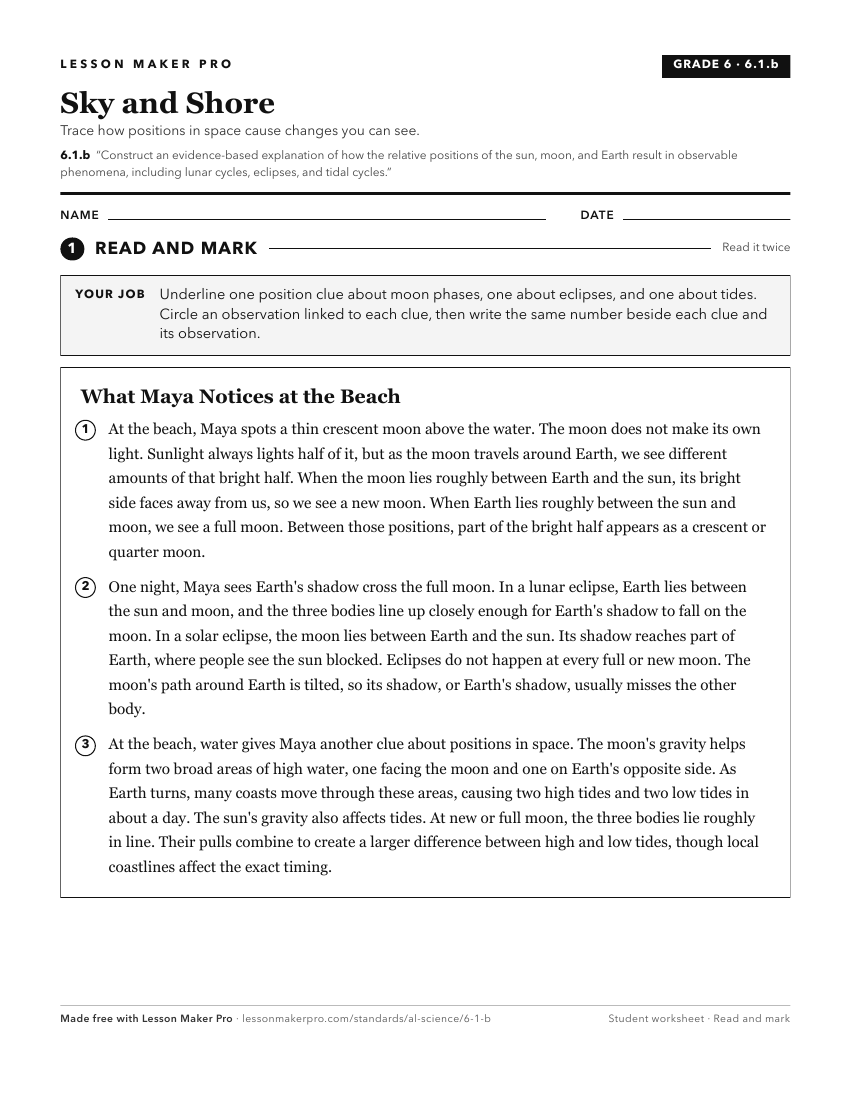
A ready-to-print activity worksheet aligned to 6.1.b, with an answer key for the teacher on its own page. No account needed.
PDF, US Letter, prints cleanly in black and white.
Download the worksheetKeep exploring
Related Standards
- 6.1.a
Construct an evidence-based explanation of how the relative positions of the sun and Earth result in observable phenomena, including day and night cycles, lengt...
- 6.8
Construct an evidence-based explanation of how the sun’s energy drives the motion and cycling of water through the hydrosphere.
- 6.1
Manipulate models to demonstrate the patterns of motion of the sun, Earth, and moon.
- ESS.3.b
Construct an evidence-based explanation of the connections among various cosmic phenomena, citing leading scientific theories.
Turn this exact standard into a lesson
Grade, subject, topic, and the complete standard are prefilled. Create one free, no account needed.
Also for this standard:Make a WorksheetMake a QuizMake a Sub Lesson