Alabama Science 6.8
Standard Cluster
Construct an evidence-based explanation of how the sun’s energy drives the motion and cycling of water through the hydrosphere. a. Plan and carry out an investigation to determine the differences in rates of energy transfer from the sun to air, to land, and to water via conduction, convection, and radiation. b. Develop and use a model that illustrates how differences in heat and pressure affect density and the relationship between density and convection.
2023 Alabama Course of Study: Science · Earth’s Systems: Energy and Weather
Cluster contents
Standards in This Cluster
6.8 is a cluster heading. These are the individual standards under it.
- 6.8.a
Plan and carry out an investigation to determine the differences in rates of energy transfer from the sun to air, to land, and to water via conduction, convecti...
- 6.8.b
Develop and use a model that illustrates how differences in heat and pressure affect density and the relationship between density and convection.
Teacher's field guide
What This Cluster Means
What Students Need to Do
- Students compare how quickly air, land, and water warm. They trace water from evaporation through clouds and rain, and use a model to show how uneven heating moves air.
What Mastery Looks Like
- They use temperature readings to compare how quickly air, soil, and water warm. They label sunlight as radiation, surface-to-air warming as conduction, and rising, less dense air as convection. Their model shows lower surface pressure, cooler air moving in, and water vapor condensing into clouds before rain falls.
Common Misconceptions
- Students may think sunlight warms a surface by conduction or that soil and water warm at the same rate. They may think evaporated water disappears or that warm air sinks. Some put high pressure beneath rising warm air.
How to Assess It
- Exit ticket: A lamp warms soil from 20°C to 30°C and water from 20°C to 24°C. Draw the air movement, label warmer air, lower density, and lower surface pressure, then trace evaporated water to rain.
Lesson moves
Ways to Teach It
Put soil and water in matching cups under a lamp; use thermometers to record both materials and nearby air every minute.
Ask: A puddle shrinks on a sunny day. Where does the water go, and how could it return as rain?
Race pairs to place warm land, cool water, low pressure, and high pressure cards on a beach sketch, then draw a convection loop.
Use a photo of a sunny beach; have students mark rising air over hot sand, sea-breeze direction, and evaporation from the water.
Free download
Printable 6.8 Worksheet
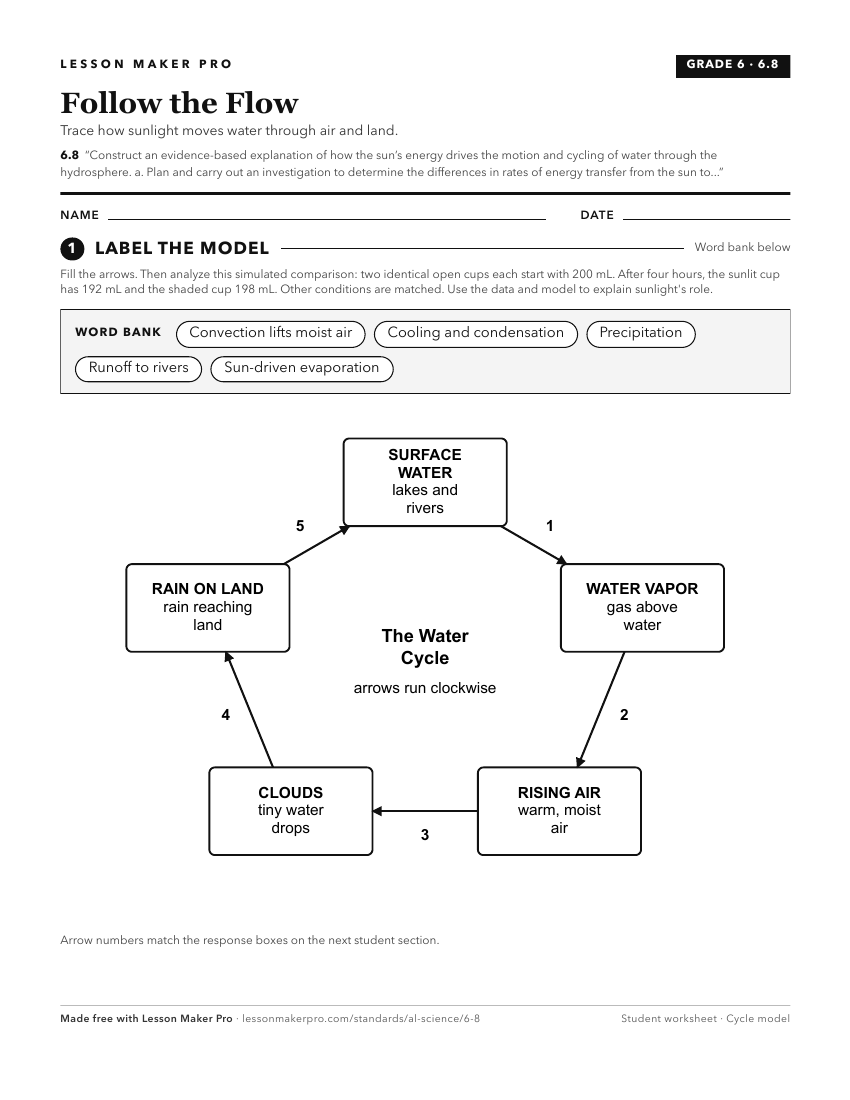
A ready-to-print activity worksheet aligned to 6.8, with an answer key for the teacher on its own page. No account needed.
PDF, US Letter, prints cleanly in black and white.
Download the worksheetKeep exploring
Related Standards
- 6.1.a
Construct an evidence-based explanation of how the relative positions of the sun and Earth result in observable phenomena, including day and night cycles, lengt...
- 6.6.a
Construct an evidence-based explanation of how Earth's internal energy flows between its surface and its interior.
- 6.1.b
Construct an evidence-based explanation of how the relative positions of the sun, moon, and Earth result in observable phenomena, including lunar cycles, eclips...
- ESS.5.c
Construct explanations from evidence of how the flow of energy through Earth's systems has changed over time.
Turn this cluster into a lesson
Grade, subject, topic, and the complete cluster are prefilled. Create one free, no account needed.
Also for this cluster:Make a WorksheetMake a QuizMake a Sub Lesson