Alabama Science ESS.3.b
The Standard
- ESS.3
- Research, evaluate, and communicate information about how the findings of early astronomers, including Aristotle, Ptolemy, Copernicus, Galileo, Brahe, Kepler, Newton, and Einstein, challenged the thinking of their time, allowed for academic advancements, and built a foundation for space exploration.
Construct an evidence-based explanation of the connections among various cosmic phenomena, citing leading scientific theories.
2023 Alabama Course of Study: Science · Earth’s Place in the Universe
Teacher's field guide
What This Standard Means
What Students Need to Do
- Students explain how an expanding universe led to stars and the elements around us. They use galaxy redshift, background radiation, and star spectra as evidence. They connect that evidence to the Big Bang theory and stellar evolution.
What Mastery Looks Like
- A student can trace hydrogen from the early universe into stars, then explain how stars made carbon and spread elements into space. They use redshift as evidence for expansion and spectra as evidence for what stars contain.
Common Misconceptions
- Some students think the Big Bang made every element found on Earth. Others think galaxy redshift means Earth is at the center of the universe. They may also think stars formed only after our solar system formed.
How to Assess It
- Exit ticket: How did carbon in your body come to exist? In three sentences, connect cosmic expansion, star formation, and carbon production. Use redshift and star spectra as evidence, and name the theories that explain those links.
Lesson moves
Ways to Teach It
Give pairs paper cards for early hydrogen, first stars, stellar carbon, and supernovae; have them order the cards and add evidence labels.
Ask, 'How do galaxy redshift and background radiation support an expanding early universe, and how did stars change its chemistry?'
Run a card match: pair redshift, background radiation, and supernova spectra with claims about expansion or stellar evolution, then explain each match.
Give students a periodic table; have them mark hydrogen in water and carbon in lunch, then write where each element came from.
Free download
Printable ESS.3.b Worksheet
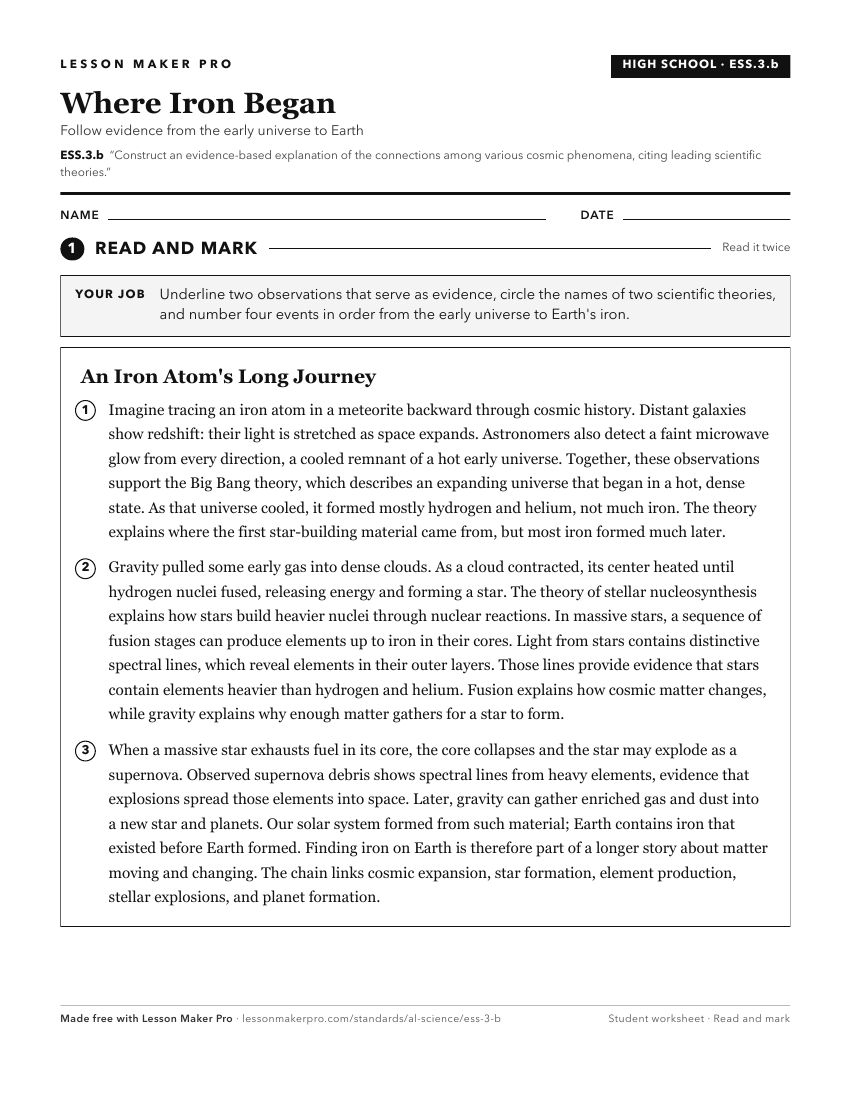
A ready-to-print activity worksheet aligned to ESS.3.b, with an answer key for the teacher on its own page. No account needed.
PDF, US Letter, prints cleanly in black and white.
Download the worksheetKeep exploring
Related Standards
- ESS.5.b
Construct an explanation based on evidence of how catastrophic and long-term events have impacted life on Earth, including mass extinctions.
- 6.1.b
Construct an evidence-based explanation of how the relative positions of the sun, moon, and Earth result in observable phenomena, including lunar cycles, eclips...
- 6.1.a
Construct an evidence-based explanation of how the relative positions of the sun and Earth result in observable phenomena, including day and night cycles, lengt...
- 6.3
Construct an evidence-based explanation of the role of gravity on the movement of natural and manmade objects within galaxies and the solar system.
Turn this exact standard into a lesson
Grade, subject, topic, and the complete standard are prefilled. Create one free, no account needed.
Also for this standard:Make a WorksheetMake a QuizMake a Sub Lesson