Alabama Science ESS.2.a
The Standard
- ESS.2
- Obtain, evaluate, and communicate information about the structure and motion of components of the universe and solar system.
Use mathematics and computational thinking to predict the motion of natural and man-made objects in the solar system, using Kepler’s laws, Newton’s laws of motion, and Newton’s gravitational laws.
2023 Alabama Course of Study: Science
Teacher's field guide
What This Standard Means
What Students Need to Do
- Students use equations or a spreadsheet to predict how orbital speed and period change with distance. They use force and velocity arrows to explain why a planet or satellite follows a curved path.
What Mastery Looks Like
- Given two orbital distances, students calculate the period ratio and gravitational force ratio. On an elliptical orbit sketch, they mark where the object moves fastest and draw gravity pointing toward the body it orbits.
Common Misconceptions
- Students may think gravity stops acting on objects in orbit. Some expect a farther planet to move faster or think doubling distance halves gravitational pull. Others draw gravity in the direction of travel.
How to Assess It
- Exit ticket: Equal-mass planets orbit a Sun-like star at 1 AU and 4 AU. Using T²=r³ and F∝1/r², find the farther planet's period in Earth years and its gravitational force ratio.
Lesson moves
Ways to Teach It
Swing a rubber stopper on a string; students sketch its velocity and inward force arrows at three points along its path.
Ask: If gravity pulls Earth toward the Sun, why does Earth not fall straight in? Write an answer using sideways velocity.
In pairs, draw cards marked 1, 2, or 4 AU; calculate orbital periods with T²=r³, then check each other's work.
Compare ISS and GPS orbit radii, 6,800 km and 26,600 km; use T=2π√(r³/GM) and GM=398,600 km³/s² to predict their periods.
Free download
Printable ESS.2.a Worksheet
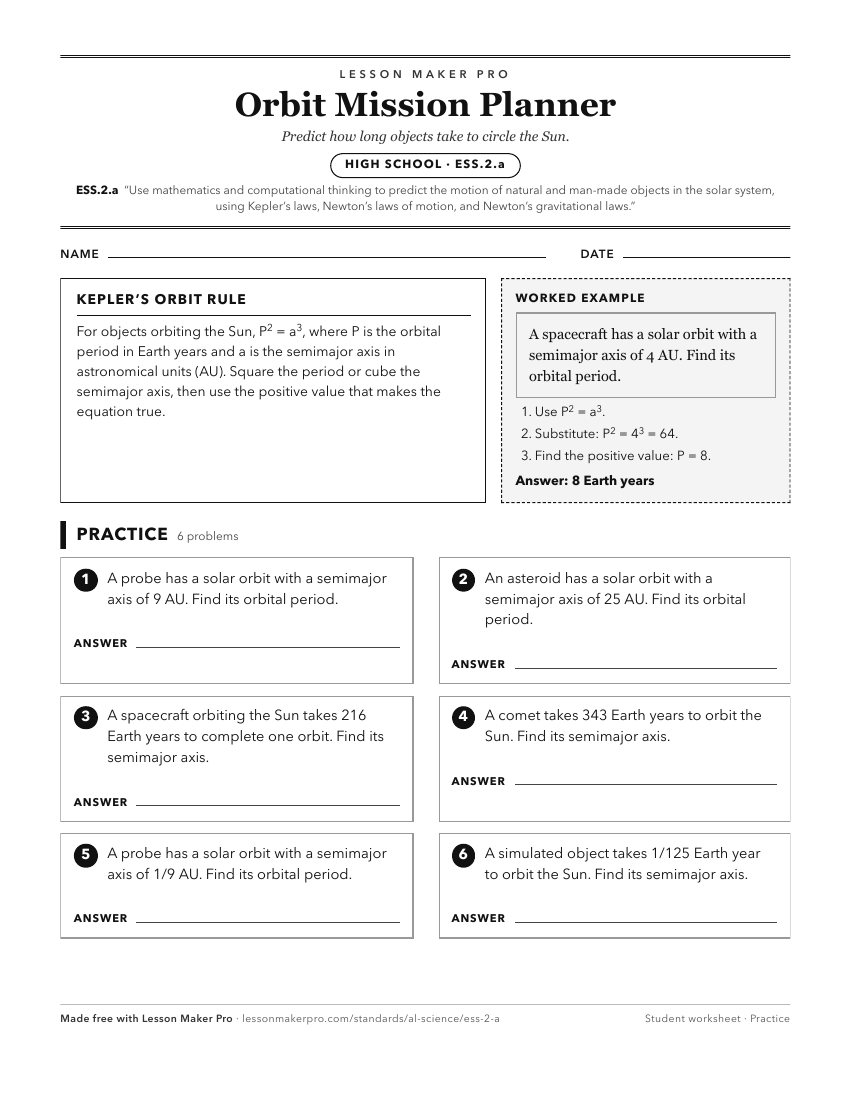
A ready-to-print activity worksheet aligned to ESS.2.a, with an answer key for the teacher on its own page. No account needed.
PDF, US Letter, prints cleanly in black and white.
Download the worksheetKeep exploring
Related Standards
- ESS.2.b
Use mathematics and computational thinking to explain the relationships between the properties of light and distances in the solar system and universe, includin...
- P.1.d
Use mathematics and computational thinking to solve problems, using kinematics equations in both one- and two-dimensional motion.
- P.5
Develop and use models to analyze the circular motion of objects.
- ESS.2
Obtain, evaluate, and communicate information about the structure and motion of components of the universe and solar system.
Turn this exact standard into a lesson
Grade, subject, topic, and the complete standard are prefilled. Create one free, no account needed.
Also for this standard:Make a WorksheetMake a QuizMake a Sub Lesson