Alabama Science P.1.d
The Standard
- P.1
- Obtain, evaluate, and communicate ideas about kinematics, including scalar quantities (distance and speed) and vector quantities (position, displacement, velocity, and acceleration).
Use mathematics and computational thinking to solve problems, using kinematics equations in both one- and two-dimensional motion.
2023 Alabama Course of Study: Science · Motion and Stability: Forces and Interactions
Teacher's field guide
What This Standard Means
What Students Need to Do
- Students use kinematics equations to find time, velocity, acceleration, or displacement. For motion in two dimensions, they separate horizontal and vertical motion. They use a calculator or spreadsheet to check their results.
What Mastery Looks Like
- Given a car's starting speed and acceleration, a student can find its displacement after a set time. Given a ball's launch speed and angle, they can find its flight time and range. They use units and signs that fit the situation.
Common Misconceptions
- Students may use distance when an equation calls for displacement. They may think a projectile slows down horizontally because gravity pulls it downward. Some use the same acceleration for both directions.
How to Assess It
- Exit ticket: A ball launches from level ground at 10 m/s horizontally and 9.8 m/s vertically. Ignoring air resistance, find its flight time and horizontal range using g = 9.8 m/s².
Lesson moves
Ways to Teach It
Tape a meterstick to a wall, film a foam ball tossed beside it, and chart horizontal and vertical positions frame by frame.
Ask students why a horizontally launched ball and a dropped ball reach the floor together when released from the same height.
Give pairs motion cards with starting velocity, acceleration, and time; have them choose an equation and calculate displacement.
Use a soccer kick's launch angle and speed to predict where the ball lands, then measure an actual kick.
Free download
Printable P.1.d Worksheet
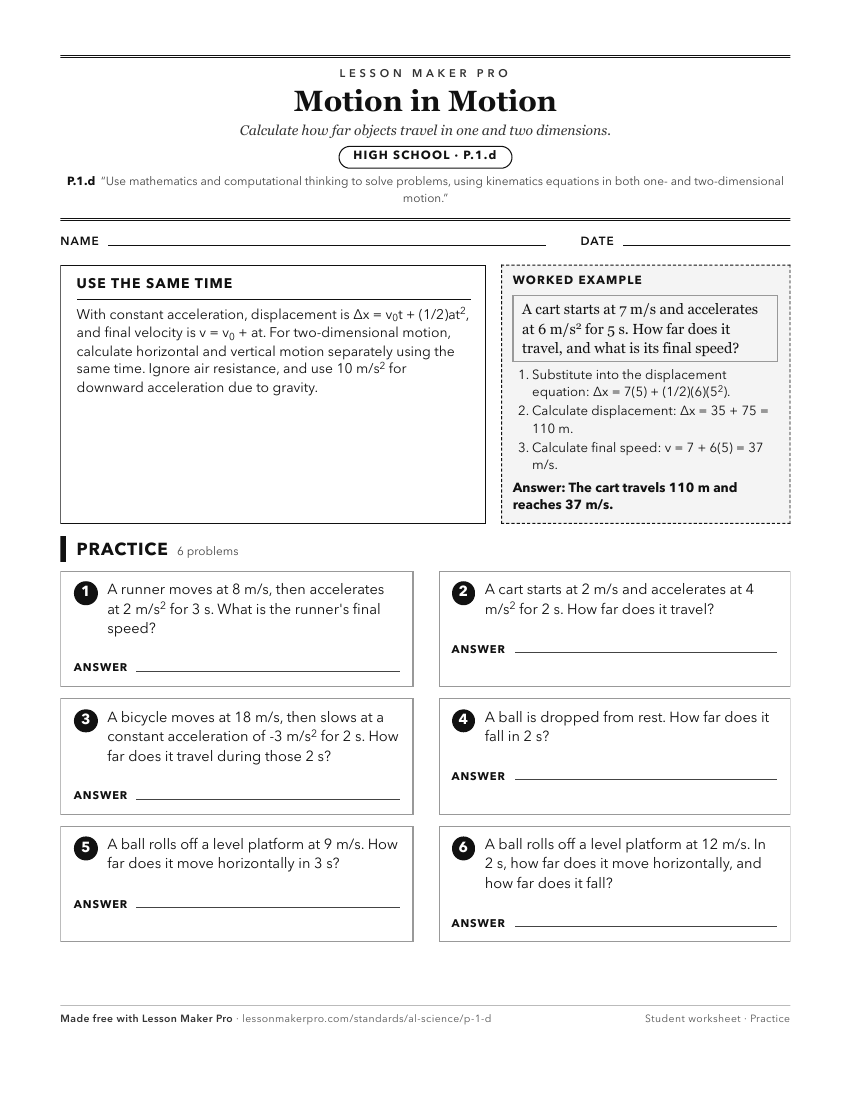
A ready-to-print activity worksheet aligned to P.1.d, with an answer key for the teacher on its own page. No account needed.
PDF, US Letter, prints cleanly in black and white.
Download the worksheetKeep exploring
Related Standards
- ESS.2.a
Use mathematics and computational thinking to predict the motion of natural and man-made objects in the solar system, using Kepler’s laws, Newton’s laws of moti...
- P.1
Obtain, evaluate, and communicate ideas about kinematics, including scalar quantities (distance and speed) and vector quantities (position, displacement, veloci...
- P.1.a
Analyze data to create and interpret graphs of position, velocity, and acceleration versus time for one-dimensional motion.
- P.3.a
Use mathematical and computational thinking to explain the relationships among work, power, and time.
Turn this exact standard into a lesson
Grade, subject, topic, and the complete standard are prefilled. Create one free, no account needed.
Also for this standard:Make a WorksheetMake a QuizMake a Sub Lesson