Alabama Science P.3.a
The Standard
- P.3
- Design and carry out experiments to verify that energy and momentum are conserved in closed systems.
Use mathematical and computational thinking to explain the relationships among work, power, and time.
2023 Alabama Course of Study: Science · Energy
Teacher's field guide
What This Standard Means
What Students Need to Do
- Students calculate work from force and distance, then find average power from work and time. They use a table to compare trials and explain why doing the same work faster takes more power.
What Mastery Looks Like
- Given a force in the direction of motion, a distance, and a time, a student calculates work in joules and average power in watts. They can use work and power to find time, then check whether the answer makes sense.
Common Misconceptions
- Students may call holding a heavy box work, even though the box does not move. They may confuse watts with total energy or think taking longer means more power for the same work.
How to Assess It
- Exit ticket: A motor does 600 J of work in 3 s. Find its average power, then find how long it would take to do 600 J at 100 W.
Lesson moves
Ways to Teach It
Lift a 1 kg bag 1 meter, time two trials, and calculate work and power using 9.8 N as its weight.
Ask: If two students carry the same box upstairs but one takes twice as long, who does more work and who has more power?
Give pairs cards showing work and time; have them calculate power, then rank the cards from lowest to highest watts.
Compare elevators that each do 30,000 J of work in 10 s and 20 s; calculate their average power.
Free download
Printable P.3.a Worksheet
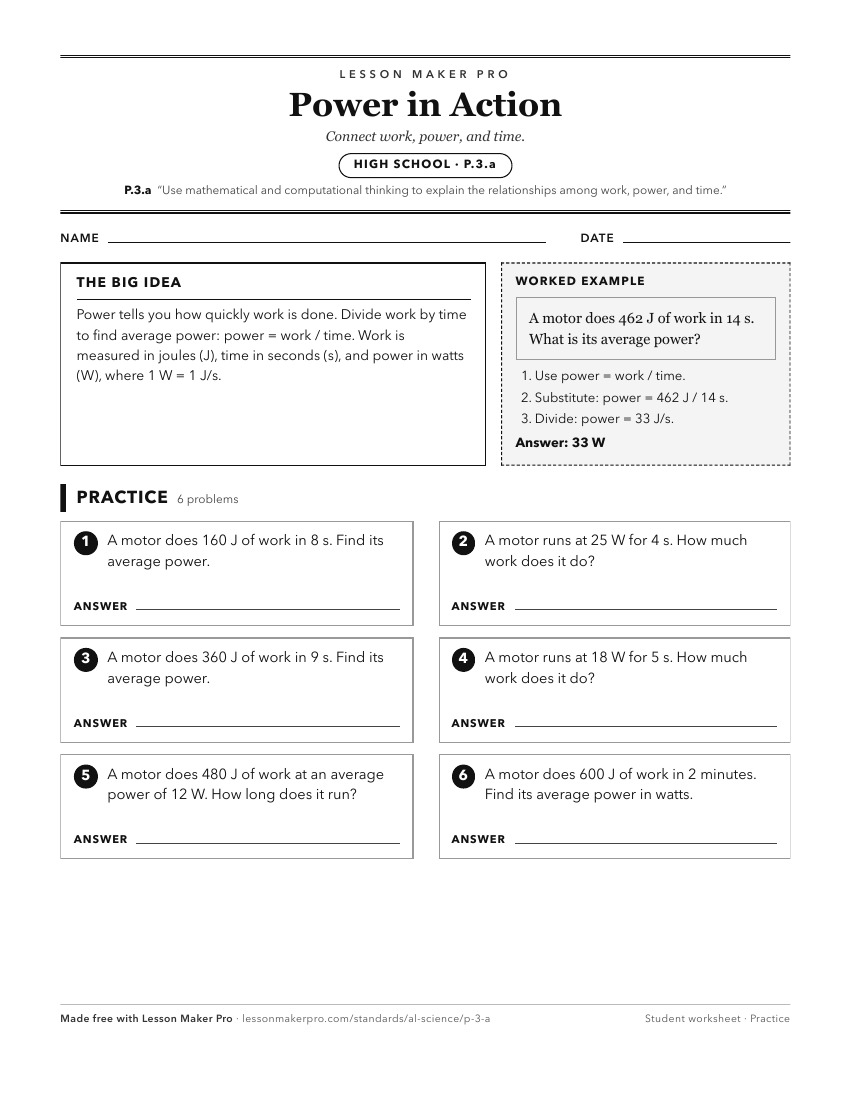
A ready-to-print activity worksheet aligned to P.3.a, with an answer key for the teacher on its own page. No account needed.
PDF, US Letter, prints cleanly in black and white.
Download the worksheetKeep exploring
Related Standards
- P.3.c
Use models to illustrate the relationship between the work performed on an object and the object’s total mechanical energy.
- P.3.b
Create mathematical and graphical representations to depict the transformation of energy from one form to another, including kinetic energy, gravitational poten...
- P.7.a
Use mathematics and computational thinking to describe the relationships among the velocity, frequency, and wavelength of a propagating wave.
- P.1.d
Use mathematics and computational thinking to solve problems, using kinematics equations in both one- and two-dimensional motion.
Turn this exact standard into a lesson
Grade, subject, topic, and the complete standard are prefilled. Create one free, no account needed.
Also for this standard:Make a WorksheetMake a QuizMake a Sub Lesson