Alabama Science P.1
Standard Cluster
Obtain, evaluate, and communicate ideas about kinematics, including scalar quantities (distance and speed) and vector quantities (position, displacement, velocity, and acceleration). a. Analyze data to create and interpret graphs of position, velocity, and acceleration versus time for one-dimensional motion. b. Analyze free fall motion using one-dimensional kinematics to determine the acceleration due to gravity (g). c. Analyze and interpret data to explain changes in the vector quantities of position, velocity, and acceleration in two-dimensional projectile motion, including projectiles launched horizontally and at an angle. d. Use mathematics and computational thinking to solve problems, using kinematics equations in both one- and two-dimensional motion.
2023 Alabama Course of Study: Science · Motion and Stability: Forces and Interactions
Cluster contents
Standards in This Cluster
P.1 is a cluster heading. These are the individual standards under it.
- P.1.a
Analyze data to create and interpret graphs of position, velocity, and acceleration versus time for one-dimensional motion.
- P.1.b
Analyze free fall motion using one-dimensional kinematics to determine the acceleration due to gravity (g).
- P.1.c
Analyze and interpret data to explain changes in the vector quantities of position, velocity, and acceleration in two-dimensional projectile motion, including p...
- P.1.d
Use mathematics and computational thinking to solve problems, using kinematics equations in both one- and two-dimensional motion.
Teacher's field guide
What This Cluster Means
What Students Need to Do
- Students graph position, velocity, and acceleration over time and use slopes and areas to describe motion. They track direction to distinguish distance and speed from position, displacement, velocity, and acceleration. They estimate gravity from falling-object data and use motion equations for straight-line motion and projectiles launched horizontally or at an angle.
What Mastery Looks Like
- Given a motion table, students draw matching graphs and use slope or area to find velocity, acceleration, or displacement. They calculate gravitational acceleration from drop data, getting a value near 9.8 m/s². For a projectile, they separate horizontal and vertical motion to find its flight time and range.
Common Misconceptions
- Students often treat distance and displacement as the same thing, or think negative velocity means slowing down. Some read the height of a position-time graph as speed instead of using its slope. Others think a projectile stops accelerating at the top of its path or loses horizontal velocity as it falls.
How to Assess It
- Exit ticket: A ball rolls off a 1.25 m high table at 2.0 m/s. Using g = 10 m/s², find its flight time and horizontal range, then describe how its vertical velocity changes.
Lesson moves
Ways to Teach It
Film a dropped tennis ball in slow motion, mark its height at equal time intervals, and graph velocity to estimate gravity.
Show a position-time graph that rises to a peak, then falls; ask, "When does velocity change sign? Explain."
Give pairs motion descriptions and graph cards; have them match position, velocity, and acceleration graphs, then check using slopes.
Film a basketball shot and a ball rolling off a desk; trace their horizontal and vertical positions frame by frame.
Free download
Printable P.1 Worksheet
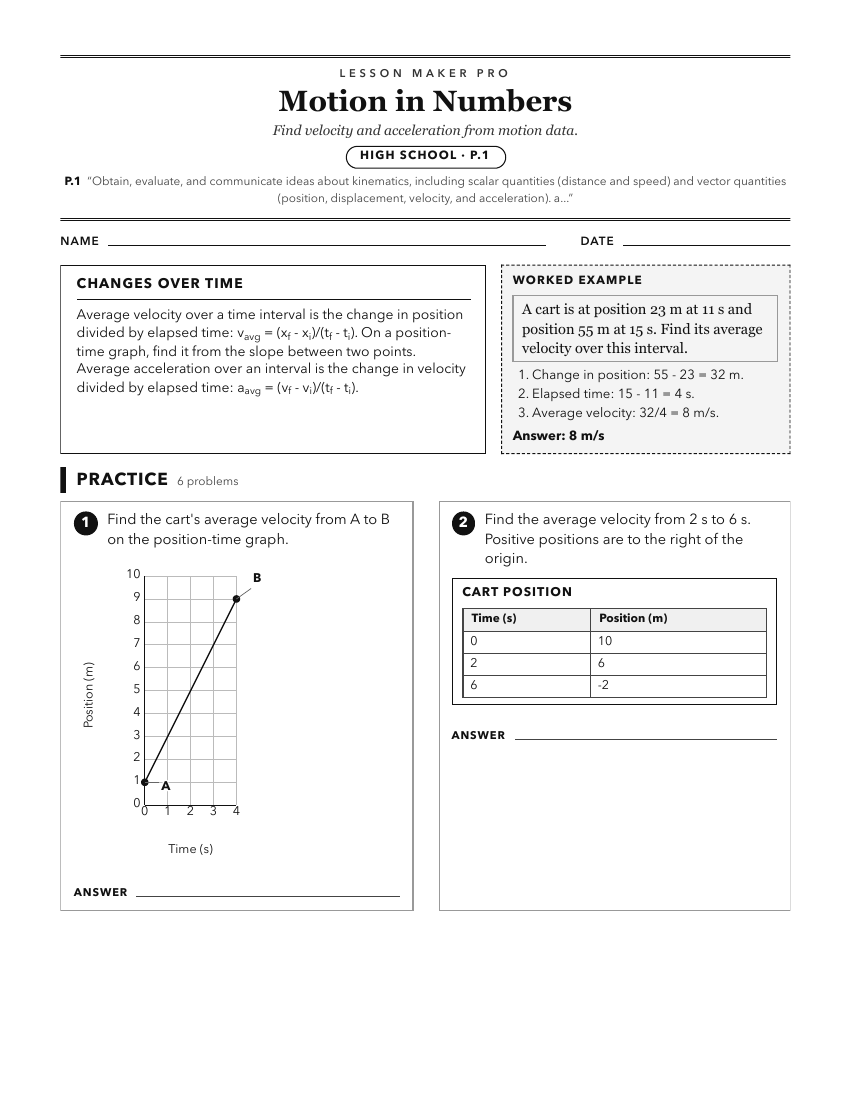
A ready-to-print activity worksheet aligned to P.1, with an answer key for the teacher on its own page. No account needed.
PDF, US Letter, prints cleanly in black and white.
Download the worksheetKeep exploring
Related Standards
Turn this cluster into a lesson
Grade, subject, topic, and the complete cluster are prefilled. Create one free, no account needed.
Also for this cluster:Make a WorksheetMake a QuizMake a Sub Lesson