Alabama Science P.1.a
The Standard
- P.1
- Obtain, evaluate, and communicate ideas about kinematics, including scalar quantities (distance and speed) and vector quantities (position, displacement, velocity, and acceleration).
Analyze data to create and interpret graphs of position, velocity, and acceleration versus time for one-dimensional motion.
2023 Alabama Course of Study: Science · Motion and Stability: Forces and Interactions
Teacher's field guide
What This Standard Means
What Students Need to Do
- Students use time and position data to draw graphs of motion along a straight line. They calculate velocity and acceleration from changes between readings, then use the graphs to describe how the object moves.
What Mastery Looks Like
- A student labels the axes with units and plots the data accurately. They use the slope of a position graph to find velocity and the slope of a velocity graph to find acceleration. They can tell when an object moves backward, speeds up, or stays still.
Common Misconceptions
- Students may read a position graph as a picture of the path. They may think a high point on the graph means high speed, rather than checking its slope. They may also assume negative acceleration always means slowing down.
How to Assess It
- Exit ticket: A cart's position at 0, 1, 2, and 3 seconds is 0, 1, 4, and 9 meters. Have students sketch position, interval-average velocity, and acceleration graphs, then explain how they know the cart speeds up.
Lesson moves
Ways to Teach It
Roll a toy car down a ramp beside a meterstick, record its position with slow-motion video, then graph position, velocity, and acceleration.
Show a straight position graph and a curved one; ask, “Which cart speeds up, and how do the slopes show it?”
Give pairs graph cards for stopped, steady, and speeding-up carts; have them match each position graph to its velocity and acceleration graphs.
Use a cyclist's speedometer readings of 0, 2, 4, and 6 m/s each second to graph velocity and acceleration and estimate distance traveled.
Free download
Printable P.1.a Worksheet
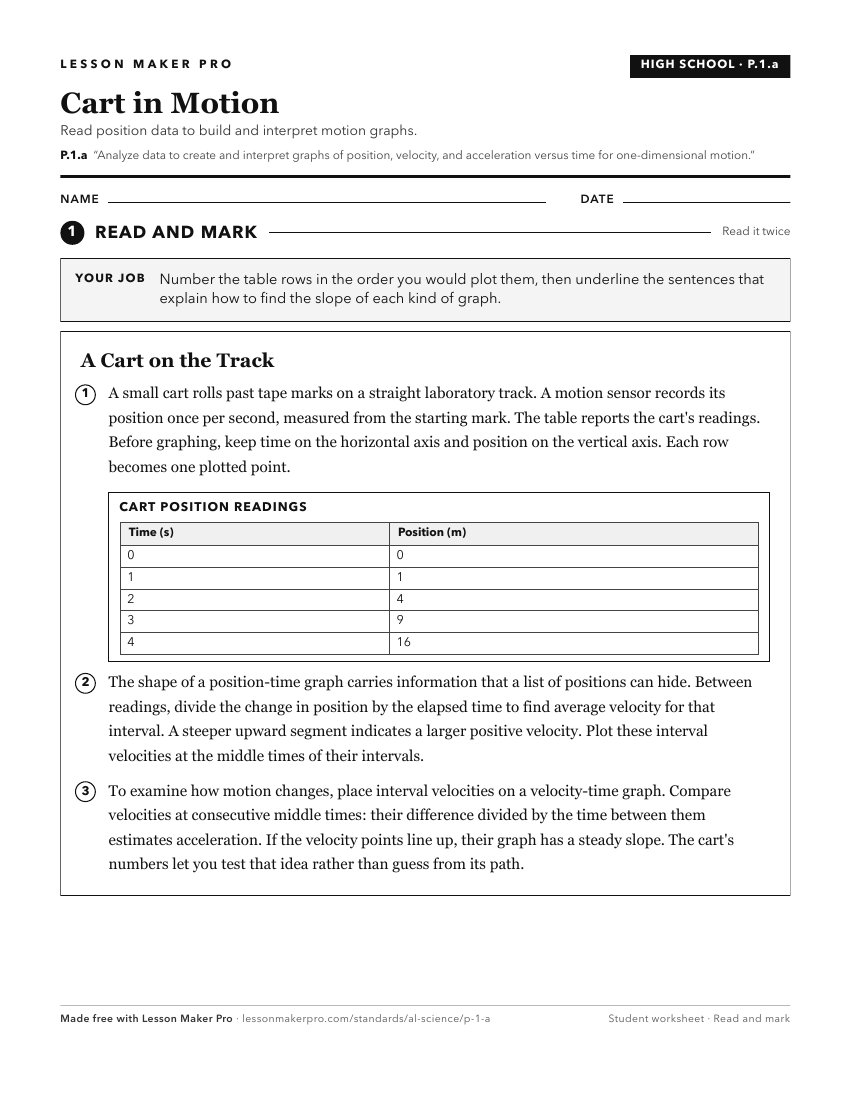
A ready-to-print activity worksheet aligned to P.1.a, with an answer key for the teacher on its own page. No account needed.
PDF, US Letter, prints cleanly in black and white.
Download the worksheetKeep exploring
Related Standards
- P.1.c
Analyze and interpret data to explain changes in the vector quantities of position, velocity, and acceleration in two-dimensional projectile motion, including p...
- 8.13
Analyze graphical displays of data to describe the relationship of mass and velocity of an object to its kinetic energy (KE).
- P.1
Obtain, evaluate, and communicate ideas about kinematics, including scalar quantities (distance and speed) and vector quantities (position, displacement, veloci...
- P.1.d
Use mathematics and computational thinking to solve problems, using kinematics equations in both one- and two-dimensional motion.
Turn this exact standard into a lesson
Grade, subject, topic, and the complete standard are prefilled. Create one free, no account needed.
Also for this standard:Make a WorksheetMake a QuizMake a Sub Lesson