Alabama Science P.5
Standard Cluster
Develop and use models to analyze the circular motion of objects. a. Use mathematics and free-body diagrams to relate the tangential velocity, the radius of orbit, the centripetal acceleration, and force to each other for an object moving in a circle. b. Develop and use a model to describe the mathematical relationship between mass, distance, and force as expressed by Newton’s law of universal gravitation.
2023 Alabama Course of Study: Science · Motion and Stability: Forces and Interactions
Cluster contents
Standards in This Cluster
P.5 is a cluster heading. These are the individual standards under it.
- P.5.a
Use mathematics and free-body diagrams to relate the tangential velocity, the radius of orbit, the centripetal acceleration, and force to each other for an obje...
- P.5.b
Develop and use a model to describe the mathematical relationship between mass, distance, and force as expressed by Newton’s law of universal gravitation.
Teacher's field guide
What This Cluster Means
What Students Need to Do
- Students draw force diagrams for objects moving in circles and mark the velocity along the path. They calculate inward acceleration and force from speed, radius, and mass. They model how mass and distance affect gravitational force.
What Mastery Looks Like
- Given a speed and radius, a student calculates acceleration with v²/r and net inward force with mv²/r. Their diagram names the force pulling inward, such as tension or gravity. They predict that doubling the distance between two masses cuts their gravitational pull to one-fourth.
Common Misconceptions
- Students may draw an outward force or point acceleration along the path. They may treat centripetal force as an extra force rather than the net inward force. For gravity, they may use altitude instead of center-to-center distance or think doubling distance halves the force.
How to Assess It
- Exit ticket: A 2 kg puck on a smooth table circles at 4 m/s on a 2 m string. Draw its velocity and force arrows, find its inward acceleration and string force, then predict how gravity changes if the distance between two masses doubles.
Lesson moves
Ways to Teach It
Roll a marble inside a cardboard ring with a gap, then sketch its exit path and the ring’s inward push.
Have pairs explain why a satellite accelerates at steady speed, using a labeled force diagram and a velocity arrow.
Give pairs speed, radius, and mass cards; have them calculate inward acceleration and force, swap cards, and check each other’s work.
Compare gravity on equal-mass satellites 400 km and 800 km above Earth, using Earth’s 6,400 km radius and an inverse-square ratio.
Free download
Printable P.5 Worksheet
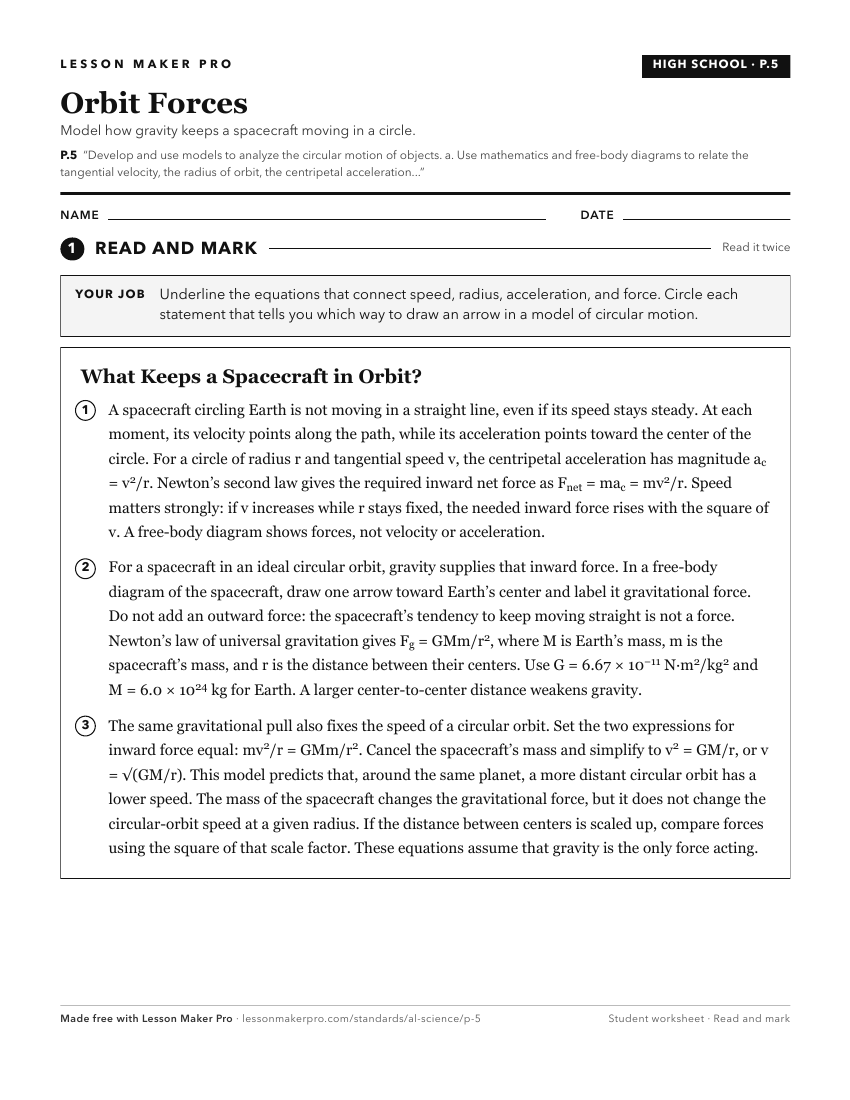
A ready-to-print activity worksheet aligned to P.5, with an answer key for the teacher on its own page. No account needed.
PDF, US Letter, prints cleanly in black and white.
Download the worksheetKeep exploring
Related Standards
- 8.10
Develop and use models to illustrate how individual external forces affect the motion of objects.
- 4.5
Develop and use models to describe amplitude and wavelength patterns and how waves can cause objects to move.
- 6.1
Manipulate models to demonstrate the patterns of motion of the sun, Earth, and moon.
- ESS.2.a
Use mathematics and computational thinking to predict the motion of natural and man-made objects in the solar system, using Kepler’s laws, Newton’s laws of moti...
Turn this cluster into a lesson
Grade, subject, topic, and the complete cluster are prefilled. Create one free, no account needed.
Also for this cluster:Make a WorksheetMake a QuizMake a Sub Lesson