Alabama Science 4.5
The Standard
Develop and use models to describe amplitude and wavelength patterns and how waves can cause objects to move.
2023 Alabama Course of Study: Science · Waves and Their Applications in Technologies for Information Transfer
Teacher's field guide
What This Standard Means
What Students Need to Do
- Students make and draw wave models. They compare wave height and the spacing between crests, then show how a passing wave moves an object.
What Mastery Looks Like
- A student labels amplitude from the resting line to a crest and wavelength from one crest to the next. They show a wave moving along a rope while a marked spot moves up and down.
Common Misconceptions
- Students may measure amplitude from a trough to a crest or wavelength from a crest to a trough. They may think a floating cork travels forward with each ripple instead of bobbing as ripples pass.
How to Assess It
- Exit ticket: Draw a wave moving right. Label its amplitude and wavelength, then add arrows showing how a cork on the water moves as the wave passes.
Lesson moves
Ways to Teach It
Stretch a rope between two students, tape its middle, make small and large waves, and watch how the tape moves.
Show two wave sketches with different crest spacing and ask, 'Which has a longer wavelength, and how can you tell?'
Give pairs wave cards to sort by amplitude and wavelength, then have them draw a new card for a partner to classify.
Show a harbor buoy video; have students sketch the buoy's path and explain why it bobs as a wave passes.
Free download
Printable 4.5 Worksheet
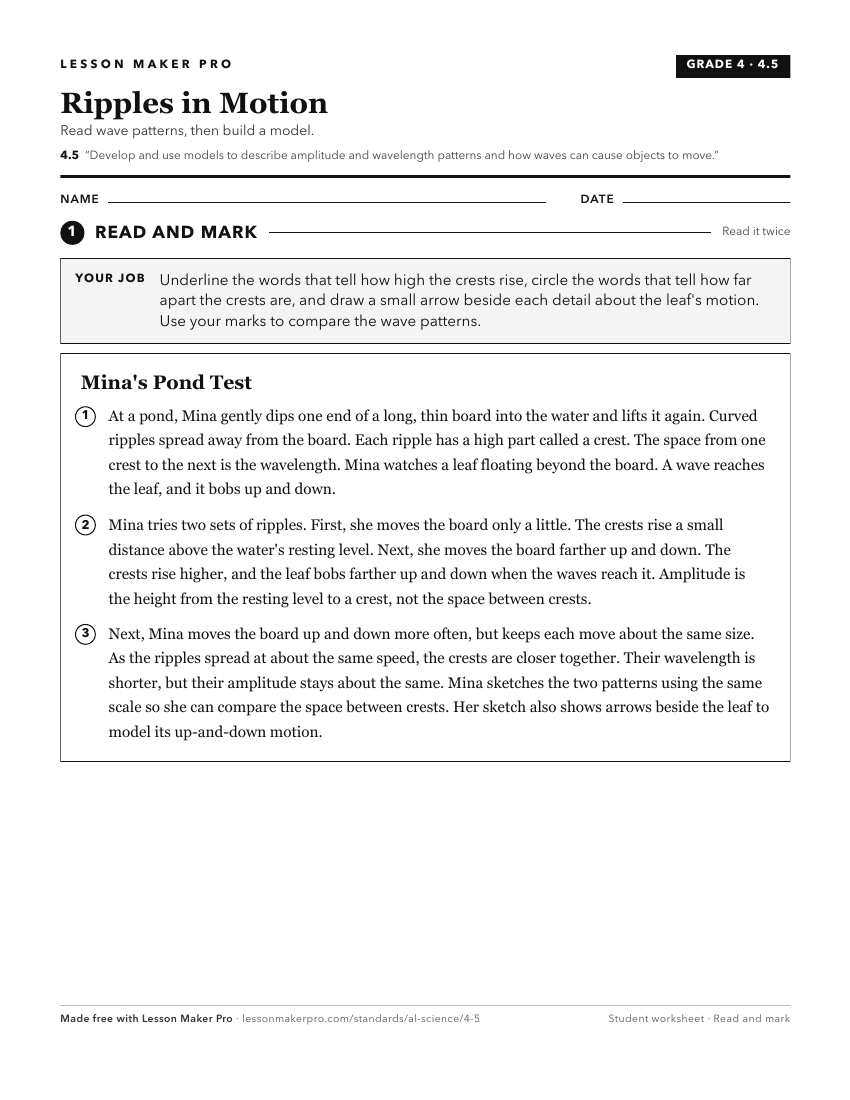
A ready-to-print activity worksheet aligned to 4.5, with an answer key for the teacher on its own page. No account needed.
PDF, US Letter, prints cleanly in black and white.
Download the worksheetKeep exploring
Related Standards
- 8.17
Use models of mechanical and electromagnetic waves to qualitatively describe the relationships among wave properties, including amplitude, wavelength, and frequ...
- 8.17.a
Use models to compare and contrast light and sound wave behaviors, including reflection, refraction, diffraction, and speed, as waves propagate and interact wit...
- 8.10
Develop and use models to illustrate how individual external forces affect the motion of objects.
- P.5
Develop and use models to analyze the circular motion of objects.
Turn this exact standard into a lesson
Grade, subject, topic, and the complete standard are prefilled. Create one free, no account needed.
Also for this standard:Make a WorksheetMake a QuizMake a Sub Lesson