Alabama Science 8.17
Standard Cluster
Use models of mechanical and electromagnetic waves to qualitatively describe the relationships among wave properties, including amplitude, wavelength, and frequency. a. Use models to compare and contrast light and sound wave behaviors, including reflection, refraction, diffraction, and speed, as waves propagate and interact with matter.
2023 Alabama Course of Study: Science · Waves and Their Applications in Technologies for Information Transfer
Cluster contents
Standards in This Cluster
8.17 is a cluster heading. These are the individual standards under it.
Teacher's field guide
What This Cluster Means
What Students Need to Do
- Students draw wave models and label amplitude, wavelength, and frequency. They use models to explain how light and sound reflect, refract, and diffract. They compare wave speeds and explain why sound needs matter to travel but light does not.
What Mastery Looks Like
- A student labels amplitude and wavelength on a wave sketch. At the same wave speed, they identify the shorter wavelength as having the higher frequency. They can sketch an echo, light bending as it enters glass, and sound spreading past a doorway.
Common Misconceptions
- Students may think a louder sound travels faster or has a higher frequency. They may think light needs air to travel, as sound does. They may call every change in direction reflection, confusing refraction at glass with diffraction at an opening.
How to Assess It
- On an exit ticket, show two waves with equal amplitude and different wavelengths. Ask students to label the higher-frequency wave at the same speed and explain why a bell can be heard around a hallway corner when its lamp cannot be seen.
Lesson moves
Ways to Teach It
Have pairs hold a rope taut, vary hand motion size and rate, and sketch the resulting crest height and spacing.
Ask pairs to sketch why they hear a bell around a hallway corner but cannot see a lamp placed beside it.
Give groups cards showing echoes, mirrors, straws in water, and sounds heard around corners to sort by reflection, refraction, or diffraction.
Play a storm clip, pause after a lightning flash, and have students predict when thunder arrives and explain the delay.
Free download
Printable 8.17 Worksheet
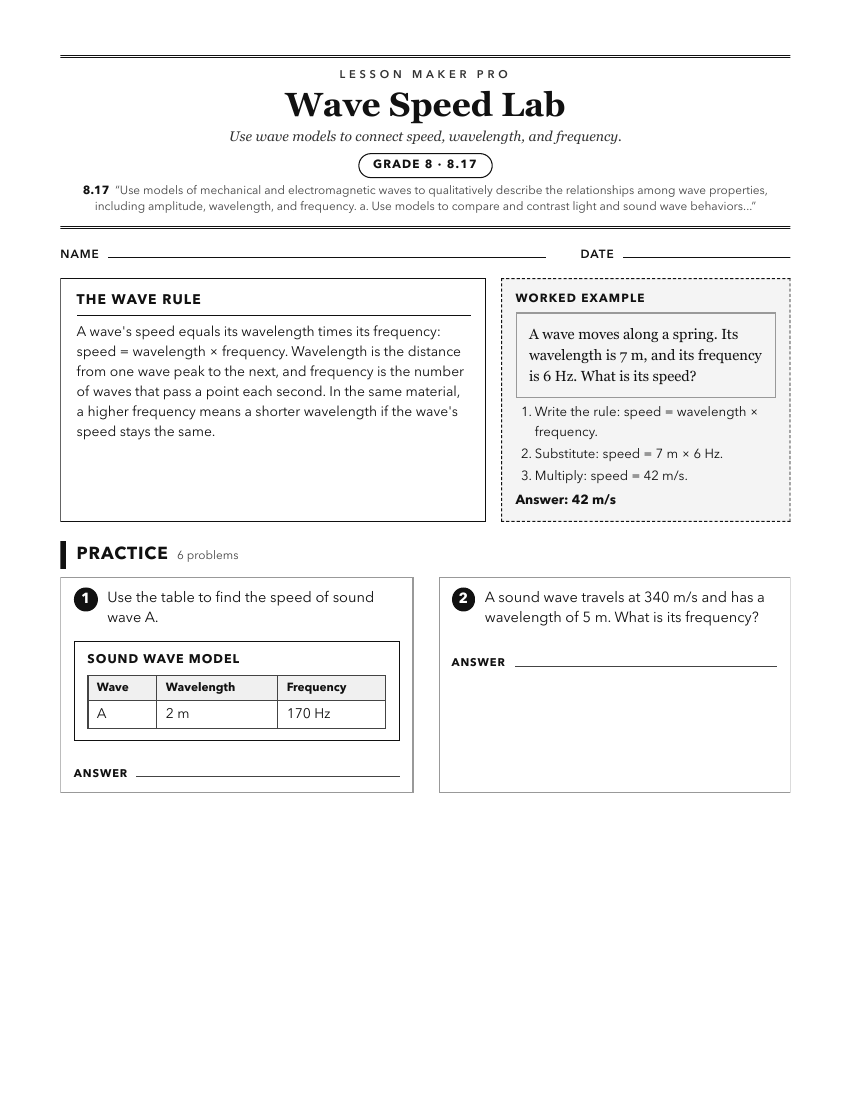
A ready-to-print activity worksheet aligned to 8.17, with an answer key for the teacher on its own page. No account needed.
PDF, US Letter, prints cleanly in black and white.
Download the worksheetKeep exploring
Related Standards
- 4.5
Develop and use models to describe amplitude and wavelength patterns and how waves can cause objects to move.
- P.7.a
Use mathematics and computational thinking to describe the relationships among the velocity, frequency, and wavelength of a propagating wave.
- PS.2.a
Analyze and interpret data to identify and describe the relationships among wavelength, frequency, amplitude, and energy in waves.
Turn this cluster into a lesson
Grade, subject, topic, and the complete cluster are prefilled. Create one free, no account needed.
Also for this cluster:Make a WorksheetMake a QuizMake a Sub Lesson