Alabama Science PS.2.a
The Standard
- PS.2
- Obtain, evaluate, and communicate information to compare and contrast the properties of mechanical and electromagnetic waves as they relate to real-world applications.
Analyze and interpret data to identify and describe the relationships among wavelength, frequency, amplitude, and energy in waves.
2023 Alabama Course of Study: Science
Teacher's field guide
What This Standard Means
What Students Need to Do
- Students read wave graphs and data tables to compare wavelength, frequency, amplitude, and energy. They explain why shorter wavelengths go with higher frequencies when wave speed stays the same. They use amplitude to predict changes in energy carried by a wave.
What Mastery Looks Like
- Given two waves traveling at the same speed, a student can rank their wavelengths and frequencies. They can mark amplitude on a graph and explain that a larger amplitude means more energy. For light, they can link higher frequency to more energy per photon.
Common Misconceptions
- Students may measure wavelength from a crest to a trough instead of crest to crest. They may confuse amplitude with wavelength or think brighter light must have higher-energy photons.
How to Assess It
- Show two light waves: A has a 400 nm wavelength and electric-field amplitude of 1 unit; B has a 700 nm wavelength and amplitude of 2 units. Ask students to rank their frequencies, photon energies, and intensities, with a reason for each.
Lesson moves
Ways to Teach It
Keep a rope taut while students shake it at two rates, then measure crest spacing and amplitude with a ruler.
Ask students to explain in writing how dim blue light can have higher-energy photons than bright red light.
Give pairs wave cards with labeled speeds, frequencies, and amplitudes; have them match cards to wavelength rankings and defend their matches.
Compare the frequencies on 2.4 GHz and 5 GHz Wi-Fi labels, then calculate which signal has the shorter wavelength.
Free download
Printable PS.2.a Worksheet
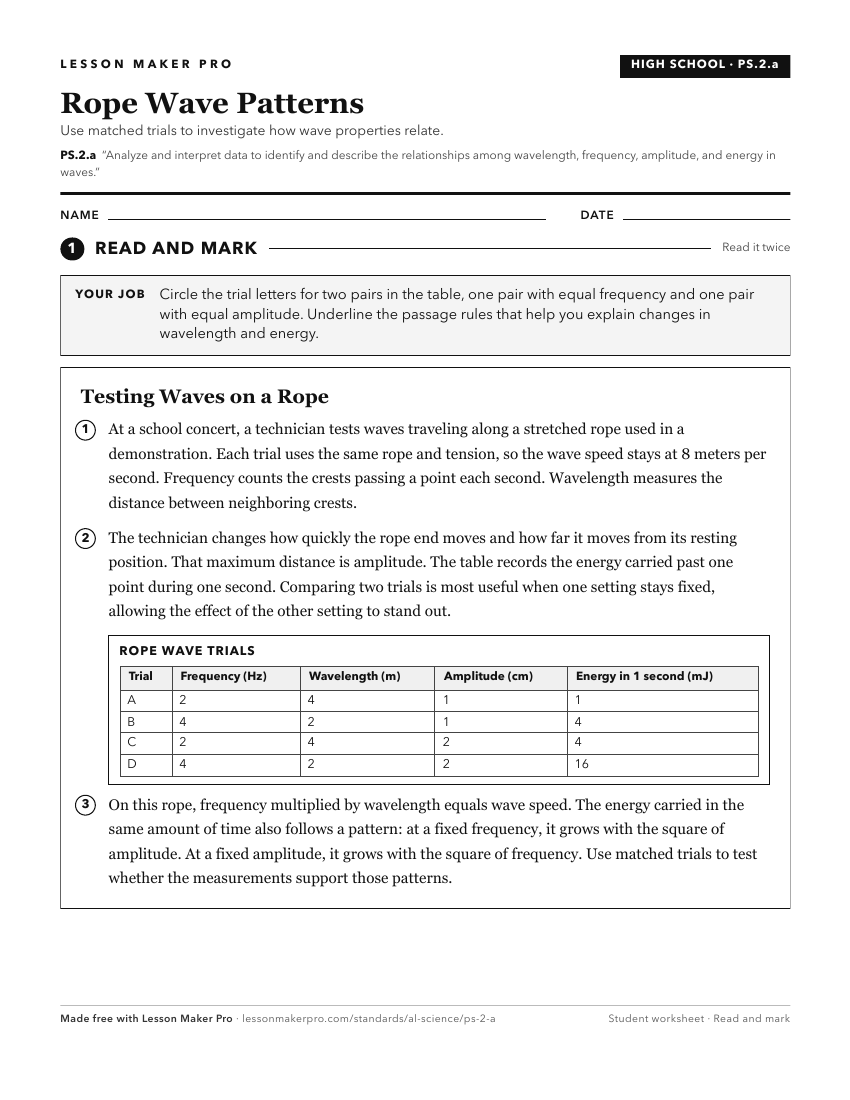
A ready-to-print activity worksheet aligned to PS.2.a, with an answer key for the teacher on its own page. No account needed.
PDF, US Letter, prints cleanly in black and white.
Download the worksheetKeep exploring
Related Standards
- 8.17
Use models of mechanical and electromagnetic waves to qualitatively describe the relationships among wave properties, including amplitude, wavelength, and frequ...
- P.7.a
Use mathematics and computational thinking to describe the relationships among the velocity, frequency, and wavelength of a propagating wave.
- P.7.c
Obtain, evaluate, and communicate information to explain the properties and behavior of electromagnetic waves.
- P.7
Obtain, evaluate, and communicate information regarding the propagation, properties, and applications of waves.
Turn this exact standard into a lesson
Grade, subject, topic, and the complete standard are prefilled. Create one free, no account needed.
Also for this standard:Make a WorksheetMake a QuizMake a Sub Lesson