Alabama Science P.7
Standard Cluster
Obtain, evaluate, and communicate information regarding the propagation, properties, and applications of waves. a. Use mathematics and computational thinking to describe the relationships among the velocity, frequency, and wavelength of a propagating wave. b. Use results of investigations to explain the production and characteristics of sound waves including interferences, the Doppler effect, and standing waves. c. Obtain, evaluate, and communicate information to explain the properties and behavior of electromagnetic waves.
2023 Alabama Course of Study: Science · Waves and Their Applications in Technologies for Information Transfer
Cluster contents
Standards in This Cluster
P.7 is a cluster heading. These are the individual standards under it.
- P.7.a
Use mathematics and computational thinking to describe the relationships among the velocity, frequency, and wavelength of a propagating wave.
- P.7.b
Use results of investigations to explain the production and characteristics of sound waves including interferences, the Doppler effect, and standing waves.
- P.7.c
Obtain, evaluate, and communicate information to explain the properties and behavior of electromagnetic waves.
Teacher's field guide
What This Cluster Means
What Students Need to Do
- Students calculate wave speed, frequency, or wavelength from the other two values. They use observations to explain how vibrations make sound, including interference, Doppler pitch shifts, and standing waves. They compare electromagnetic waves by wavelength, frequency, and how they carry information.
What Mastery Looks Like
- Given a 170 Hz sound wave traveling at 340 m/s, a student calculates its wavelength as 2 m. They explain quiet spots between two speakers, a passing siren's pitch shift, and fixed nodes on a vibrating string. They explain why radio waves can carry signals through empty space but sound cannot.
Common Misconceptions
- Students often think louder sound has a higher frequency, rather than a greater amplitude. They may think a passing siren changes the frequency it produces, or that nothing moves in a standing wave. Some think electromagnetic waves need air or are all visible.
How to Assess It
- Exit ticket: A 170 Hz sound wave travels at 340 m/s. Find its wavelength, explain why a passing siren changes pitch, and say why radio waves can cross empty space but sound cannot.
Lesson moves
Ways to Teach It
Connect two speakers to one 440 Hz tone source; walk across the room and mark where the sound grows louder or quieter.
Play a passing-siren clip; ask students whether the siren changes its own frequency and what causes the heard pitch shift.
Hand out wave speed and frequency cards; pairs calculate wavelengths, swap answers, and check the units.
Show a phone-to-tower diagram; have students label the radio wave and explain why the signal can cross empty space.
Free download
Printable P.7 Worksheet
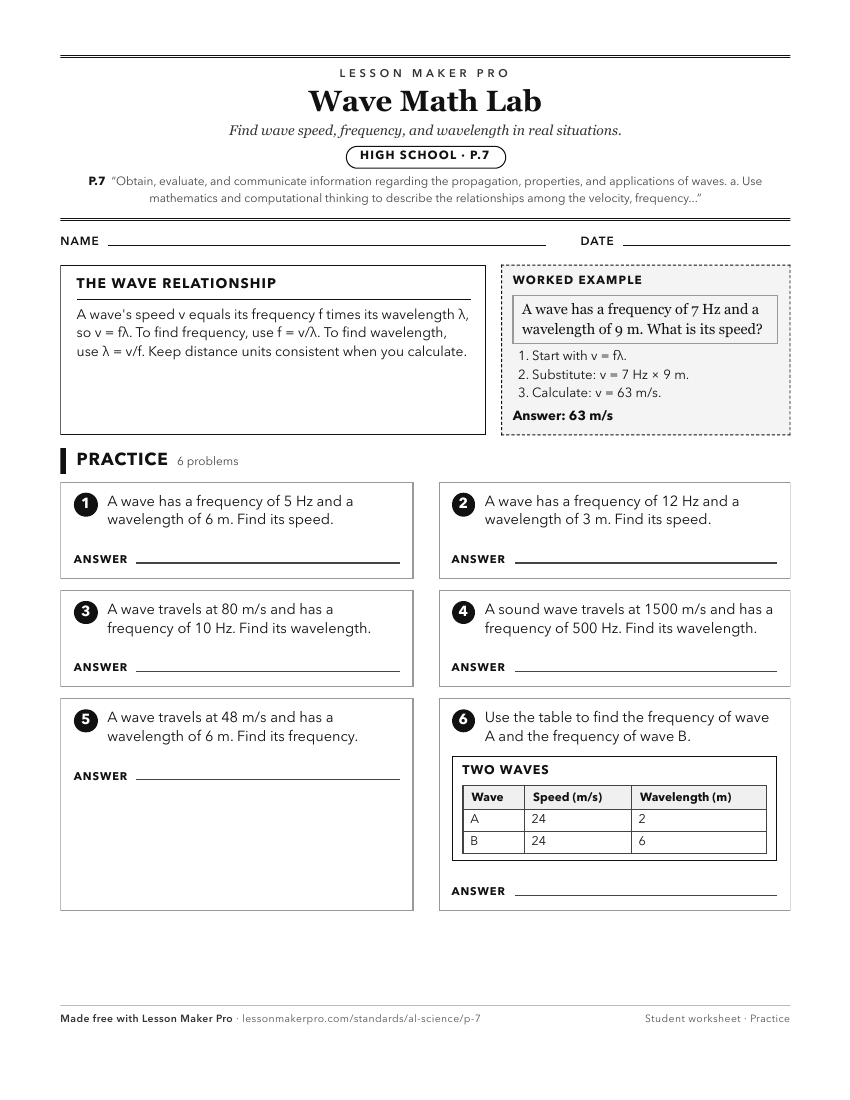
A ready-to-print activity worksheet aligned to P.7, with an answer key for the teacher on its own page. No account needed.
PDF, US Letter, prints cleanly in black and white.
Download the worksheetKeep exploring
Related Standards
- PS.2
Obtain, evaluate, and communicate information to compare and contrast the properties of mechanical and electromagnetic waves as they relate to real-world applic...
- PS.2.e
Obtain and communicate information from published materials to explain how transmitting and receiving devices use the principles of wave behavior and wave inter...
Turn this cluster into a lesson
Grade, subject, topic, and the complete cluster are prefilled. Create one free, no account needed.
Also for this cluster:Make a WorksheetMake a QuizMake a Sub Lesson