Alabama Science P.7.b
The Standard
- P.7
- Obtain, evaluate, and communicate information regarding the propagation, properties, and applications of waves.
Use results of investigations to explain the production and characteristics of sound waves including interferences, the Doppler effect, and standing waves.
2023 Alabama Course of Study: Science · Waves and Their Applications in Technologies for Information Transfer
Teacher's field guide
What This Standard Means
What Students Need to Do
- Students observe vibrating objects, overlapping sound waves, moving sound sources, and resonating strings. They use their results to explain pitch, loudness, interference, Doppler shifts, and standing waves.
What Mastery Looks Like
- Students link faster vibration to higher pitch and greater wave amplitude to louder sound. They use loud and quiet spots to explain interference, fixed nodes to explain standing waves, and a passing siren's frequency trace to explain a Doppler shift.
Common Misconceptions
- Students often mix up pitch and loudness or think a moving siren changes the frequency it produces. They may think no waves reach a quiet spot, rather than waves arriving and canceling. They may think a standing wave is motionless everywhere, even at its antinodes.
How to Assess It
- Show students a map of loud and quiet spots from two speakers, a diagram of a vibrating string with fixed nodes, and a passing siren's pitch trace. Ask them to name each wave behavior and use one observation to explain its cause.
Lesson moves
Ways to Teach It
Stretch a rope between two students, shake one end at different rates, and mark the fixed nodes with floor tape.
Play a passing siren clip and show its frequency trace; ask students to explain the pitch drop using the trace.
Give pairs cards showing wave peaks and troughs; have them stack cards and predict which pairs make louder or quieter spots.
Compare a guitar's open string and 12th fret with a tuner app; explain why the shorter vibrating string sounds an octave higher.
Free download
Printable P.7.b Worksheet
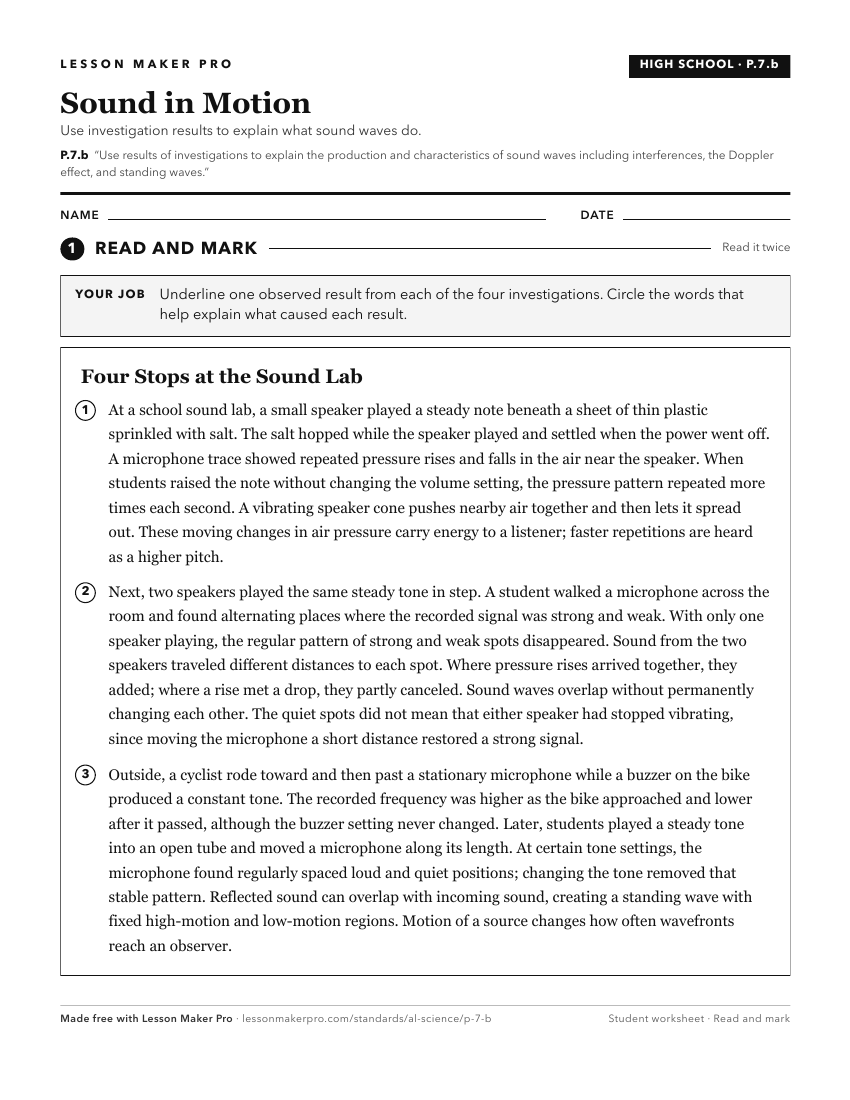
A ready-to-print activity worksheet aligned to P.7.b, with an answer key for the teacher on its own page. No account needed.
PDF, US Letter, prints cleanly in black and white.
Download the worksheetKeep exploring
Related Standards
- PS.2.d
Use models to illustrate the Doppler effect and explain the changes in sound perception associated with it.
- 8.17.a
Use models to compare and contrast light and sound wave behaviors, including reflection, refraction, diffraction, and speed, as waves propagate and interact wit...
- PS.2.c
Analyze the ways in which different media and their characteristics affect the speed of sound and light waves.
- 1.1
Carry out investigations to provide evidence that the vibrations of matter can make sound and sound can make matter vibrate.
Turn this exact standard into a lesson
Grade, subject, topic, and the complete standard are prefilled. Create one free, no account needed.
Also for this standard:Make a WorksheetMake a QuizMake a Sub Lesson