Alabama Science PS.2.c
The Standard
- PS.2
- Obtain, evaluate, and communicate information to compare and contrast the properties of mechanical and electromagnetic waves as they relate to real-world applications.
Analyze the ways in which different media and their characteristics affect the speed of sound and light waves.
2023 Alabama Course of Study: Science · Waves and Their Applications in Technologies for Information Transfer
Teacher's field guide
What This Standard Means
What Students Need to Do
- Students compare how fast sound and light travel through air, water, and glass. They explain why the two waves change speed differently when they enter a new material. They also recognize that sound cannot travel through empty space, but light can.
What Mastery Looks Like
- Given a table of wave speeds, a student can predict whether each wave speeds up or slows down when it enters water from air. They explain sound speed using stiffness and density, and light speed using refractive index.
Common Misconceptions
- Students often assume sound and light both speed up in denser materials. Some think sound can travel through empty space. Others use density alone to predict sound speed and overlook how hard a material is to compress.
How to Assess It
- Exit ticket: A sound wave and a light wave travel from air into water. Which speeds up, which slows down, and what property of water helps explain each change?
Lesson moves
Ways to Teach It
Put a pencil in a clear cup of water, sketch its apparent bend, and trace how light changes direction as it slows.
Ask students to write why sound speeds up in water compared with air, while light slows down.
Give pairs speed cards for sound and light in air, water, and glass; have them match each card to its wave and material.
Use the delay between lightning and thunder to estimate a storm's distance, then explain why the flash arrives first.
Free download
Printable PS.2.c Worksheet
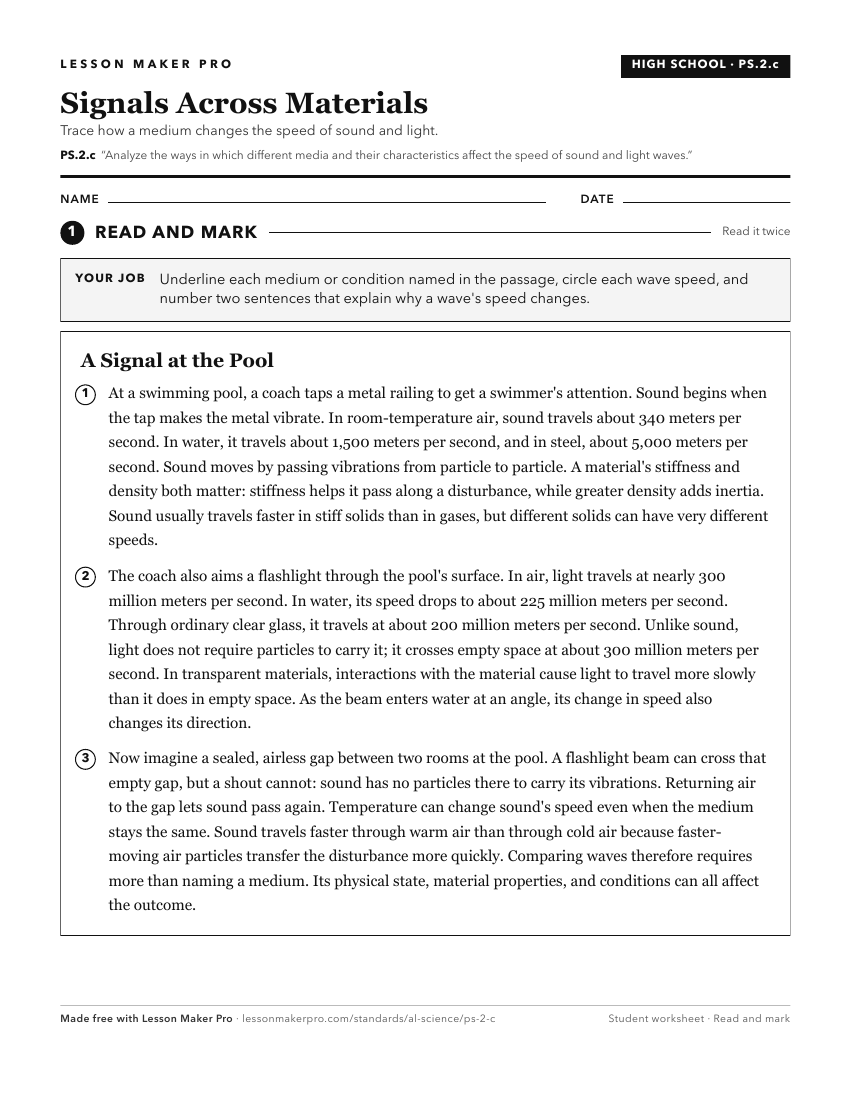
A ready-to-print activity worksheet aligned to PS.2.c, with an answer key for the teacher on its own page. No account needed.
PDF, US Letter, prints cleanly in black and white.
Download the worksheetKeep exploring
Related Standards
- 8.17.a
Use models to compare and contrast light and sound wave behaviors, including reflection, refraction, diffraction, and speed, as waves propagate and interact wit...
- P.7.b
Use results of investigations to explain the production and characteristics of sound waves including interferences, the Doppler effect, and standing waves.
- PS.2.a
Analyze and interpret data to identify and describe the relationships among wavelength, frequency, amplitude, and energy in waves.
- 4.6
Construct an explanation of how light, sound, and digitized information are transferred by waves.
Turn this exact standard into a lesson
Grade, subject, topic, and the complete standard are prefilled. Create one free, no account needed.
Also for this standard:Make a WorksheetMake a QuizMake a Sub Lesson