Alabama Science 4.6
The Standard
Construct an explanation of how light, sound, and digitized information are transferred by waves.
2023 Alabama Course of Study: Science · Waves and Their Applications in Technologies for Information Transfer
Teacher's field guide
What This Standard Means
What Students Need to Do
- Students explain how sound waves move through material and how light waves travel from a source to an eye. They explain how coded light or radio waves can carry a digital message.
What Mastery Looks Like
- A student traces sound from a vibrating object through air to an ear, and light from a source to an eye. They can explain that a phone sends photo data by coding it onto radio waves.
Common Misconceptions
- Students may think sound can travel through empty space or that light needs air to travel. They may think a photo moves through the air as a picture, rather than as data carried by radio waves.
How to Assess It
- Exit ticket: A phone shows a photo, plays a song, and sends the photo by Wi-Fi. What carries the light to your eyes, the sound to your ears, and the photo data to another phone?
Lesson moves
Ways to Teach It
Build cup-and-string phones, test taut and loose strings, and sketch how vibrations travel from one cup to the other.
Ask why you see lightning before you hear thunder, then have students draw the paths of the light and sound.
Flash a flashlight once for 0 and twice for 1; trade four-digit messages and decode each other's signals.
Sketch a phone sending a photo to a router by Wi-Fi, and label the radio waves that carry the coded photo data.
Free download
Printable 4.6 Worksheet
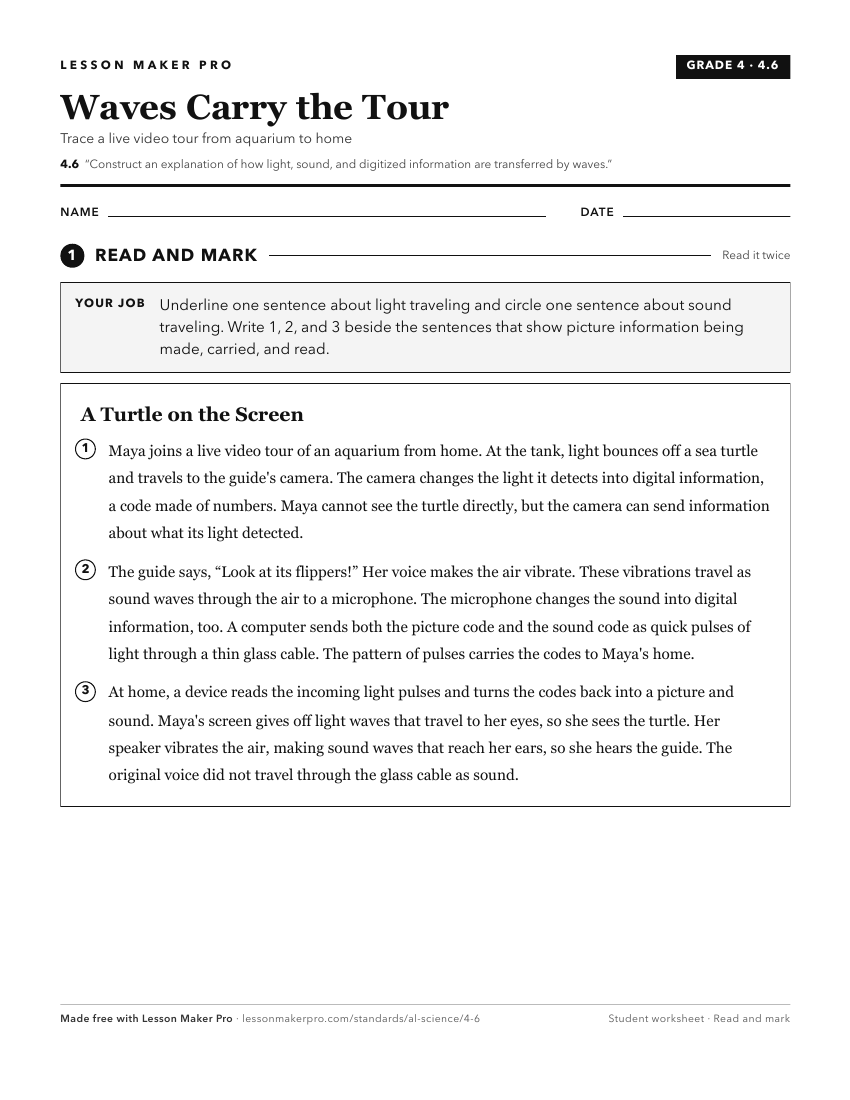
A ready-to-print activity worksheet aligned to 4.6, with an answer key for the teacher on its own page. No account needed.
PDF, US Letter, prints cleanly in black and white.
Download the worksheetKeep exploring
Related Standards
- PS.2.e
Obtain and communicate information from published materials to explain how transmitting and receiving devices use the principles of wave behavior and wave inter...
- PS.2.c
Analyze the ways in which different media and their characteristics affect the speed of sound and light waves.
- 8.17.a
Use models to compare and contrast light and sound wave behaviors, including reflection, refraction, diffraction, and speed, as waves propagate and interact wit...
- P.7.c
Obtain, evaluate, and communicate information to explain the properties and behavior of electromagnetic waves.
Turn this exact standard into a lesson
Grade, subject, topic, and the complete standard are prefilled. Create one free, no account needed.
Also for this standard:Make a WorksheetMake a QuizMake a Sub Lesson