Alabama Science 1.1
The Standard
Carry out investigations to provide evidence that the vibrations of matter can make sound and sound can make matter vibrate.
2023 Alabama Course of Study: Science · Waves and Their Applications in Technologies for Information Transfer
Teacher's field guide
What This Standard Means
What Students Need to Do
- Students make sounds with objects they can see moving, such as a plucked rubber band. They also test whether sound can move something they do not touch.
What Mastery Looks Like
- A student shows that a rubber band moves while it makes sound and stops moving when the sound stops. They hum into a tube and explain that the sound makes rice on its plastic-wrap cover move.
Common Misconceptions
- Some students think a rubber band can make sound without moving. Others think the rice moves because someone touched the cover, even when no one did.
How to Assess It
- Set out a rubber band stretched over a box and a tube capped with plastic wrap and rice. Ask each student to pluck the band, hum into the tube, and point out what moves in each test.
Lesson moves
Ways to Teach It
Stretch a rubber band over a tissue box, then have pairs pluck it and watch what happens as the sound fades.
Ask, 'What moved when you heard the rubber band, and what happened when the sound stopped?' Have students draw both moments.
Give pairs picture cards of a plucked band, a humming throat, and rice on plastic wrap; have them sort sound makers from sound movers.
Hum into a cardboard tube capped with plastic wrap and rice, then ask why a car window might rattle near loud music.
Free download
Printable 1.1 Worksheet
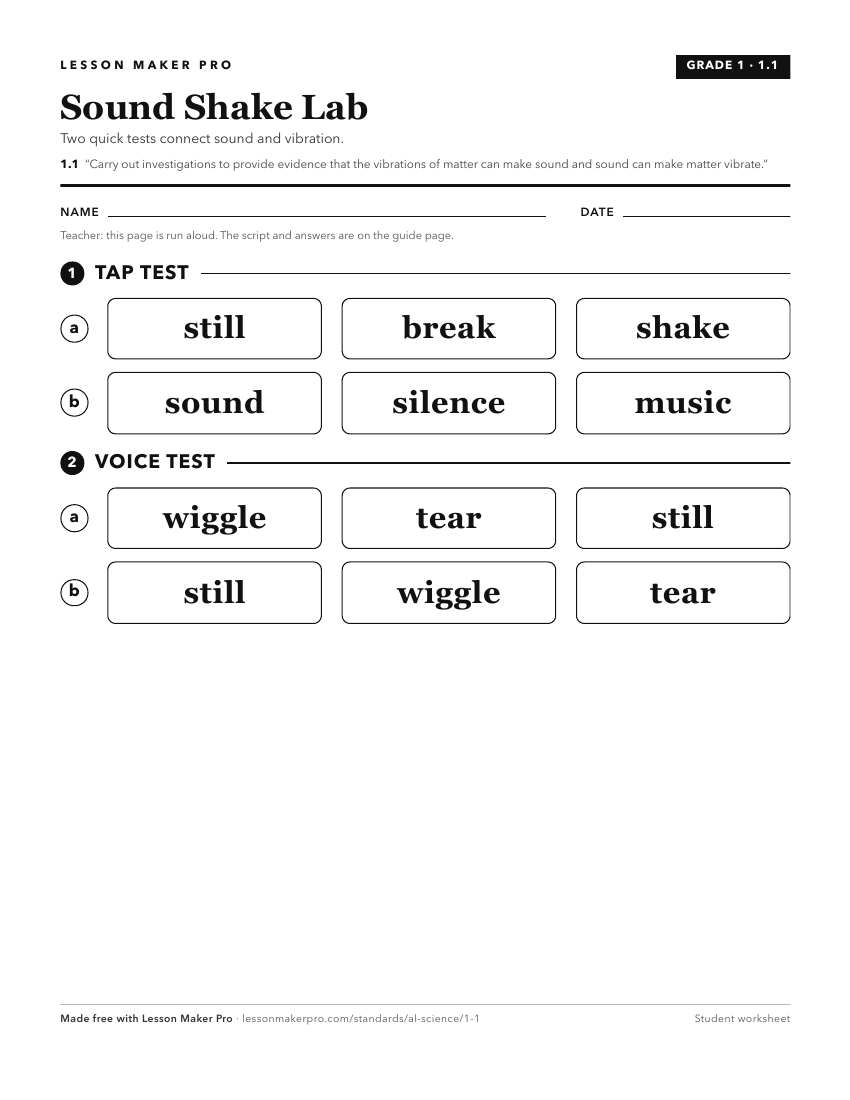
A ready-to-print activity worksheet aligned to 1.1, with an answer key for the teacher on its own page. No account needed.
PDF, US Letter, prints cleanly in black and white.
Download the worksheetKeep exploring
Related Standards
- 4.3
Plan and carry out investigations to provide evidence that energy is transferred by sound, light, heat, and electric currents.
- 5.1
Plan and carry out investigations to provide evidence that matter is made of particles too small to be seen.
- P.7.b
Use results of investigations to explain the production and characteristics of sound waves including interferences, the Doppler effect, and standing waves.
- 5.3
Conduct investigations to provide evidence that the total weight of matter is conserved during phase changes when substances are heated, cooled, or mixed.
Turn this exact standard into a lesson
Grade, subject, topic, and the complete standard are prefilled. Create one free, no account needed.
Also for this standard:Make a WorksheetMake a QuizMake a Sub Lesson