Alabama Science PS.2.d
The Standard
- PS.2
- Obtain, evaluate, and communicate information to compare and contrast the properties of mechanical and electromagnetic waves as they relate to real-world applications.
Use models to illustrate the Doppler effect and explain the changes in sound perception associated with it.
2023 Alabama Course of Study: Science · Waves and Their Applications in Technologies for Information Transfer
Teacher's field guide
What This Standard Means
What Students Need to Do
- Students draw or build a model showing sound waves crowded in front of a moving source and spread out behind it. They use the model to explain why a listener hears a higher pitch as the source approaches and a lower pitch as it moves away.
What Mastery Looks Like
- Given a moving siren and a stationary listener, a student draws wavefronts closer together ahead of the siren and farther apart behind it. They predict the pitch the listener hears on each side and explain that the siren's emitted frequency stays the same.
Common Misconceptions
- Students may think the siren changes the note it plays when it passes. They may confuse a louder sound with a higher pitch or think sound travels faster toward the listener.
How to Assess It
- Exit ticket: A siren passes a stationary listener. Sketch its wavefronts, then explain why the listener hears a higher pitch before it passes and a lower pitch after.
Lesson moves
Ways to Teach It
Mark a toy car's positions on graph paper at equal time steps, then draw circles with larger radii around older positions.
Ask: 'Does a passing ambulance change the note it plays, or only the note you hear?' Explain using your wavefront drawing.
Give pairs four wavefront sketches; have them sort each as approaching or receding and label the pitch heard by a stationary listener.
Play a passing train horn recording; students note the pitch before and after it passes, then explain the change in one sentence.
Free download
Printable PS.2.d Worksheet
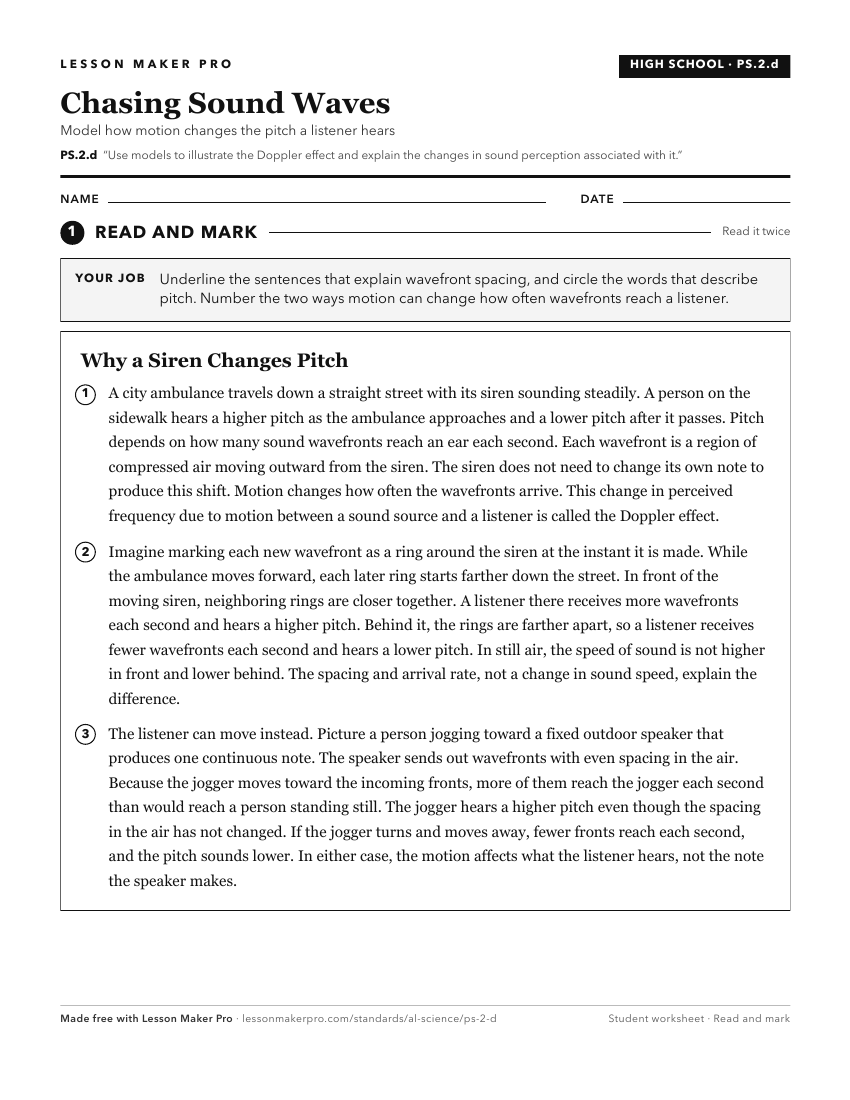
A ready-to-print activity worksheet aligned to PS.2.d, with an answer key for the teacher on its own page. No account needed.
PDF, US Letter, prints cleanly in black and white.
Download the worksheetKeep exploring
Related Standards
- 8.17.a
Use models to compare and contrast light and sound wave behaviors, including reflection, refraction, diffraction, and speed, as waves propagate and interact wit...
- P.7.b
Use results of investigations to explain the production and characteristics of sound waves including interferences, the Doppler effect, and standing waves.
- 4.5
Develop and use models to describe amplitude and wavelength patterns and how waves can cause objects to move.
- 8.17
Use models of mechanical and electromagnetic waves to qualitatively describe the relationships among wave properties, including amplitude, wavelength, and frequ...
Turn this exact standard into a lesson
Grade, subject, topic, and the complete standard are prefilled. Create one free, no account needed.
Also for this standard:Make a WorksheetMake a QuizMake a Sub Lesson