Alabama Science ESS.2.b
The Standard
- ESS.2
- Obtain, evaluate, and communicate information about the structure and motion of components of the universe and solar system.
Use mathematics and computational thinking to explain the relationships between the properties of light and distances in the solar system and universe, including the Doppler effect, red shift, light years, and astronomical units.
2023 Alabama Course of Study: Science
Teacher's field guide
What This Standard Means
What Students Need to Do
- Students use astronomical units for solar system distances and light-years for distances between stars. They calculate light travel times and use shifts in spectral lines to estimate how fast an object is moving away.
What Mastery Looks Like
- Given a spectral line that shifts from 656 nm to 660 nm, a student identifies redshift and estimates a speed of about 1,800 km/s. They can calculate light travel time from a distance given in astronomical units or light-years, with units shown.
Common Misconceptions
- Students may think a light-year measures time or that one astronomical unit is the distance from Earth to any planet. They may assume any red light shows motion away, rather than checking whether a known spectral line has shifted.
How to Assess It
- Exit ticket: A spectral line shifts from 656 nm to 660 nm. Estimate the object's speed and direction using v ≈ 300,000 km/s × Δλ/656 nm, then find the light travel time from 2 light-years away.
Lesson moves
Ways to Teach It
Overlay a transparent galaxy spectrum on a labeled reference spectrum, measure the 656 nm line shift, and estimate speed using v ≈ c(Δλ/λ).
Ask students: 'Why is a light-year a distance, not a time?' Compare starlight from 4 light-years away with sunlight's 8-minute trip.
Give pairs cards labeled 2 AU, 300 million km, 3 light-years, and 28.4 trillion km; have them match equivalent distances.
A spacecraft is 1.5 AU from Earth. Calculate its one-way radio delay using 8.3 minutes per AU, then explain why replies take longer.
Free download
Printable ESS.2.b Worksheet
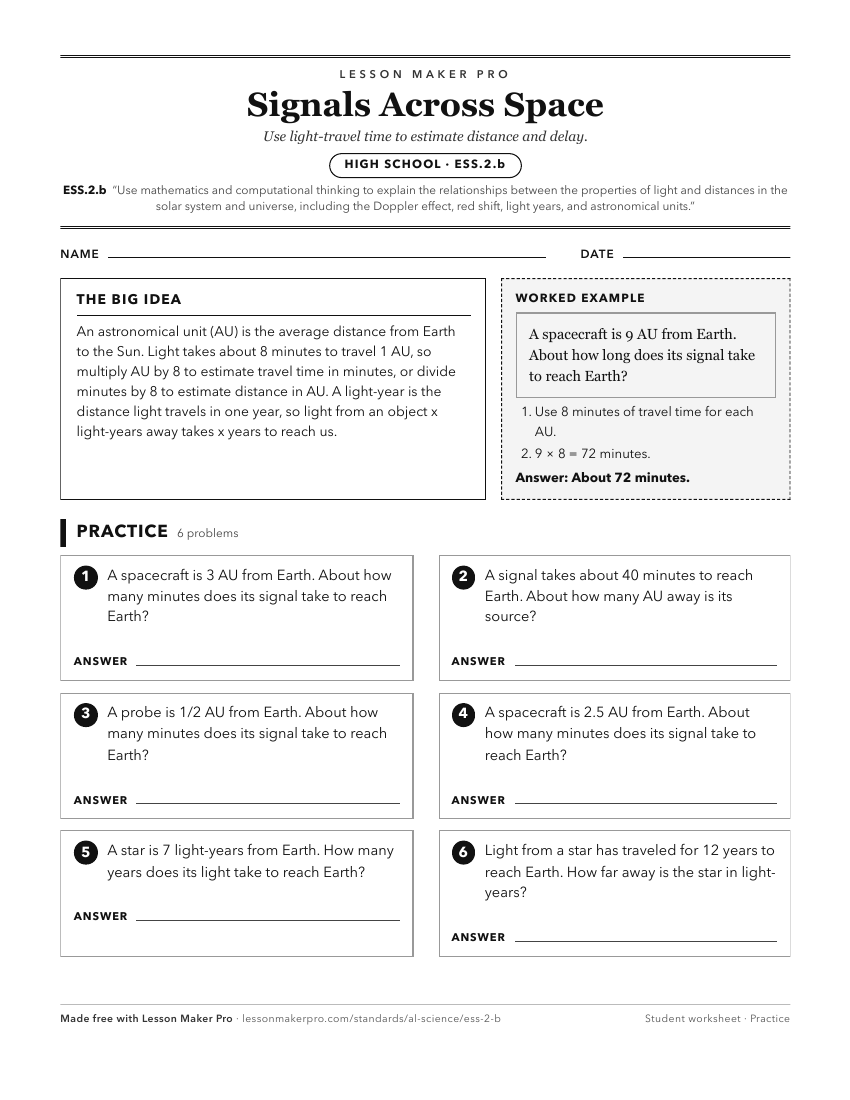
A ready-to-print activity worksheet aligned to ESS.2.b, with an answer key for the teacher on its own page. No account needed.
PDF, US Letter, prints cleanly in black and white.
Download the worksheetKeep exploring
Related Standards
- ESS.2.a
Use mathematics and computational thinking to predict the motion of natural and man-made objects in the solar system, using Kepler’s laws, Newton’s laws of moti...
- P.7.a
Use mathematics and computational thinking to describe the relationships among the velocity, frequency, and wavelength of a propagating wave.
- P.3.a
Use mathematical and computational thinking to explain the relationships among work, power, and time.
- 6.4
Analyze and use data to determine scale properties and characteristics of objects in the solar system including sizes, distances, orbital periods, basic composi...
Turn this exact standard into a lesson
Grade, subject, topic, and the complete standard are prefilled. Create one free, no account needed.
Also for this standard:Make a WorksheetMake a QuizMake a Sub Lesson