Alabama Science 6.4
The Standard
Analyze and use data to determine scale properties and characteristics of objects in the solar system including sizes, distances, orbital periods, basic composition, and ability to support life.
2023 Alabama Course of Study: Science · Earth’s Place in the Universe
Teacher's field guide
What This Standard Means
What Students Need to Do
- Students use planet data to compare diameters, distances from the Sun, and orbital periods. They identify what planets are made of and use evidence about water and atmosphere to judge whether conditions could support life.
What Mastery Looks Like
- A student can calculate that Jupiter is about 11 times Earth's diameter and use data to compare their distances and orbital periods. They can explain why Earth supports known life, using evidence about its water and atmosphere.
Common Misconceptions
- Students may confuse a planet's day with its year or think a larger planet must take longer to orbit. Some assume that any rocky planet can support life, even without enough liquid water or a suitable atmosphere.
How to Assess It
- Exit ticket: Give students Earth (12,742 km wide, 1 AU, 1 year, rocky, liquid water) and Jupiter (139,820 km wide, 5.2 AU, 12 years, mostly gas, no solid surface). Ask which is wider, farther from the Sun, and slower to orbit, then ask which has known life-supporting conditions; require two numbers and one condition.
Lesson moves
Ways to Teach It
Tape planet cards in a hallway: Sun at 0, Earth at 1, Mars at 1.5, Jupiter at 5.2 meters; 1 meter equals 1 AU.
Ask: Why can't Jupiter's large size alone tell us whether it supports life? Use its composition and Earth's liquid water in your answer.
Give pairs planet data cards; have them sort by diameter, Sun distance, and orbital period, then check each order against the numbers.
Hand teams a Mars mission card stating its atmosphere is thin and surface liquid water is scarce; ask which two supplies astronauts need.
Free download
Printable 6.4 Worksheet
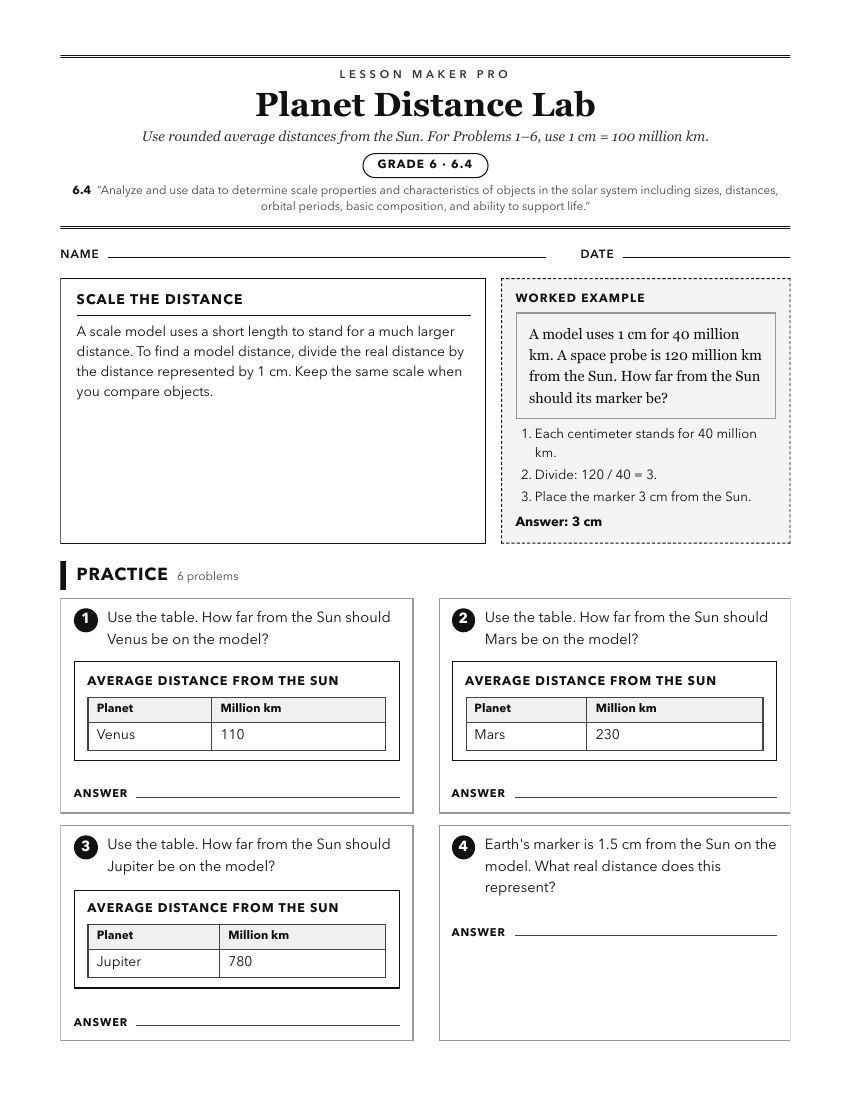
A ready-to-print activity worksheet aligned to 6.4, with an answer key for the teacher on its own page. No account needed.
PDF, US Letter, prints cleanly in black and white.
Download the worksheetKeep exploring
Related Standards
- ESS.2.d
Investigate and communicate major properties of bodies in the solar system and the zones they inhabit.
- ESS.2.c
Analyze spectroscopic data to determine the properties and motion of objects in space.
- ESS.2
Obtain, evaluate, and communicate information about the structure and motion of components of the universe and solar system.
- ESS.2.a
Use mathematics and computational thinking to predict the motion of natural and man-made objects in the solar system, using Kepler’s laws, Newton’s laws of moti...
Turn this exact standard into a lesson
Grade, subject, topic, and the complete standard are prefilled. Create one free, no account needed.
Also for this standard:Make a WorksheetMake a QuizMake a Sub Lesson