Alabama Science ESS.2.c
The Standard
- ESS.2
- Obtain, evaluate, and communicate information about the structure and motion of components of the universe and solar system.
Analyze spectroscopic data to determine the properties and motion of objects in space.
2023 Alabama Course of Study: Science · Earth’s Place in the Universe
Teacher's field guide
What This Standard Means
What Students Need to Do
- Students use spectra to identify elements in stars and galaxies. They use the pattern of light to compare temperatures and shifts in spectral lines to tell whether an object is moving toward or away from Earth.
What Mastery Looks Like
- A student matches several lines to a lab spectrum before naming an element. They use the spectrum's peak to compare temperatures, then use a line's wavelength shift to give the direction of motion.
Common Misconceptions
- Students may treat a red-looking object as proof of redshift or assume redshift means the object is cooler. They may name an element from one matching line or mix up the directions of redshift and blueshift.
How to Assess It
- Give students lab lines at 500 and 600 nm and star lines at 505 and 606 nm. Ask whether the lines match the same element, which way the star is moving, and what numbers support their answers.
Lesson moves
Ways to Teach It
Give pairs printed lab and star spectra with transparent rulers; have them line up matching lines and measure the wavelength shifts.
Ask students to write why a star can look red without its spectral lines being redshifted.
Play spectral match: teams use a reference sheet to identify elements in four mystery spectra, then sort shifted spectra by direction of motion.
Compare a printed solar spectrum with a lab hydrogen spectrum; have students mark the lines that reveal hydrogen in the Sun.
Free download
Printable ESS.2.c Worksheet
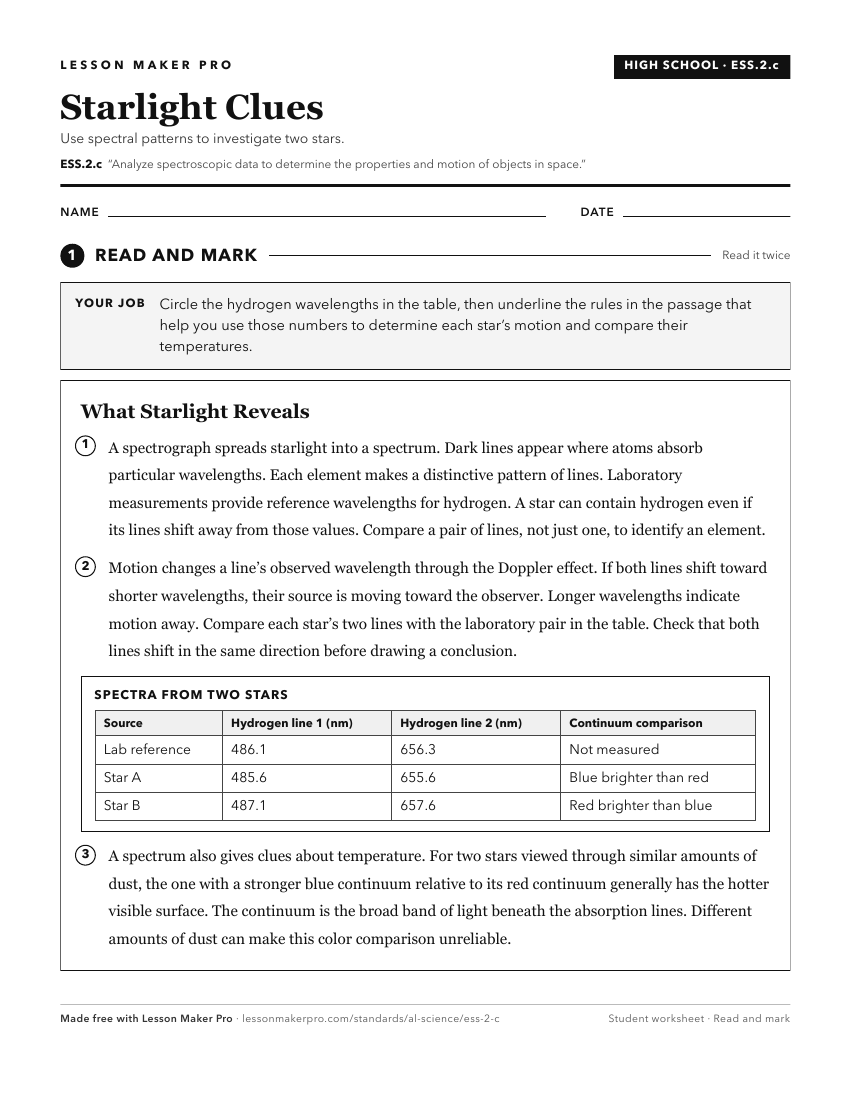
A ready-to-print activity worksheet aligned to ESS.2.c, with an answer key for the teacher on its own page. No account needed.
PDF, US Letter, prints cleanly in black and white.
Download the worksheetKeep exploring
Related Standards
- 6.4
Analyze and use data to determine scale properties and characteristics of objects in the solar system including sizes, distances, orbital periods, basic composi...
- ESS.2
Obtain, evaluate, and communicate information about the structure and motion of components of the universe and solar system.
- CHE.1.c
Analyze and interpret data to identify or describe an element based on its number of protons, its relative abundance of isotopes, its organization and placement...
- 5.11
Analyze data that reveal patterns of daily changes in length and direction of shadows, day and night, phases of the moon, and seasonal appearance of some stars ...
Turn this exact standard into a lesson
Grade, subject, topic, and the complete standard are prefilled. Create one free, no account needed.
Also for this standard:Make a WorksheetMake a QuizMake a Sub Lesson