Alabama Science 5.11
The Standard
Analyze data that reveal patterns of daily changes in length and direction of shadows, day and night, phases of the moon, and seasonal appearance of some stars in the night sky.
2023 Alabama Course of Study: Science · Earth’s Place in the Universe
Teacher's field guide
What This Standard Means
What Students Need to Do
- Students read shadow measurements, daylight records, Moon sketches, and night sky charts. They find patterns within a day, across a month, and across seasons.
What Mastery Looks Like
- Students use morning and noon shadow data to predict a later shadow's length and direction. They predict the next Moon phase and identify stars visible in one season but not another. They explain day and night with Earth's rotation and seasonal star changes with Earth's orbit.
Common Misconceptions
- Students may think shadows always point the same way or that the Sun travels around Earth each day. They may think Earth's shadow causes Moon phases. Some expect the same stars to appear at the same time every season.
How to Assess It
- Give an exit ticket with shadow data (9 a.m., long west; noon, short north; 2 p.m., long east), Moon sketches from days 1, 8, and 15, and January and July 9 p.m. sky maps. Ask students to predict the next shadow direction and Moon phase, name a star group seen only in January, and explain why daytime turns to night.
Lesson moves
Ways to Teach It
Trace a flagpole's shadow with sidewalk chalk at 9 a.m., noon, and 2 p.m.; measure each trace and mark its direction.
Show four dated Moon sketches and ask, 'What changes each week, and does Earth's shadow cause it?'
Give pairs sunrise, noon, sunset, and midnight cards; have them order the cards and match each with a shadow or no shadow.
Give students January and July 9 p.m. sky maps for Alabama; have them circle Orion and explain why it appears on only one map.
Free download
Printable 5.11 Worksheet
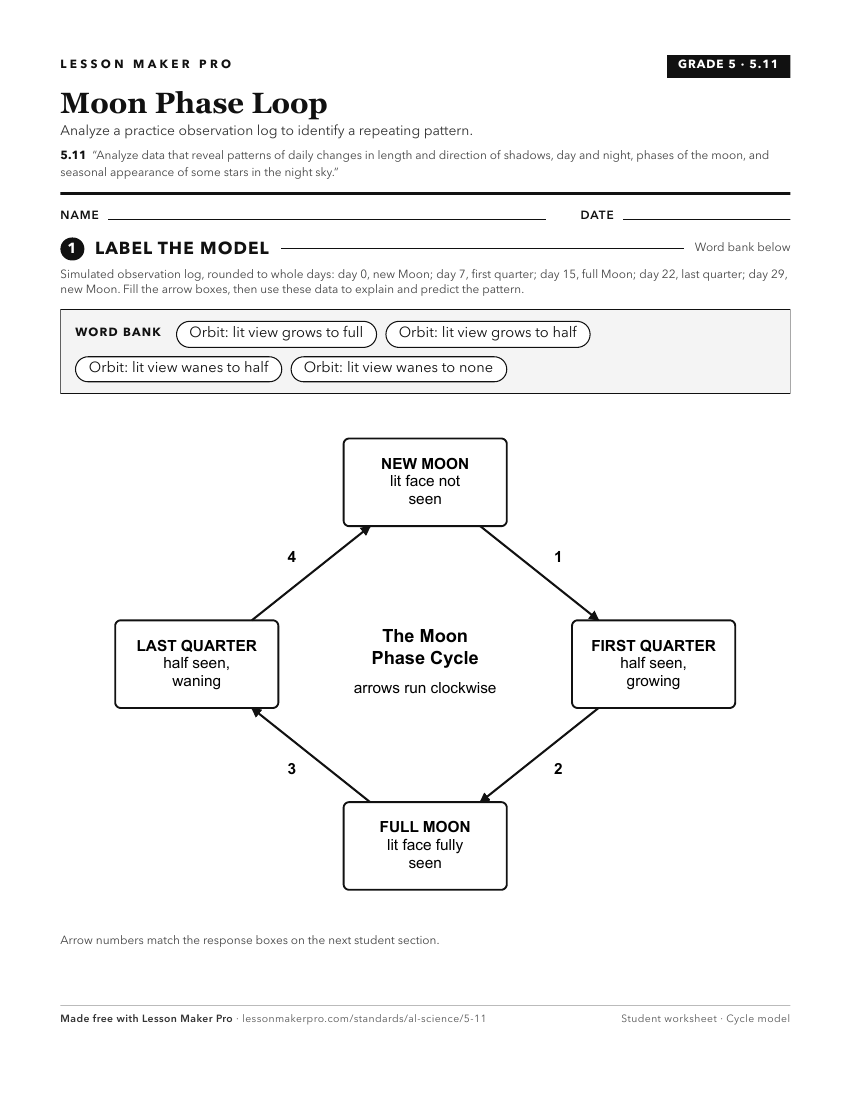
A ready-to-print activity worksheet aligned to 5.11, with an answer key for the teacher on its own page. No account needed.
PDF, US Letter, prints cleanly in black and white.
Download the worksheetKeep exploring
Related Standards
- 1.8
Observe, describe, and predict patterns of the sun, moon, and stars as they appear in the sky.
- 1.9
Use observations of seasonal sunrise and sunset patterns to describe the relationship between the number of hours of daylight and the time of year.
- 6.1.a
Construct an evidence-based explanation of how the relative positions of the sun and Earth result in observable phenomena, including day and night cycles, lengt...
- 6.1
Manipulate models to demonstrate the patterns of motion of the sun, Earth, and moon.
Turn this exact standard into a lesson
Grade, subject, topic, and the complete standard are prefilled. Create one free, no account needed.
Also for this standard:Make a WorksheetMake a QuizMake a Sub Lesson