Alabama Science ESS.2.d
The Standard
- ESS.2
- Obtain, evaluate, and communicate information about the structure and motion of components of the universe and solar system.
Investigate and communicate major properties of bodies in the solar system and the zones they inhabit.
2023 Alabama Course of Study: Science · Earth’s Place in the Universe
Teacher's field guide
What This Standard Means
What Students Need to Do
- Students compare planets, dwarf planets, moons, asteroids, and comets using data on size, composition, and orbit. They explain where each body travels and how its properties relate to its location.
What Mastery Looks Like
- Given a data table, a student places Ceres in the asteroid belt and Pluto in the Kuiper belt, using orbital distance as evidence. They describe how rocky inner planets differ from outer gas and ice giants.
Common Misconceptions
- Students may confuse the asteroid belt with the Kuiper belt beyond Neptune. They may assume every distant object is a gas giant or that comets stay in one zone throughout their orbits.
How to Assess It
- Exit ticket: Give students Ceres (2.8 AU, rocky), Jupiter (5.2 AU, gas giant), and Pluto (39 AU, icy). Ask them to name each body's zone and cite one clue for each choice.
Lesson moves
Ways to Teach It
Use object cards listing orbital distance, size, and composition to build a 5-meter hallway model, with 1 AU equal to 10 cm.
Show Ceres and Pluto data cards, then ask students to write why these dwarf planets occupy different zones.
Run a card sort in which teams match object names, orbital distances, and properties to four solar system zones.
Show a Europa Clipper instrument card, then ask students why ice-penetrating radar suits a moon orbiting Jupiter.
Free download
Printable ESS.2.d Worksheet
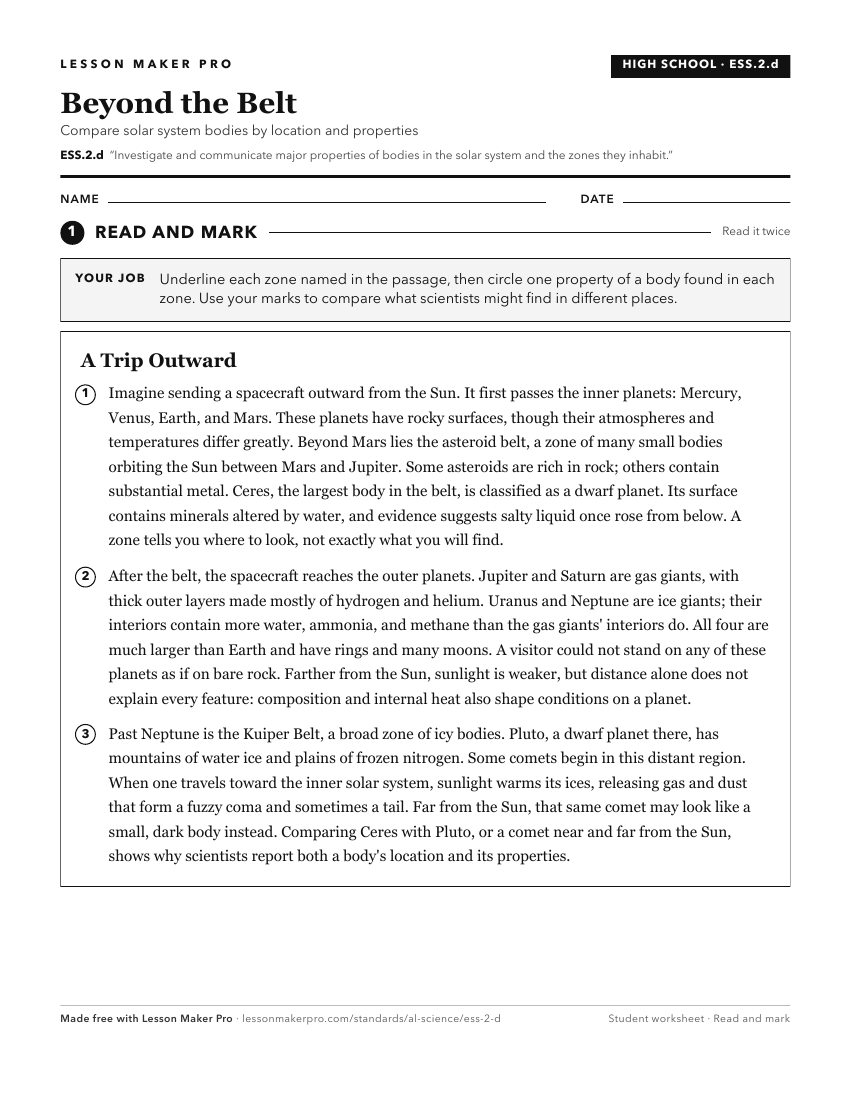
A ready-to-print activity worksheet aligned to ESS.2.d, with an answer key for the teacher on its own page. No account needed.
PDF, US Letter, prints cleanly in black and white.
Download the worksheetKeep exploring
Related Standards
- 6.4
Analyze and use data to determine scale properties and characteristics of objects in the solar system including sizes, distances, orbital periods, basic composi...
- ESS.2
Obtain, evaluate, and communicate information about the structure and motion of components of the universe and solar system.
- ESS.2.c
Analyze spectroscopic data to determine the properties and motion of objects in space.
- 1.8
Observe, describe, and predict patterns of the sun, moon, and stars as they appear in the sky.
Turn this exact standard into a lesson
Grade, subject, topic, and the complete standard are prefilled. Create one free, no account needed.
Also for this standard:Make a WorksheetMake a QuizMake a Sub Lesson