Alabama Science ESS.5
Standard Cluster
Obtain, evaluate, and communicate information about major events in Earth’s history. a. Analyze and interpret data to sequence events in Earth’s history, including relative and absolute dating techniques, principles of superposition and crosscutting relationships, igneous intrusions, radiometric dating, and the fossil record. b. Construct an explanation based on evidence of how catastrophic and long-term events have impacted life on Earth, including mass extinctions. c. Construct explanations from evidence of how the flow of energy through Earth's systems has changed over time. d. Obtain, evaluate, and communicate information about important tectonic and geologic events that have occurred in Alabama over geologic time.
2023 Alabama Course of Study: Science · Earth’s Systems
Cluster contents
Standards in This Cluster
ESS.5 is a cluster heading. These are the individual standards under it.
- ESS.5.a
Analyze and interpret data to sequence events in Earth’s history, including relative and absolute dating techniques, principles of superposition and crosscuttin...
- ESS.5.b
Construct an explanation based on evidence of how catastrophic and long-term events have impacted life on Earth, including mass extinctions.
- ESS.5.c
Construct explanations from evidence of how the flow of energy through Earth's systems has changed over time.
- ESS.5.d
Obtain, evaluate, and communicate information about important tectonic and geologic events that have occurred in Alabama over geologic time.
Teacher's field guide
What This Cluster Means
What Students Need to Do
- Students order rock layers, fossils, and intrusions, then use radiometric ages to place them in time. They explain how sudden disasters and slow changes affected life, including mass extinctions. They compare how sunlight and internal heat moved through Earth’s systems over time, using Alabama rocks as evidence.
What Mastery Looks Like
- Given a rock diagram and an age for an intrusion, students order the events and explain their choices. They use evidence to connect changes in the environment to changes in life. They explain how Alabama coal records sunlight stored by ancient plants and how Appalachian rocks record plate movement driven by internal heat.
Common Misconceptions
- Students may think deeper layers are always older, even where an intrusion cuts through them. They may treat the age of an intrusion as the exact age of every nearby fossil. They may assume Alabama has always been dry land or that every extinction had one cause.
How to Assess It
- Show three rock layers, a 300-million-year-old intrusion cutting the lower two, and a marine fossil in the top layer labeled Alabama. Ask students to order the events, bound the fossil’s age, and explain what the fossil says about Alabama’s past environment.
Lesson moves
Ways to Teach It
Stack colored paper rock layers, add a dark paper intrusion, and use a dated intrusion card to order the events.
Show an extinction graph and a diagram of an impact layer; ask, “What evidence supports a sudden cause, and what remains uncertain?”
Run a timeline card sort with fossil appearances, Appalachian mountain building, Alabama marine sediments, and dated volcanic ash; require a reason for each placement.
Show an Alabama coal photo and an Appalachian map; trace sunlight into ancient swamp plants and internal heat into plate motion.
Free download
Printable ESS.5 Worksheet
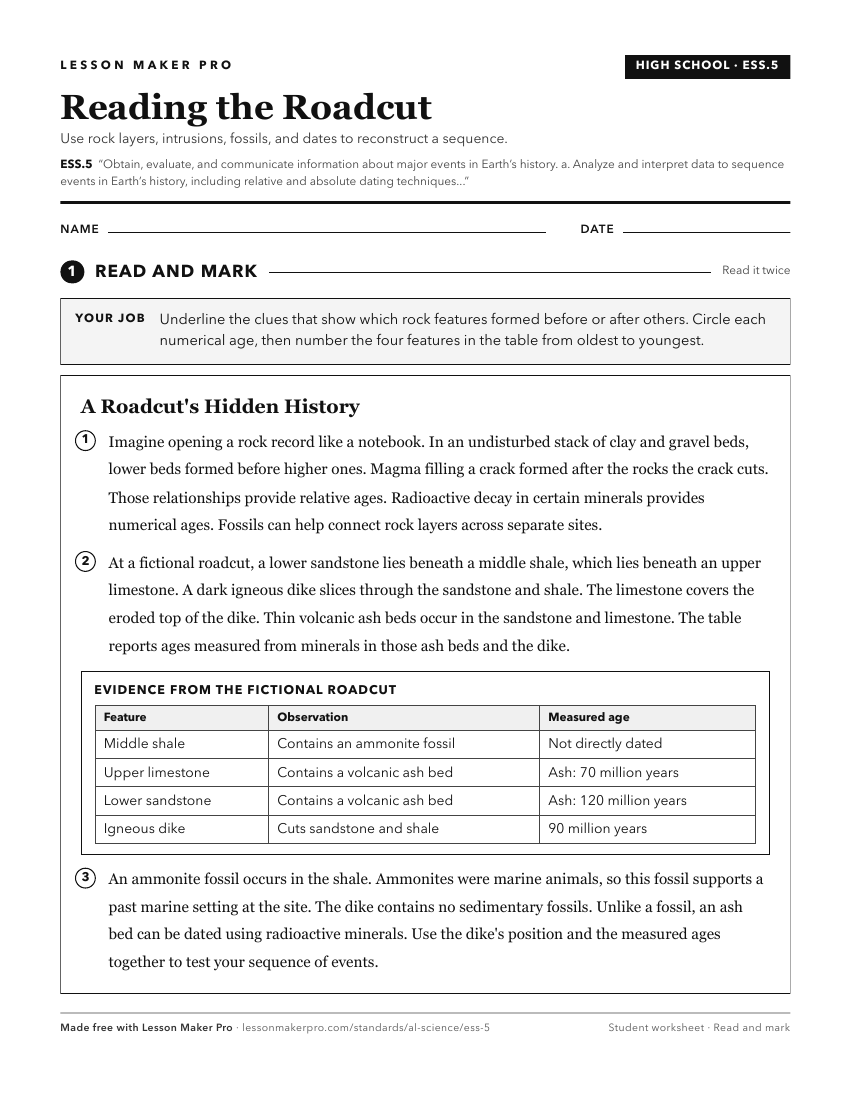
A ready-to-print activity worksheet aligned to ESS.5, with an answer key for the teacher on its own page. No account needed.
PDF, US Letter, prints cleanly in black and white.
Download the worksheetKeep exploring
Related Standards
- ESS.4
Obtain, evaluate, and communicate information about the geologic conditions and processes that form different Earth materials.
- 6.11
Obtain, evaluate, and communicate information concerning the relationships between human activities and natural processes and how those relationships affect Ear...
- 6.7
Analyze data from rock strata and the fossil record to construct a chronology of occurrences in Earth’s history.
Turn this cluster into a lesson
Grade, subject, topic, and the complete cluster are prefilled. Create one free, no account needed.
Also for this cluster:Make a WorksheetMake a QuizMake a Sub Lesson