Virginia SOL LS.3
SOL Standard (Key Ideas Cluster)
The student will investigate and understand that there are levels of structural organization in living things. Key ideas include patterns of cellular organization support life processes; unicellular and multicellular organisms have comparative structures; and similar characteristics determine the classification of organisms.
Virginia Standards of Learning for Science
Cluster contents
Key Ideas in This Standard
LS.3 is a Standards of Learning science standard. These are the key ideas and practices under it.
Teacher's field guide
What This Cluster Means
What Students Need to Do
- Students arrange cells, tissues, organs, organ systems, and organisms from simplest to most complex. They compare how single-celled and multicellular organisms carry out life functions. They group organisms using shared traits as evidence.
What Mastery Looks Like
- Students can identify each level in a diagram and explain how one level builds the next. They can compare structures in unicellular and multicellular organisms. They can classify an unfamiliar organism and defend the choice with observable traits.
Common Misconceptions
- Students may confuse tissues with organs or place organ systems before organs. They may think unicellular organisms have tissues and organs, or cannot perform all life functions. They may classify organisms by size or habitat instead of shared traits.
How to Assess It
- Exit ticket: Order cell, tissue, organ, organ system, and organism, then explain where an amoeba fits. Classify two pictured organisms using two shared traits.
Lesson moves
Ways to Teach It
Give groups labeled structure cards and yarn, then have them build and explain a cell-to-organism sequence.
Show yeast and human body diagrams, then ask, "How does each organism complete nutrition, waste removal, and reproduction?"
Play a mystery organism game using trait cards, and require teams to classify each organism with two pieces of evidence.
Trace how damage to heart muscle cells can affect heart tissue, the circulatory system, and the whole person.
Free download
Printable LS.3 Worksheet
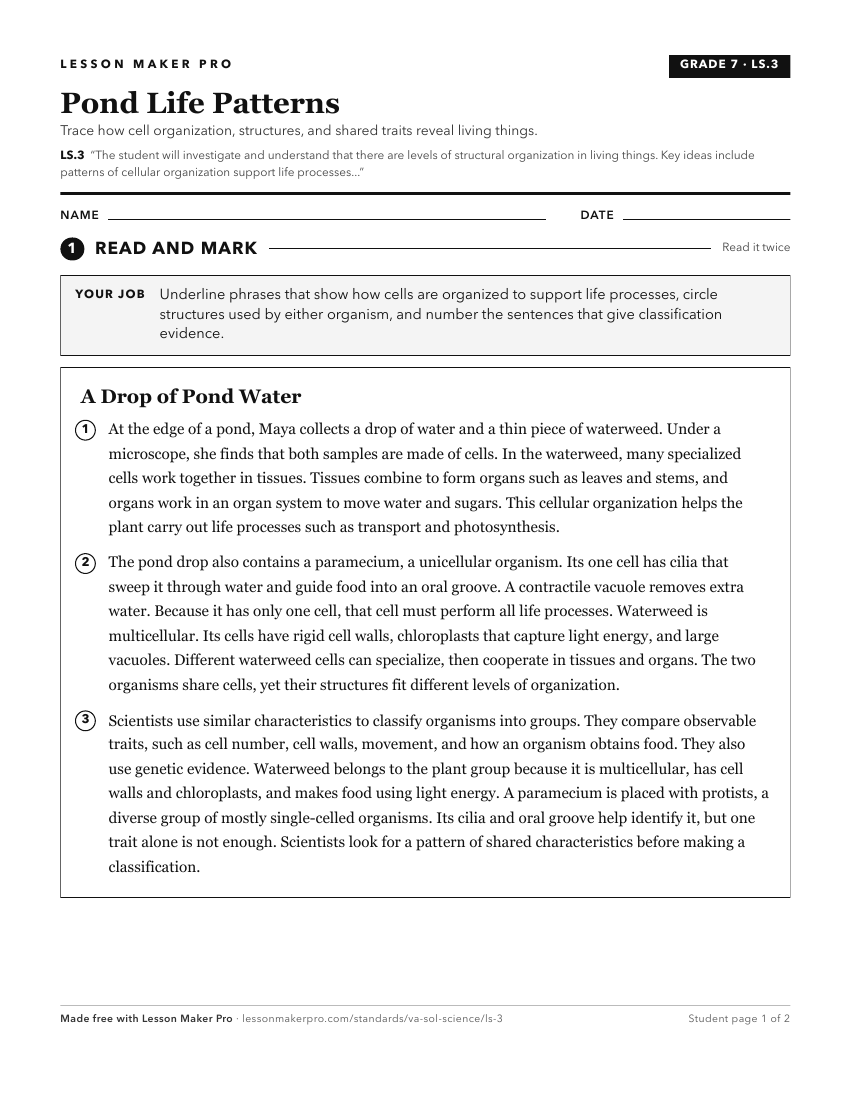
A ready-to-print activity worksheet aligned to LS.3, with an answer key for the teacher on its own page. No account needed.
PDF, US Letter, prints cleanly in black and white.
Download the worksheetKeep exploring
Related Standards
- 4.2
The student will investigate and understand that plants and animals have structures that distinguish them from one another and play vital roles in their ability...
- 2.5
The student will investigate and understand that living things are part of a system. Key ideas include
- K.6
The student will investigate and understand that there are differences between living organisms and nonliving objects. Key ideas include
- LS.2
The student will investigate and understand that all living things are composed of one or more cells that support life processes, as described by the cell theor...
Turn this cluster into a lesson
Grade, subject, topic, and the complete cluster are prefilled. Create one free, no account needed.
Also for this cluster:Make a WorksheetMake a QuizMake a Sub Lesson