Virginia SOL LS.3.a
The Standard
- LS.3
- The student will investigate and understand that there are levels of structural organization in living things. Key ideas include
patterns of cellular organization support life processes
Virginia Standards of Learning for Science · The student will investigate and understand that there are levels of structural organization in living things. Key ideas include
Teacher's field guide
What This Standard Means
What Students Need to Do
- Students compare how unicellular and multicellular organisms complete life processes. They connect specialized cells and larger body structures with jobs such as transport, digestion, and movement.
What Mastery Looks Like
- Given an organism or diagram, a student identifies its organization pattern and explains where life functions occur. They correctly trace a specialized cell through tissue, organ, organ system, and organism.
Common Misconceptions
- Students may think a unicellular organism cannot perform all life functions. They often reverse tissue and organ, treat cells as interchangeable, or assume larger organisms have larger cells.
How to Assess It
- Exit ticket: Compare an amoeba and a human in three sentences. State where each completes life functions and give one human cell-to-system example.
Lesson moves
Ways to Teach It
Give groups picture cards for muscle cell, muscle tissue, heart, circulatory system, and human, then have them build and justify the sequence.
Ask students to write: How can one amoeba cell survive alone while one human muscle cell cannot?
Play Organization Match: students pair structure cards with function cards, then challenge another pair to explain one match.
Trace oxygen delivery by linking red blood cells, blood, the heart, blood vessels, and the whole body on a whiteboard.
Free download
Printable LS.3.a Worksheet
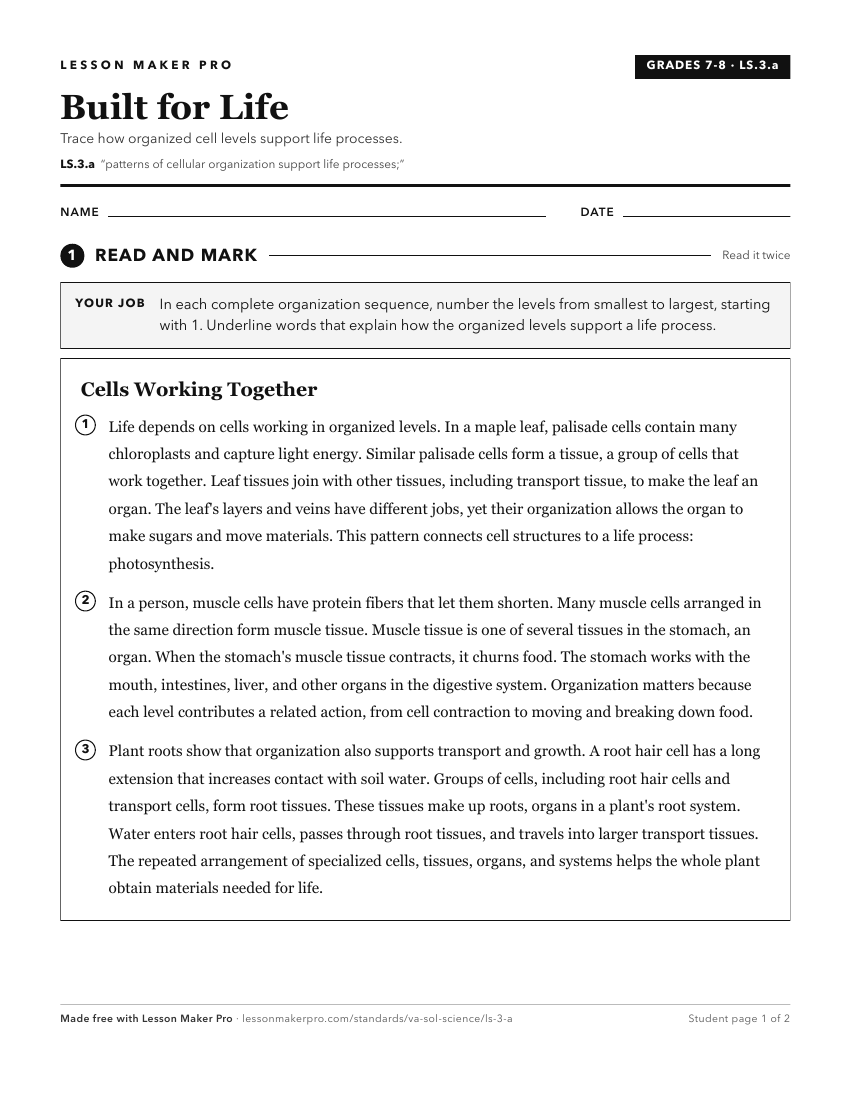
A ready-to-print activity worksheet aligned to LS.3.a, with an answer key for the teacher on its own page. No account needed.
PDF, US Letter, prints cleanly in black and white.
Download the worksheetKeep exploring
Related Standards
- LS.2.c
similarities and differences between plant and animal cells determine how they support life processes
- LS.4.b
photosynthesis and cellular respiration support life processes.
- LS.2.b
cell structure and organelles support life processes
- LS.2
The student will investigate and understand that all living things are composed of one or more cells that support life processes, as described by the cell theor...
Turn this exact standard into a lesson
Grade, subject, topic, and the complete standard are prefilled. Create one free, no account needed.
Also for this standard:Make a WorksheetMake a QuizMake a Sub Lesson