Virginia SOL LS.2
SOL Standard (Key Ideas Cluster)
The student will investigate and understand that all living things are composed of one or more cells that support life processes, as described by the cell theory. Key ideas include the development of the cell theory demonstrates the nature of science; cell structure and organelles support life processes; similarities and differences between plant and animal cells determine how they support life processes; cell division is the mechanism for growth and reproduction; and cellular transport (osmosis and diffusion) is important for life processes.
Virginia Standards of Learning for Science
Cluster contents
Key Ideas in This Standard
LS.2 is a Standards of Learning science standard. These are the key ideas and practices under it.
- LS.2.a
the development of the cell theory demonstrates the nature of science
- LS.2.b
cell structure and organelles support life processes
- LS.2.c
similarities and differences between plant and animal cells determine how they support life processes
- LS.2.d
cell division is the mechanism for growth and reproduction
- LS.2.e
cellular transport (osmosis and diffusion) is important for life processes.
Teacher's field guide
What This Cluster Means
What Students Need to Do
- Students explain how observations by several scientists built an evidence-based account of cells and their origins. They identify organelles and connect each structure to a job in plant or animal cells. They model cell division, diffusion, and osmosis to explain growth, reproduction, and movement across membranes.
What Mastery Looks Like
- A student can label an unfamiliar plant or animal cell and explain how its structures keep the cell alive. They can use evidence to explain cell theory, order basic stages of cell division, and predict particle or water movement across a membrane.
Common Misconceptions
- Students often treat cells as solid blobs, confuse the cell wall with the membrane, or assume every plant cell has visible chloroplasts. They may think diffusion requires cellular energy, osmosis moves solute, or growth happens because individual cells simply get larger. Some describe cell theory as one scientist's guess rather than an explanation built from repeated observations.
How to Assess It
- Use a five-part exit ticket: label three cell structures, name one plant and animal cell difference, state one cell theory claim, sequence cell division, and predict water movement when the solution outside a cell is saltier.
Lesson moves
Ways to Teach It
Students examine prepared onion and cheek cell slides, sketch what they see, and label the membrane, nucleus, cell wall, and cytoplasm.
Give groups evidence cards from Hooke, Leeuwenhoek, Schleiden, Schwann, and Virchow, then ask how new observations changed the cell theory.
Run a card sort matching organelles to functions, plant or animal cells, mitosis stages, and diffusion or osmosis examples.
Ask students to explain why salted vegetables lose water and connect the change to water movement across cell membranes.
Free download
Printable LS.2 Worksheet
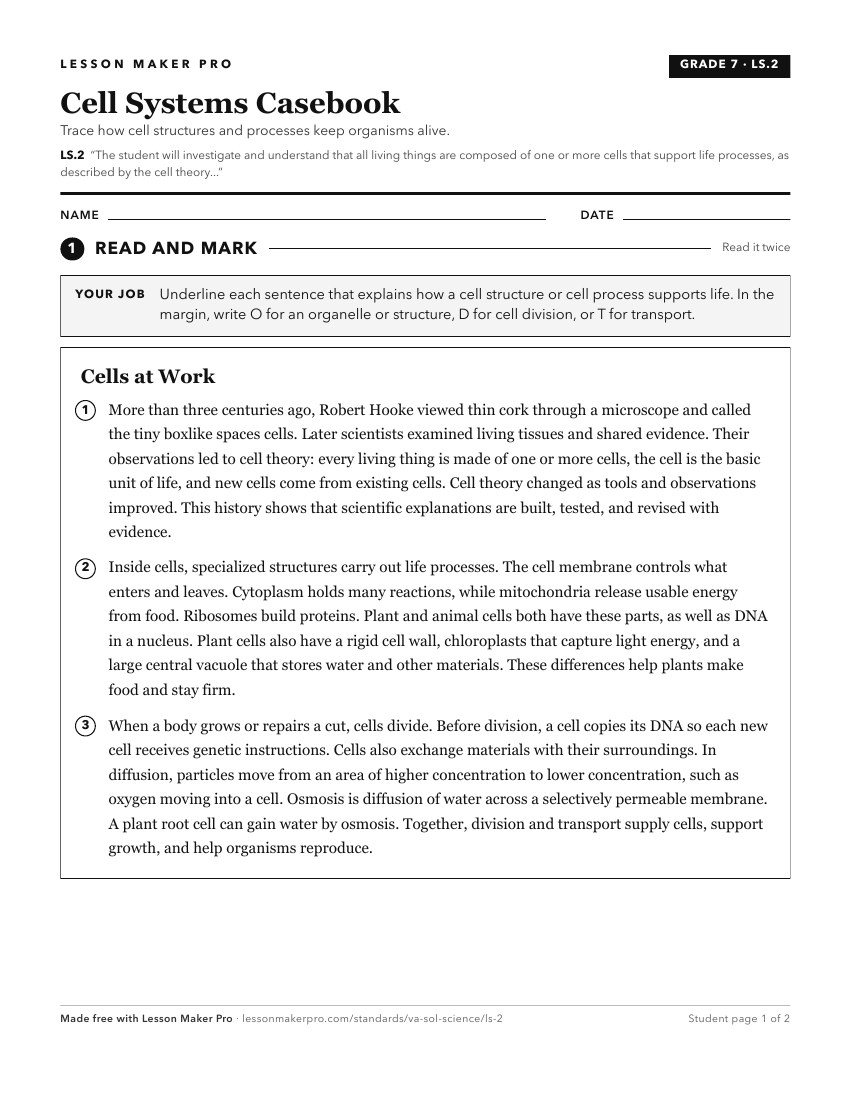
A ready-to-print activity worksheet aligned to LS.2, with an answer key for the teacher on its own page. No account needed.
PDF, US Letter, prints cleanly in black and white.
Download the worksheetKeep exploring
Related Standards
- 4.2
The student will investigate and understand that plants and animals have structures that distinguish them from one another and play vital roles in their ability...
- 2.5
The student will investigate and understand that living things are part of a system. Key ideas include
- K.7
The student will investigate and understand that plants and animals have basic needs and life processes. Key ideas include
- LS.3
The student will investigate and understand that there are levels of structural organization in living things. Key ideas include
Turn this cluster into a lesson
Grade, subject, topic, and the complete cluster are prefilled. Create one free, no account needed.
Also for this cluster:Make a WorksheetMake a QuizMake a Sub Lesson