Virginia SOL LS.2.e
The Standard
- LS.2
- The student will investigate and understand that all living things are composed of one or more cells that support life processes, as described by the cell theory. Key ideas include
cellular transport (osmosis and diffusion) is important for life processes.
Virginia Standards of Learning for Science · The student will investigate and understand that all living things are composed of one or more cells that support life processes, as described by the cell theory. Key ideas include
Teacher's field guide
What This Standard Means
What Students Need to Do
- Students predict how water and other particles move across a cell membrane based on concentration differences. They distinguish diffusion from osmosis and connect transport to cell survival.
What Mastery Looks Like
- Given a diagram or data table, students identify what moves, its direction, and the transport process involved. They explain that particles continue moving at equilibrium, with no net change.
Common Misconceptions
- Students may think osmosis moves solute rather than water, or that particles move from low to high concentration. They may also think movement stops completely at equilibrium.
How to Assess It
- Ask: “A cell containing 10 percent solute is placed in a 2 percent solute solution. Which way will water move, and why?”
Lesson moves
Ways to Teach It
Place equal potato pieces in distilled water and saltwater, then measure and compare their mass changes after 30 minutes.
Have students explain why wilted lettuce becomes crisp after soaking in water, using concentration and water movement.
Give groups particle diagrams to sort as diffusion, osmosis, or neither, then require one sentence of evidence for each choice.
Compare diagrams of red blood cells in distilled water and saline, then predict why hospitals use saline for intravenous fluids.
Free download
Printable LS.2.e Worksheet
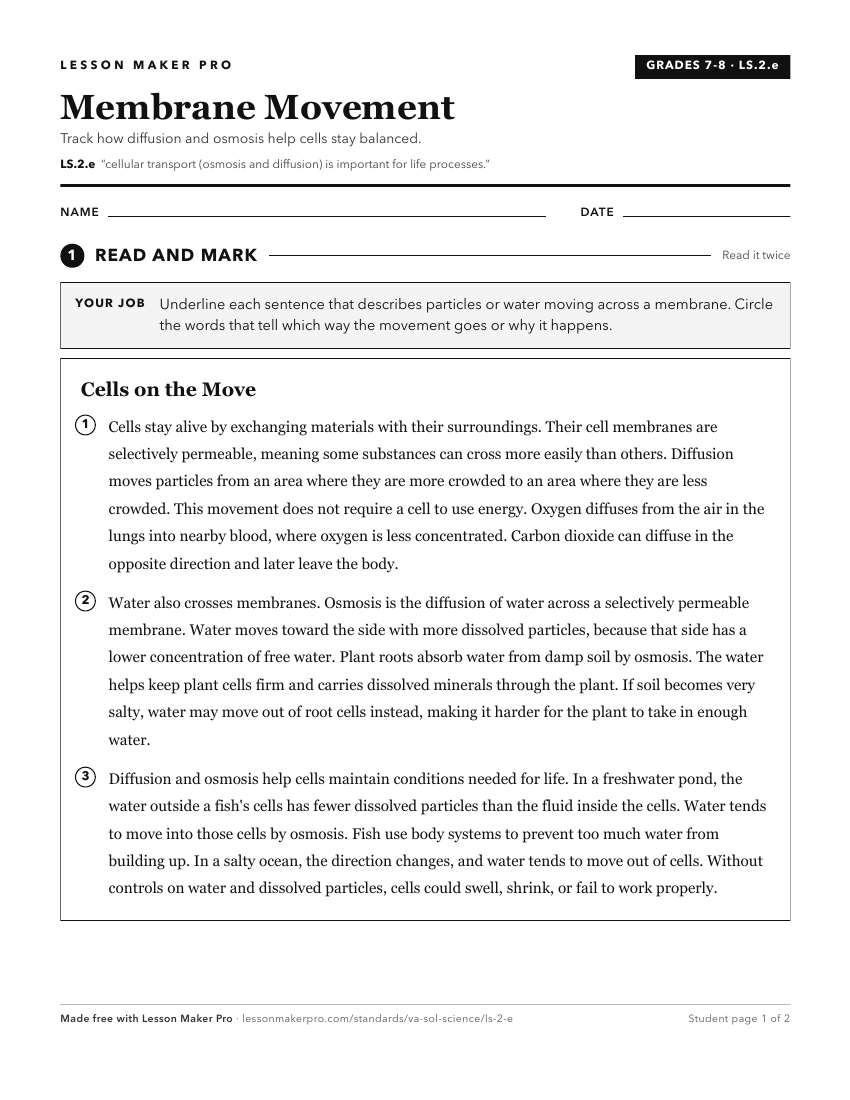
A ready-to-print activity worksheet aligned to LS.2.e, with an answer key for the teacher on its own page. No account needed.
PDF, US Letter, prints cleanly in black and white.
Download the worksheetKeep exploring
Related Standards
- LS.3.a
patterns of cellular organization support life processes
- LS.4
The student will investigate and understand that there are chemical processes of energy transfer which are important for life. Key ideas include
- LS.4.b
photosynthesis and cellular respiration support life processes.
- LS.2.b
cell structure and organelles support life processes
Turn this exact standard into a lesson
Grade, subject, topic, and the complete standard are prefilled. Create one free, no account needed.
Also for this standard:Make a WorksheetMake a QuizMake a Sub Lesson