Virginia SOL 6.5
SOL Standard (Key Ideas Cluster)
The student will investigate and understand that all matter is composed of atoms. Key ideas include atoms consist of particles, including electrons, protons, and neutrons; atoms of a particular element are similar but differ from atoms of other elements; elements may be represented by chemical symbols; two or more atoms interact to form new substances, which are held together by electrical forces (bonds); compounds may be represented by chemical formulas; chemical equations can be used to model chemical changes; and a few elements comprise the largest portion of the solid Earth, living matter, the oceans, and the atmosphere.
Virginia Standards of Learning for Science
Cluster contents
Key Ideas in This Standard
6.5 is a Standards of Learning science standard. These are the key ideas and practices under it.
- 6.5.a
atoms consist of particles, including electrons, protons, and neutrons
- 6.5.b
atoms of a particular element are similar but differ from atoms of other elements
- 6.5.c
elements may be represented by chemical symbols
- 6.5.d
two or more atoms interact to form new substances, which are held together by electrical forces (bonds)
- 6.5.e
compounds may be represented by chemical formulas
- 6.5.f
chemical equations can be used to model chemical changes
- 6.5.g
a few elements comprise the largest portion of the solid Earth, living matter, the oceans, and the atmosphere.
Teacher's field guide
What This Cluster Means
What Students Need to Do
- Students identify protons, neutrons, and electrons in an atom and compare atoms of different elements. They read chemical symbols and formulas, model how atoms bond, and use equations to show atoms rearranging. They also compare which elements are common in Earth, living things, oceans, and air.
What Mastery Looks Like
- Students can label an atom model and explain that proton number identifies the element. They can interpret a formula such as H2O and count atoms on both sides of a simple chemical equation. They can name common elements found in major Earth systems.
Common Misconceptions
- Students may place electrons in the nucleus or think neutrons have a negative charge. They may confuse an element symbol with a compound formula or treat a subscript as a coefficient. Some think chemical reactions create new atoms rather than rearrange existing ones.
How to Assess It
- Give students the equation 2H2 + O2 → 2H2O. Ask them to count each type of atom before and after, identify the elements, and explain what changed.
Lesson moves
Ways to Teach It
Build carbon dioxide and water molecules with colored clay and toothpicks, then count each element and compare the formulas.
Write a claim explaining how atoms can form a new substance without becoming different kinds of atoms.
Play formula match with cards showing names, particle models, symbols, and formulas, earning a point for each correct set.
Use composition charts for air, ocean water, rock, and the human body to identify the most abundant elements in each.
Free download
Printable 6.5 Worksheet
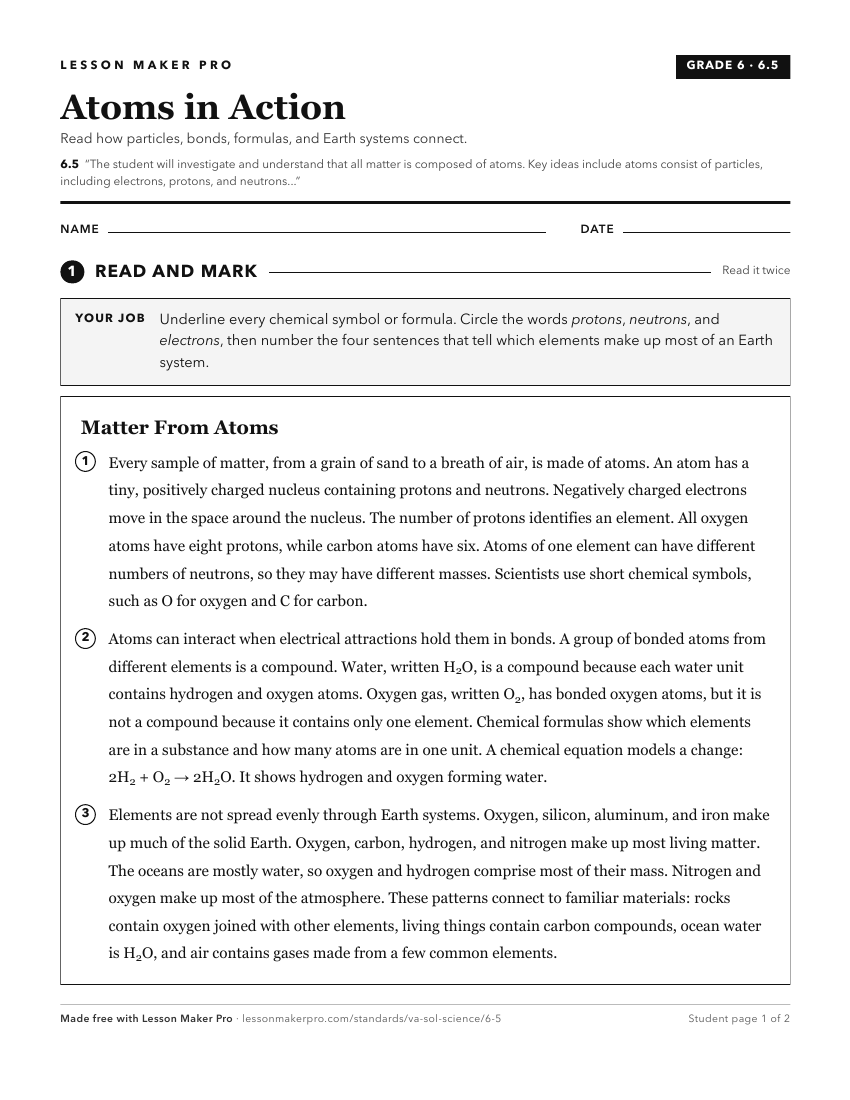
A ready-to-print activity worksheet aligned to 6.5, with an answer key for the teacher on its own page. No account needed.
PDF, US Letter, prints cleanly in black and white.
Download the worksheetKeep exploring
Related Standards
- PS.2
The student will investigate and understand that matter is composed of atoms. Key ideas include
- 5.7.a
matter is composed of atoms
- 5.7
The student will investigate and understand that matter has properties and interactions. Key ideas include
- PS.3
The student will investigate and understand that matter has properties and is conserved in chemical and physical processes. Key ideas include
Turn this cluster into a lesson
Grade, subject, topic, and the complete cluster are prefilled. Create one free, no account needed.
Also for this cluster:Make a WorksheetMake a QuizMake a Sub Lesson