Virginia SOL 5.7.a
The Standard
- 5.7
- The student will investigate and understand that matter has properties and interactions. Key ideas include
matter is composed of atoms
Virginia Standards of Learning for Science
Teacher's field guide
What This Standard Means
What Students Need to Do
- Students explain that every solid, liquid, and gas consists of tiny particles called atoms. They use simple models to show that objects contain many atoms, even though individual atoms cannot be seen with classroom tools.
What Mastery Looks Like
- A student can name air, water, and a desk as matter and explain that each is built from atoms. Given a particle diagram, the student identifies each circle as a model of an atom.
Common Misconceptions
- Students may think only solids are matter, or that atoms exist only in living things. They may treat model balls as actual-size atoms or think atoms can be seen with a classroom microscope.
How to Assess It
- Exit ticket: Draw a model showing what a tiny piece of chalk is made of, then complete, "Chalk is matter because ____."
Lesson moves
Ways to Teach It
Give pairs 30 beads and clay; have them build a model object, label each bead as an atom, and note the model's limits.
Display a rock, cup of water, and inflated balloon; ask, "How are these alike when their appearances differ?"
Play Matter Match with cards showing air, milk, wood, light, and sound; students match matter cards to an atom-model card.
Have students examine a pencil mark with a hand lens, then explain why unseen atoms are still present in the graphite.
Free download
Printable 5.7.a Worksheet
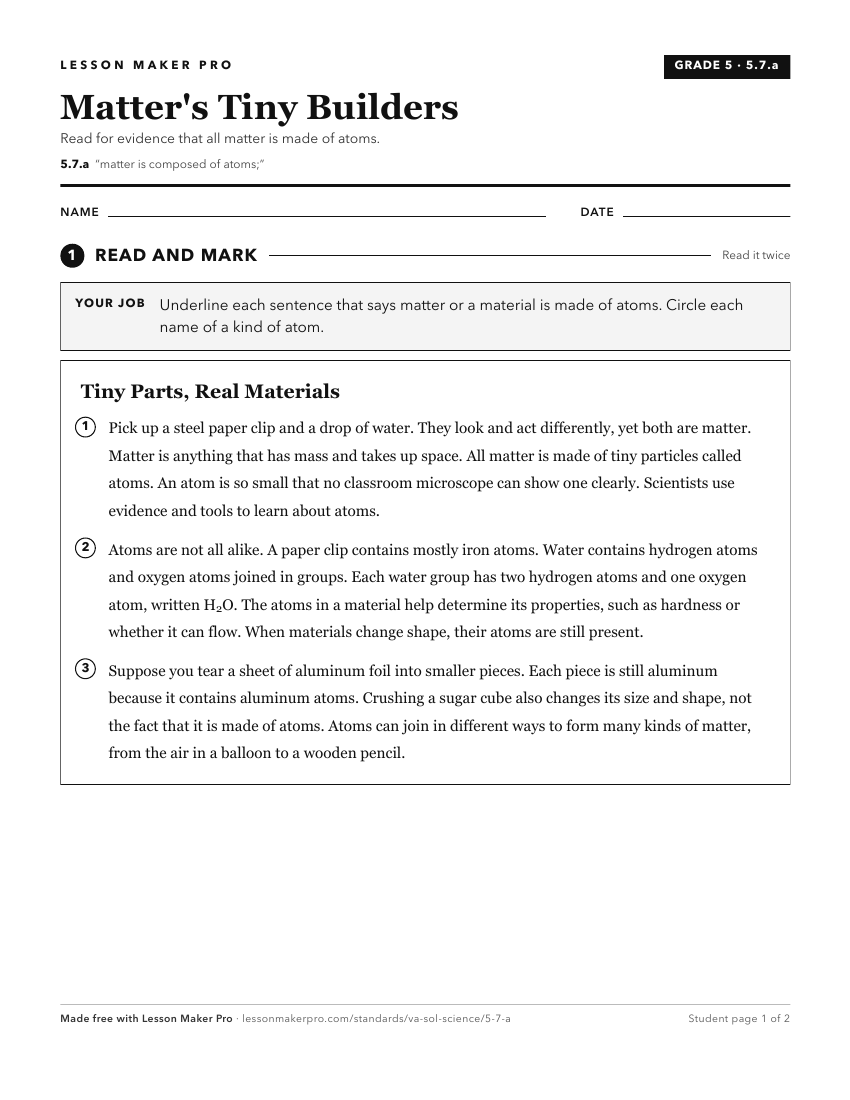
A ready-to-print activity worksheet aligned to 5.7.a, with an answer key for the teacher on its own page. No account needed.
PDF, US Letter, prints cleanly in black and white.
Download the worksheetKeep exploring
Related Standards
- 6.5.a
atoms consist of particles, including electrons, protons, and neutrons
- PS.2
The student will investigate and understand that matter is composed of atoms. Key ideas include
- 6.5
The student will investigate and understand that all matter is composed of atoms. Key ideas include
- 2.3.a
matter has mass and takes up space
Turn this exact standard into a lesson
Grade, subject, topic, and the complete standard are prefilled. Create one free, no account needed.
Also for this standard:Make a WorksheetMake a QuizMake a Sub Lesson