Virginia SOL 6.5.a
The Standard
- 6.5
- The student will investigate and understand that all matter is composed of atoms. Key ideas include
atoms consist of particles, including electrons, protons, and neutrons
Virginia Standards of Learning for Science
Teacher's field guide
What This Standard Means
What Students Need to Do
- Students identify protons, neutrons, and electrons as parts of an atom. They describe each particle’s charge and its location in the nucleus or electron cloud.
What Mastery Looks Like
- A student can label the three particles on an atom model. They correctly place protons and neutrons in the nucleus and electrons outside it.
Common Misconceptions
- Students may place electrons inside the nucleus or think neutrons have a negative charge. Some think an atom is a single solid piece with no smaller particles.
How to Assess It
- Give students a blank atom diagram. Ask them to label each particle, mark its charge, and circle the particles found in the nucleus.
Lesson moves
Ways to Teach It
Have pairs build an atom with colored beads for protons and neutrons, then place paper electrons around the nucleus.
Ask students to write: How are protons, neutrons, and electrons different in charge and location?
Play a particle sorting game using cards labeled with names, charges, and locations, then have teams match each set.
Show graphite from a pencil and explain that its carbon atoms contain the same three particle types students modeled.
Free download
Printable 6.5.a Worksheet
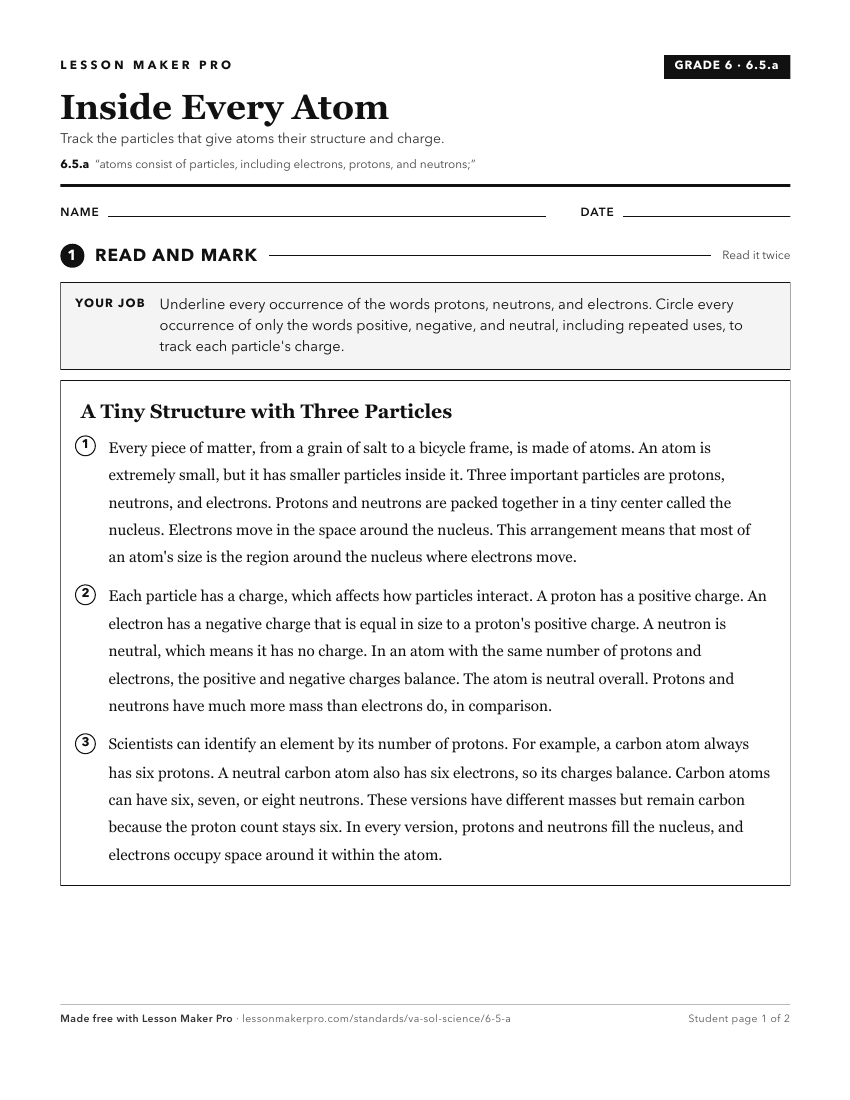
A ready-to-print activity worksheet aligned to 6.5.a, with an answer key for the teacher on its own page. No account needed.
PDF, US Letter, prints cleanly in black and white.
Download the worksheetKeep exploring
Related Standards
- 6.5.b
atoms of a particular element are similar but differ from atoms of other elements
- PS.2
The student will investigate and understand that matter is composed of atoms. Key ideas include
- 5.7.a
matter is composed of atoms
- 6.5
The student will investigate and understand that all matter is composed of atoms. Key ideas include
Turn this exact standard into a lesson
Grade, subject, topic, and the complete standard are prefilled. Create one free, no account needed.
Also for this standard:Make a WorksheetMake a QuizMake a Sub Lesson