Virginia SOL PS.3
SOL Standard (Key Ideas Cluster)
The student will investigate and understand that matter has properties and is conserved in chemical and physical processes. Key ideas include pure substances can be identified based on their chemical and physical properties; pure substances can undergo physical and chemical changes that may result in a change of properties; compounds form through ionic and covalent bonding; and balanced chemical equations model the conservation of matter.
Virginia Standards of Learning for Science
Cluster contents
Key Ideas in This Standard
PS.3 is a Standards of Learning science standard. These are the key ideas and practices under it.
- PS.3.a
pure substances can be identified based on their chemical and physical properties
- PS.3.b
pure substances can undergo physical and chemical changes that may result in a change of properties
- PS.3.c
compounds form through ionic and covalent bonding
- PS.3.d
balanced chemical equations model the conservation of matter.
Teacher's field guide
What This Cluster Means
What Students Need to Do
- Students identify pure substances using properties such as density, melting point, solubility, and conductivity. They distinguish physical changes from chemical changes and compare properties before and after a change. They explain ionic and covalent bonding, then balance equations to show that atoms are conserved.
What Mastery Looks Like
- Given property data, students can identify an unknown pure substance and justify the match. They can classify observed changes, predict a likely bond type, and balance simple equations by counting atoms of each element.
Common Misconceptions
- Students may assume any color or state change proves that a new substance formed. They may think matter disappears when gas escapes from an open container. They often change subscripts instead of coefficients when balancing equations or confuse electron transfer with electron sharing.
How to Assess It
- Exit ticket: A metal and chlorine gas form solid sodium chloride. Classify the change, identify the bond type, balance Na + Cl2 → NaCl, and explain how the equation shows conservation.
Lesson moves
Ways to Teach It
Measure the mass of vinegar and baking soda in a sealed bag before and after mixing, then compare observations and mass.
Ask students to explain how melting ice and rusting iron differ, using evidence about whether a new substance forms.
Run a card sort matching unknown pure substances to density, melting point, solubility, and conductivity data.
Examine a road salt label and connect ionic bonding to crystal structure, dissolving, and electrical conductivity in solution.
Free download
Printable PS.3 Worksheet
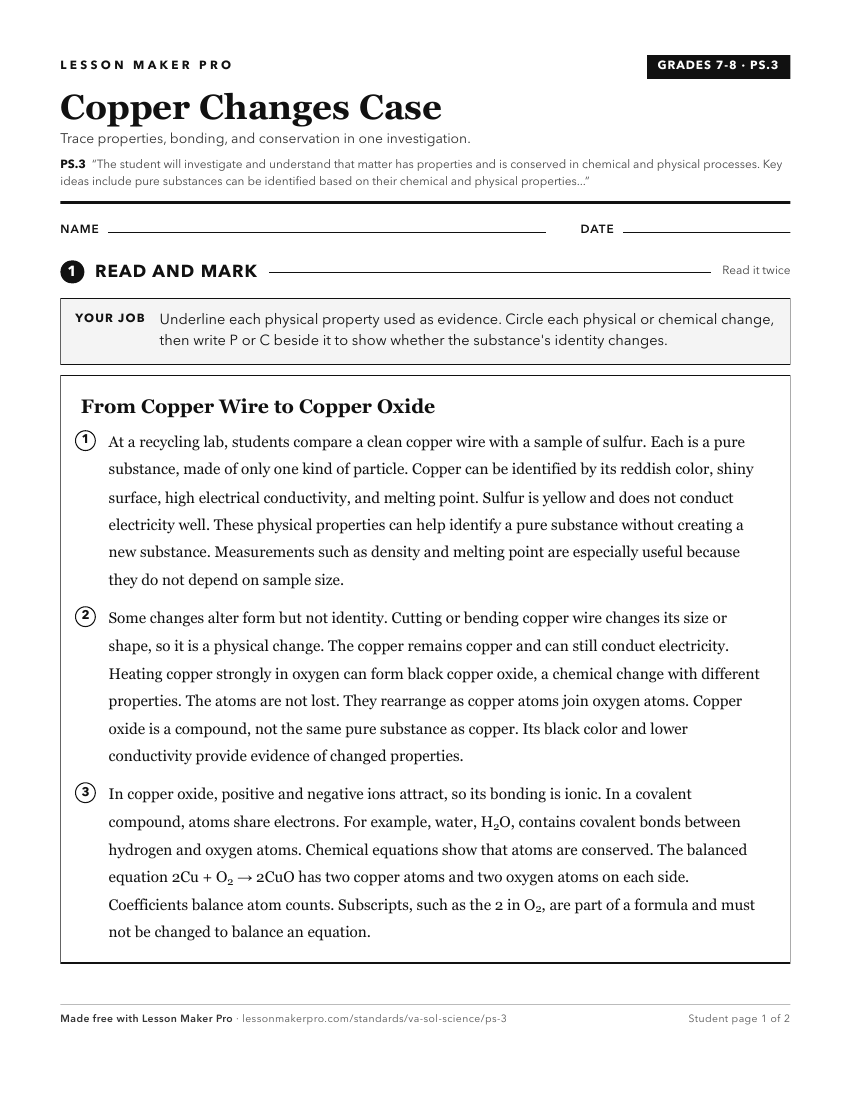
A ready-to-print activity worksheet aligned to PS.3, with an answer key for the teacher on its own page. No account needed.
PDF, US Letter, prints cleanly in black and white.
Download the worksheetKeep exploring
Related Standards
- 1.3
The student will investigate and understand that objects are made from materials that can be described by their physical properties. Key ideas include
- PS.5
The student will investigate and understand that energy is conserved. Key ideas include
- 5.7
The student will investigate and understand that matter has properties and interactions. Key ideas include
- 2.3
The student will investigate and understand that matter can exist in different phases. Key ideas include
Turn this cluster into a lesson
Grade, subject, topic, and the complete cluster are prefilled. Create one free, no account needed.
Also for this cluster:Make a WorksheetMake a QuizMake a Sub Lesson