Virginia SOL PS.3.c
The Standard
- PS.3
- The student will investigate and understand that matter has properties and is conserved in chemical and physical processes. Key ideas include
compounds form through ionic and covalent bonding
Virginia Standards of Learning for Science · The student will investigate and understand that matter has properties and is conserved in chemical and physical processes. Key ideas include
Teacher's field guide
What This Standard Means
What Students Need to Do
- Students use valence electrons to explain how atoms join. They distinguish electron transfer and attraction between ions from electron sharing between atoms.
What Mastery Looks Like
- Given two elements, students predict the likely bond type and support the choice with a Lewis dot model. They explain how the resulting particles form a compound.
Common Misconceptions
- Students may reverse transfer and sharing or think ionic bonds form between any two atoms. They may also think covalent compounds contain charged particles or that bonded atoms keep their original properties.
How to Assess It
- Give students NaCl and H2O. Ask them to name each bond type, draw the valence electrons, and explain what happens to the electrons.
Lesson moves
Ways to Teach It
Build models of NaCl and H2O with atom cards and counters, moving valence electrons to show transfer or sharing.
Ask, “Why does sodium chloride form ions, while water forms molecules?” Require a claim supported by each atom’s valence electrons.
Run a card sort with element pairs, Lewis dot diagrams, formulas, and bond types, then have groups justify every match.
Compare table salt, water, and carbon dioxide on product labels, then connect each substance’s elements to its likely bonding.
Free download
Printable PS.3.c Worksheet
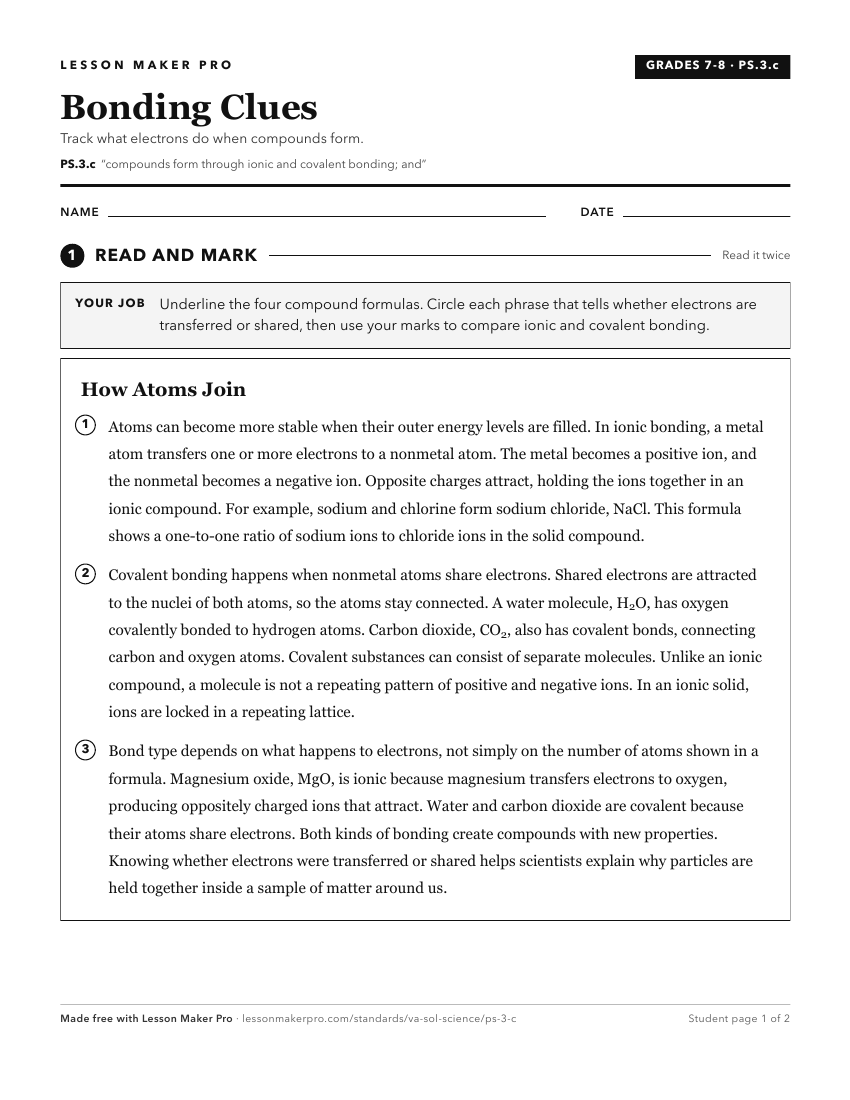
A ready-to-print activity worksheet aligned to PS.3.c, with an answer key for the teacher on its own page. No account needed.
PDF, US Letter, prints cleanly in black and white.
Download the worksheetKeep exploring
Related Standards
Turn this exact standard into a lesson
Grade, subject, topic, and the complete standard are prefilled. Create one free, no account needed.
Also for this standard:Make a WorksheetMake a QuizMake a Sub Lesson