Virginia SOL 5.3
SOL Standard (Key Ideas Cluster)
The student will investigate and understand that there is a relationship between force and energy of moving objects. Key ideas include moving objects have kinetic energy; motion is described by an object’s direction and speed; changes in motion are related to net force and mass; when objects collide, the contact forces transfer energy and can change objects’ motion; and friction is a force that opposes motion.
Virginia Standards of Learning for Science
Cluster contents
Key Ideas in This Standard
5.3 is a Standards of Learning science standard. These are the key ideas and practices under it.
Teacher's field guide
What This Cluster Means
What Students Need to Do
- Students describe a moving object’s speed and direction and identify its kinetic energy. They predict how net force, mass, friction, and collisions change motion. They use observations and measurements to explain those changes.
What Mastery Looks Like
- Given carts, balls, or diagrams, students compare speed and direction before and after a push or collision. They explain that greater net force causes more change in motion, while greater mass causes less change. They identify friction as opposing motion and describe energy transfer during contact.
Common Misconceptions
- Students may think motion requires a continuing force or that friction always stops an object immediately. They may confuse speed with direction, assume heavier objects always move faster, or treat force and energy as the same thing. They may also miss that balanced forces do not change motion.
How to Assess It
- Exit ticket: A light cart and a heavy cart receive equal pushes across the same rough floor. Predict which cart changes speed more, then explain the roles of mass, net force, friction, and kinetic energy.
Lesson moves
Ways to Teach It
Roll toy cars down the same ramp onto carpet and tile, then measure stopping distance and explain how friction changes motion.
Show two balls colliding and ask students to write how each ball’s speed, direction, and kinetic energy changed.
Play Net Force Match: students pair force-arrow cards with motion-change cards, then justify whether forces are balanced or unbalanced.
Use a bicycle-braking photo to label motion, brake friction, contact forces, and the bicycle’s change in kinetic energy.
Free download
Printable 5.3 Worksheet
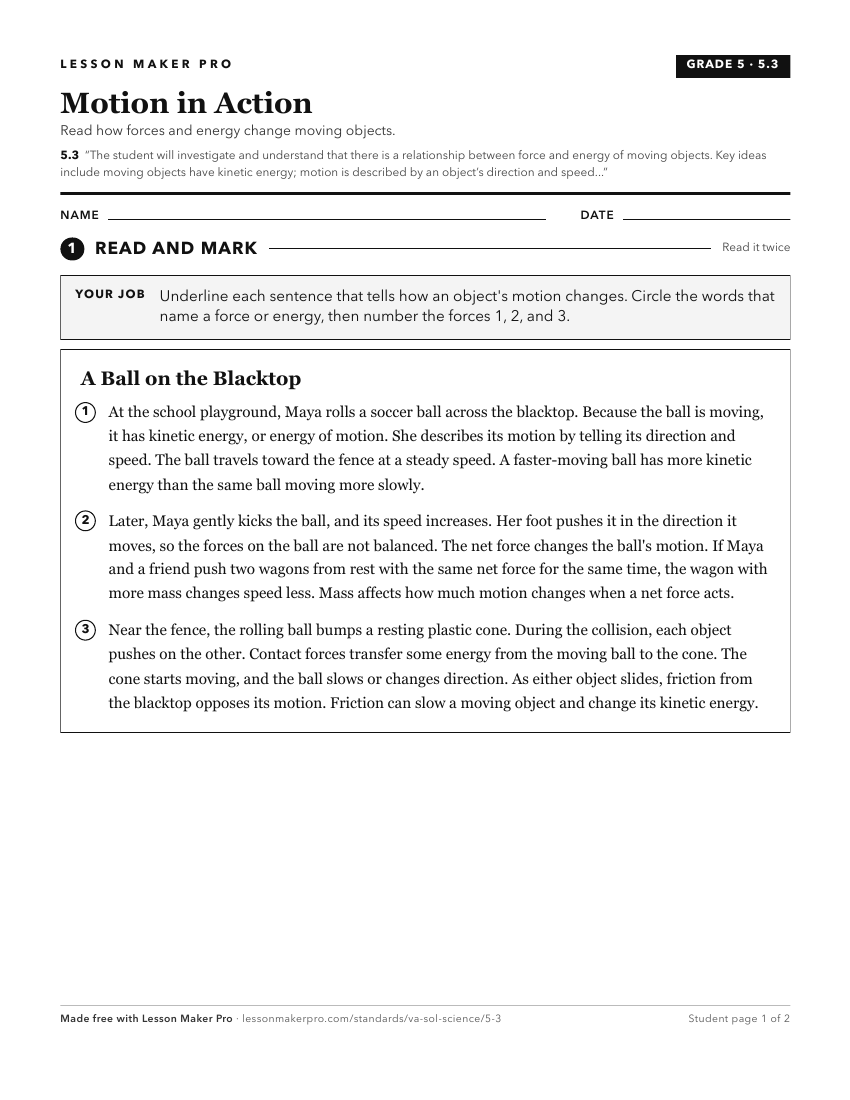
A ready-to-print activity worksheet aligned to 5.3, with an answer key for the teacher on its own page. No account needed.
PDF, US Letter, prints cleanly in black and white.
Download the worksheetKeep exploring
Related Standards
- 3.2
The student will investigate and understand that the direction and size of force affects the motion of an object. Key ideas include
- PS.8
The student will investigate and understand that work, force, and motion are related. Key ideas include
- K.2
The student will investigate and understand that pushes and pulls affect the motion of objects. Key ideas include
- 2.2
The student will investigate and understand that different types of forces may cause an object's motion to change. Key ideas include
Turn this cluster into a lesson
Grade, subject, topic, and the complete cluster are prefilled. Create one free, no account needed.
Also for this cluster:Make a WorksheetMake a QuizMake a Sub Lesson