Virginia SOL 5.3.b
The Standard
- 5.3
- The student will investigate and understand that there is a relationship between force and energy of moving objects. Key ideas include
motion is described by an object’s direction and speed
Virginia Standards of Learning for Science
Teacher's field guide
What This Standard Means
What Students Need to Do
- Students track an object's change in position over a measured time. They use arrows or compass words for its path and compare rates using distance and time.
What Mastery Looks Like
- A student can report that a car traveled east at 2 meters per second, rather than saying only that it moved quickly. The student can compare two motions and identify a change in rate, direction, or both.
Common Misconceptions
- Students may treat fast and slow as complete descriptions without measurements. They may confuse the way an object points with the way it moves, such as a car facing east while rolling west. Some think a turn automatically changes speed.
How to Assess It
- Give this exit ticket: Car A travels 6 meters east in 3 seconds, and Car B travels 6 meters west in 2 seconds. Describe each car's motion and identify the faster car.
Lesson moves
Ways to Teach It
Roll toy cars down ramps, measure distance traveled in five seconds, and label each car's direction with compass cards.
Show a cyclist turning north while slowing down, then ask, "What changed about the motion, and what evidence supports your answer?"
Play Motion Match with cards showing arrows and speeds, then have students pair each card with the matching movement description.
Use a school bus route map and travel times to compare each segment's direction and average speed.
Free download
Printable 5.3.b Worksheet
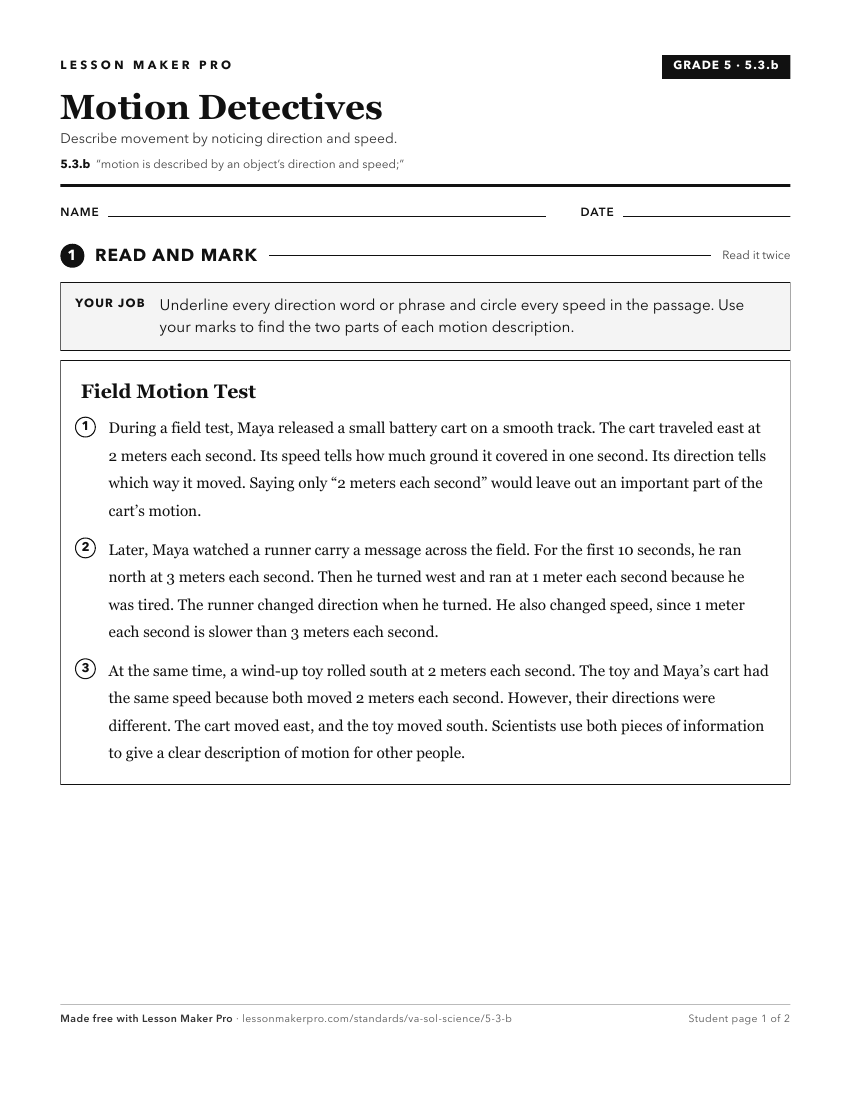
A ready-to-print activity worksheet aligned to 5.3.b, with an answer key for the teacher on its own page. No account needed.
PDF, US Letter, prints cleanly in black and white.
Download the worksheetKeep exploring
Related Standards
Turn this exact standard into a lesson
Grade, subject, topic, and the complete standard are prefilled. Create one free, no account needed.
Also for this standard:Make a WorksheetMake a QuizMake a Sub Lesson