Virginia SOL 5.3.a
The Standard
- 5.3
- The student will investigate and understand that there is a relationship between force and energy of moving objects. Key ideas include
moving objects have kinetic energy
Virginia Standards of Learning for Science
Teacher's field guide
What This Standard Means
What Students Need to Do
- Students identify which objects have kinetic energy by observing whether they are moving. They explain that even a slowly moving object has energy of motion.
What Mastery Looks Like
- A student correctly sorts moving and stationary objects based on whether they have kinetic energy. The student uses visible motion as evidence.
Common Misconceptions
- Students may think only fast objects have kinetic energy. They may also think a stationary object has kinetic energy because it could move later.
How to Assess It
- Show a rolling ball, a parked toy car, and a spinning top. Ask students which have kinetic energy and how they know.
Lesson moves
Ways to Teach It
Release toy cars down a ramp, then have students identify when each car has kinetic energy.
Ask students to write: How can you prove that a rolling marble has kinetic energy?
Play Motion Sort with picture cards, placing each object under kinetic energy or no kinetic energy.
Observe playground objects, such as swings and balls, and list when each object has kinetic energy.
Free download
Printable 5.3.a Worksheet
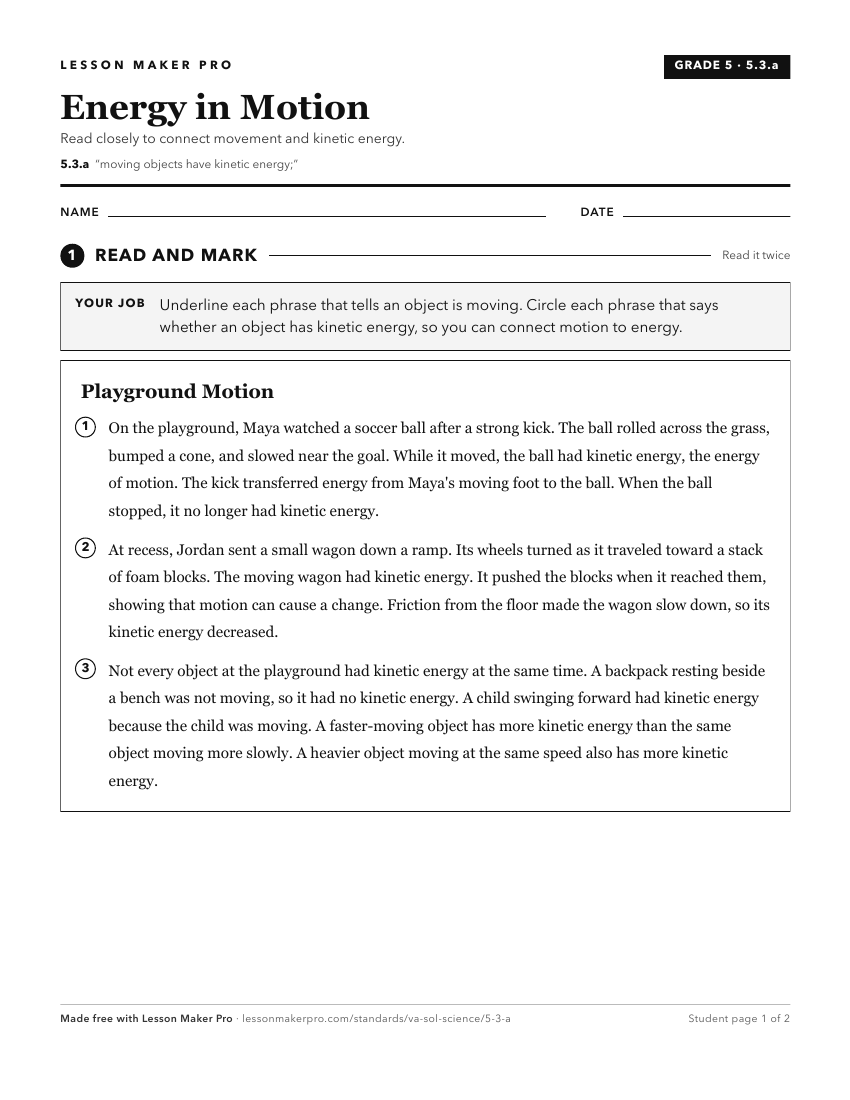
A ready-to-print activity worksheet aligned to 5.3.a, with an answer key for the teacher on its own page. No account needed.
PDF, US Letter, prints cleanly in black and white.
Download the worksheetKeep exploring
Related Standards
- 5.3.b
motion is described by an object's direction and speed
- 5.3.d
when objects collide, the contact forces transfer energy and can change objects' motion
- 5.3
The student will investigate and understand that there is a relationship between force and energy of moving objects. Key ideas include
- 3.2.a
multiple forces may act on an object
Turn this exact standard into a lesson
Grade, subject, topic, and the complete standard are prefilled. Create one free, no account needed.
Also for this standard:Make a WorksheetMake a QuizMake a Sub Lesson