Virginia SOL 5.3.d
The Standard
- 5.3
- The student will investigate and understand that there is a relationship between force and energy of moving objects. Key ideas include
when objects collide, the contact forces transfer energy and can change objects’ motion
Virginia Standards of Learning for Science
Teacher's field guide
What This Standard Means
What Students Need to Do
- Students observe collisions and describe how each object's motion changes. They explain that contact forces transfer energy, causing changes in speed, direction, or movement.
What Mastery Looks Like
- A student can compare an object's motion before and after a collision. The student uses observations or measurements to explain where energy was transferred and how motion changed.
Common Misconceptions
- Students may think only the moving object experiences a force. They may think energy disappears when an object stops, or that every collision makes objects move faster.
How to Assess It
- Give students this prompt: A rolling marble hits a resting marble, then slows down while the second marble moves. Explain the energy transfer and both motion changes.
Lesson moves
Ways to Teach It
Roll one marble down a ruler ramp into another, then mark and compare both marbles' positions before and after each collision.
Ask students to write: How can one moving object make a resting object move without continuing to push it?
Play Collision Sort using picture cards, grouping outcomes as speeding up, slowing down, stopping, or changing direction.
Show a slow-motion soccer collision and have students label the contact point, energy transfer, and motion changes.
Free download
Printable 5.3.d Worksheet
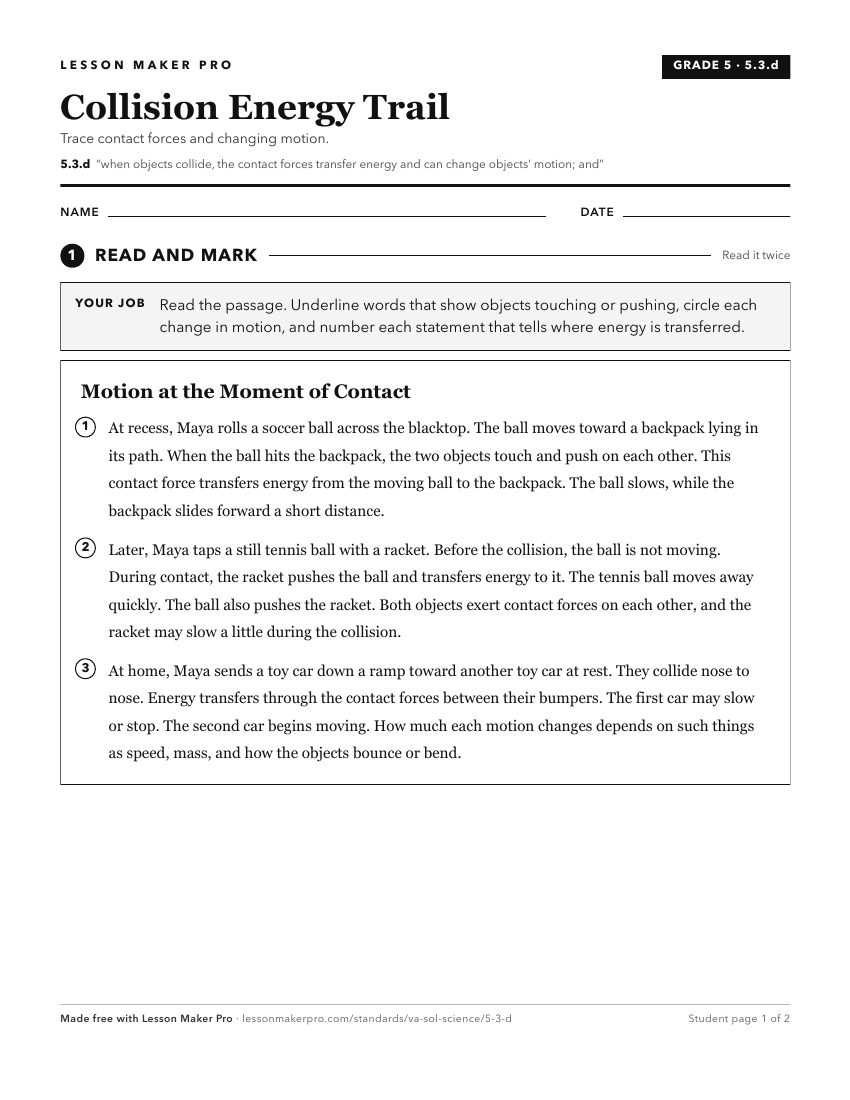
A ready-to-print activity worksheet aligned to 5.3.d, with an answer key for the teacher on its own page. No account needed.
PDF, US Letter, prints cleanly in black and white.
Download the worksheetKeep exploring
Related Standards
Turn this exact standard into a lesson
Grade, subject, topic, and the complete standard are prefilled. Create one free, no account needed.
Also for this standard:Make a WorksheetMake a QuizMake a Sub Lesson