Virginia SOL 2.2.a
The Standard
- 2.2
- The student will investigate and understand that different types of forces may cause an object's motion to change. Key ideas include
forces from direct contact can cause an object to move
Virginia Standards of Learning for Science
Teacher's field guide
What This Standard Means
What Students Need to Do
- Students push or pull objects and observe when motion begins. They identify what touched the object and describe how the contact made it move.
What Mastery Looks Like
- Students can use a hand or another object to make a toy move. They can name the contact, identify a push or pull, and explain the result.
Common Misconceptions
- Students may think objects begin moving on their own or that only pushes cause motion. They may also think every touch must make an object move.
How to Assess It
- Give each student a toy car and ask them to make it move without lifting it. Then ask, "What touched the car, and how did it move?"
Lesson moves
Ways to Teach It
Set out toy cars, blocks, and balls for students to move using one finger, a craft stick, or a loop of string.
Show a child pulling a wagon and ask, "What touched the wagon, and how did that contact make it move?"
Play Contact Detective by sorting picture cards into contact made it move, contact did not move it, and no contact.
Visit the playground and identify where hands or feet touch swings, balls, and scooters to start their motion.
Free download
Printable 2.2.a Worksheet
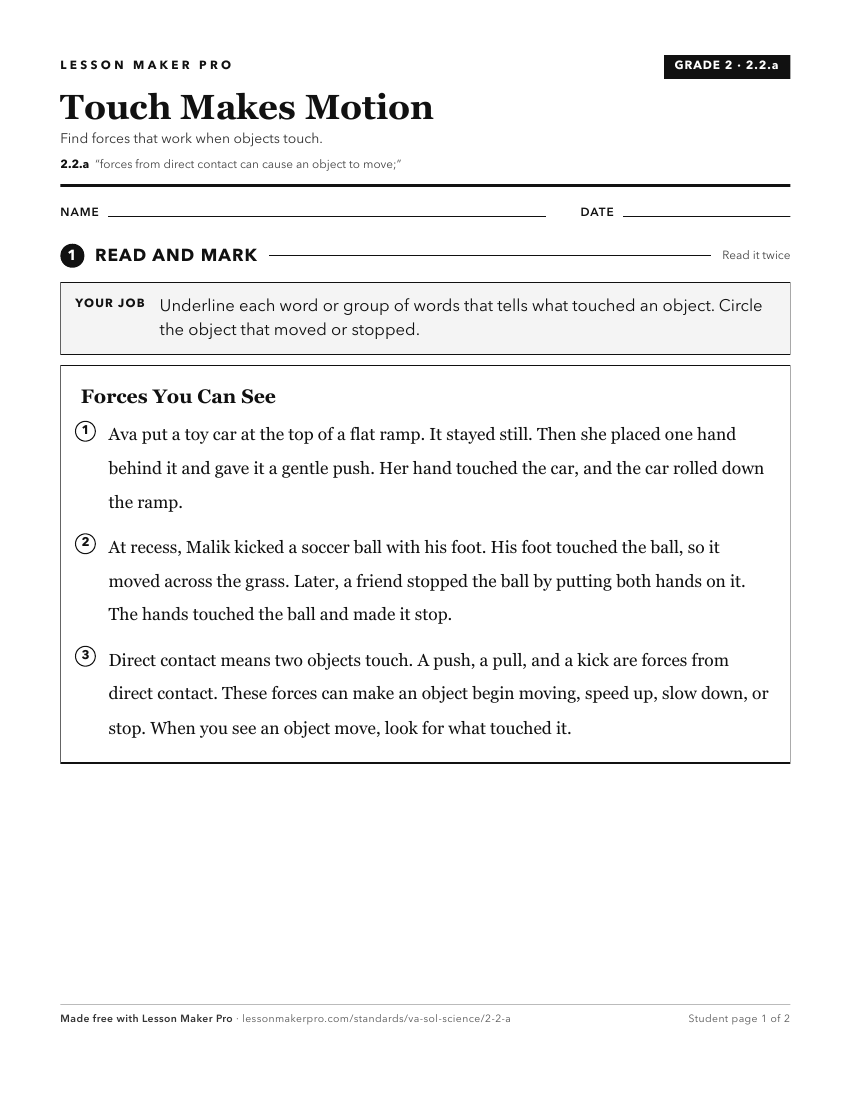
A ready-to-print activity worksheet aligned to 2.2.a, with an answer key for the teacher on its own page. No account needed.
PDF, US Letter, prints cleanly in black and white.
Download the worksheetKeep exploring
Related Standards
Turn this exact standard into a lesson
Grade, subject, topic, and the complete standard are prefilled. Create one free, no account needed.
Also for this standard:Make a WorksheetMake a QuizMake a Sub Lesson