Virginia SOL 4.3
SOL Standard (Key Ideas Cluster)
The student will investigate and understand that organisms, including humans, interact with one another and with the nonliving components in the ecosystem. Key ideas include interrelationships exist in populations, communities, and ecosystems; food webs show the flow of energy within an ecosystem; changes in an organism’s niche and habitat may occur at various stages in its life cycle; and classification can be used to identify organisms.
Virginia Standards of Learning for Science
Cluster contents
Key Ideas in This Standard
4.3 is a Standards of Learning science standard. These are the key ideas and practices under it.
Teacher's field guide
What This Cluster Means
What Students Need to Do
- Students describe how living things depend on other organisms and on water, air, soil, and sunlight. They trace energy through food webs and explain how habitat and niche can change during a life cycle. They distinguish populations, communities, and ecosystems, then classify organisms by observable traits.
What Mastery Looks Like
- A student can follow energy from the Sun through several organisms and predict effects of one population changing. They can compare an organism's habitat and role at two life stages. They can sort unfamiliar organisms by shared traits and explain each grouping.
Common Misconceptions
- Students often reverse food web arrows, pointing from the eater to its food instead of from food to eater. They may treat population, community, habitat, niche, and ecosystem as interchangeable terms. They may also assume an organism keeps the same food, shelter, and role throughout its life.
How to Assess It
- Use a pond exit ticket: circle one population, box the community, add arrows to an algae-insect-frog chain, and sort six organisms by traits. Ask students to explain one niche change after a tadpole becomes a frog.
Lesson moves
Ways to Teach It
Build a pond food web with organism cards and yarn, then remove one species card and trace the resulting changes.
Write how a tadpole's habitat, food, and role differ from an adult frog's, using evidence for each difference.
Play Trait Sort Relay: teams group organism cards by observable traits, name each rule, then regroup the cards another way.
Study a schoolyard square, recording one population, the community, and nonliving components, then describe two interactions observed there.
Free download
Printable 4.3 Worksheet
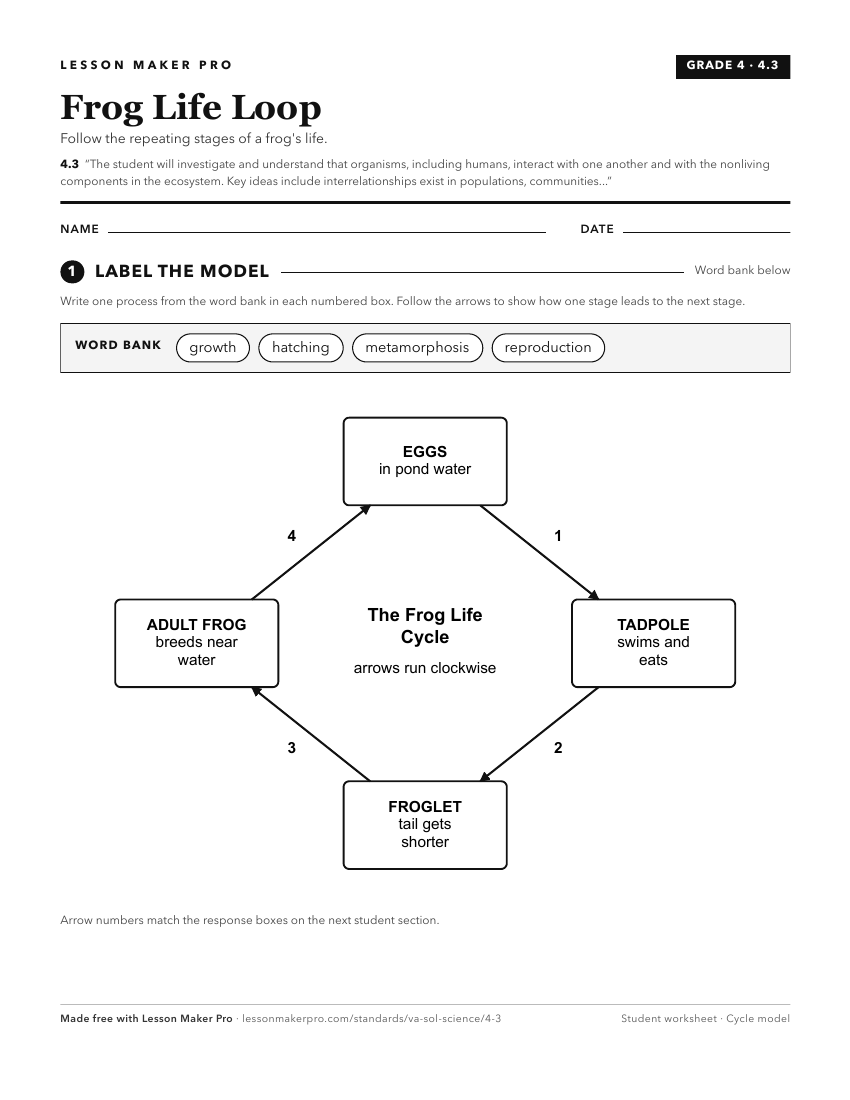
A ready-to-print activity worksheet aligned to 4.3, with an answer key for the teacher on its own page. No account needed.
PDF, US Letter, prints cleanly in black and white.
Download the worksheetKeep exploring
Related Standards
- 3.8
The student will investigate and understand that natural events and humans influence ecosystems. Key ideas include
- 2.5
The student will investigate and understand that living things are part of a system. Key ideas include
- LS.6
The student will investigate and understand that populations in a biological community interact and are interdependent. Key ideas include
- LS.5
The student will investigate and understand that biotic and abiotic factors affect an ecosystem. Key ideas include
Turn this cluster into a lesson
Grade, subject, topic, and the complete cluster are prefilled. Create one free, no account needed.
Also for this cluster:Make a WorksheetMake a QuizMake a Sub Lesson