Virginia SOL 4.3.c
The Standard
- 4.3
- The student will investigate and understand that organisms, including humans, interact with one another and with the nonliving components in the ecosystem. Key ideas include
changes in an organism’s niche and habitat may occur at various stages in its life cycle
Virginia Standards of Learning for Science
Teacher's field guide
What This Standard Means
What Students Need to Do
- Students compare where an organism lives and what it does at different life stages. They explain how its food, shelter, movement, and interactions may change as it grows.
What Mastery Looks Like
- Students can sequence an organism’s life stages and describe its habitat and role at each stage. They support each description with details about food, shelter, or behavior.
Common Misconceptions
- Students may treat habitat and niche as the same thing. They may assume every life stage uses the same food and space, or that all organisms change habitats as they grow.
How to Assess It
- Show pictures of a tadpole and an adult frog. Ask students to name each habitat and explain one way the frog’s role changes.
Lesson moves
Ways to Teach It
Have groups sort frog life-stage cards with matching food, shelter, movement, and habitat cards.
Ask students to write how a caterpillar and butterfly use the same garden differently.
Play a matching game pairing animal life stages with habitat and food cards, then require players to explain each match.
Survey a schoolyard for places that could support young and adult insects, then record which resources each stage might use.
Free download
Printable 4.3.c Worksheet
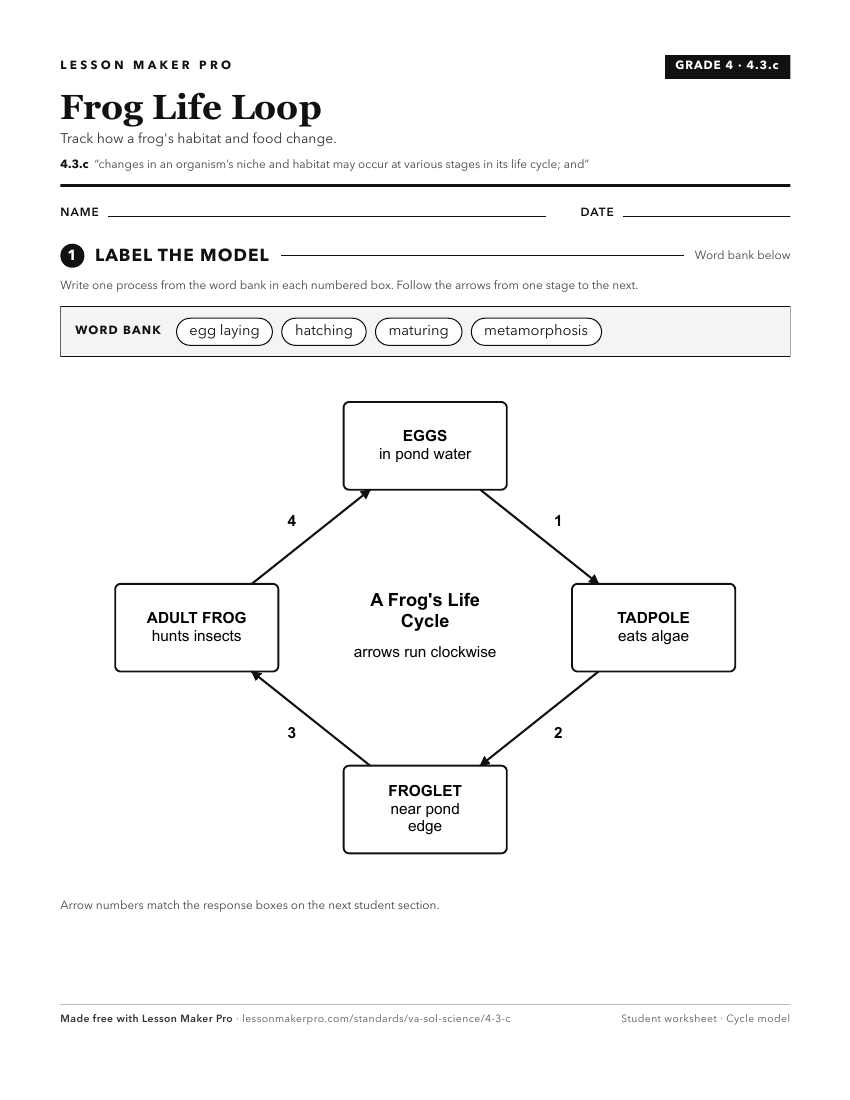
A ready-to-print activity worksheet aligned to 4.3.c, with an answer key for the teacher on its own page. No account needed.
PDF, US Letter, prints cleanly in black and white.
Download the worksheetKeep exploring
Related Standards
Turn this exact standard into a lesson
Grade, subject, topic, and the complete standard are prefilled. Create one free, no account needed.
Also for this standard:Make a WorksheetMake a QuizMake a Sub Lesson