Virginia SOL 1.MG.2
SOL Standard (Knowledge and Skills Cluster)
The student will describe, sort, draw, and name plane figures (circles, triangles, squares, and rectangles), and compose larger plane figures by combining simple plane figures.
Virginia Standards of Learning for Mathematics
Cluster contents
Knowledge and Skills in This Standard
1.MG.2 is a Standards of Learning standard. These are the knowledge and skills expectations under it.
- 1.MG.2.a
Describe triangles, squares, and rectangles using the terms sides, vertices, and angles. Describe a circle using terms such as round and curved.
- 1.MG.2.b
Sort plane figures based on their characteristics (e.g., number of sides, vertices, angles, curved).
- 1.MG.2.c
Draw and name the plane figure (circle, square, rectangle, triangle) when given information about the number of sides, vertices, and angles.
- 1.MG.2.d
Identify, name, and describe representations of circles, squares, rectangles, and triangles, regardless of orientation, in different environments and explain re...
- 1.MG.2.e
Recognize and name the angles found in rectangles and squares as right angles.
- 1.MG.2.f
Compose larger plane figures by combining two or three simple plane figures (triangles, squares, and/or rectangles).
Teacher's field guide
What This Cluster Means
What Students Need to Do
- Students identify, name, sort, and draw circles, triangles, squares, and rectangles by their attributes, even when figures are turned or resized. They use side, vertex, angle, curved, and right angle correctly. They also combine two or three simple figures to make and name a larger figure.
What Mastery Looks Like
- A student can explain a figure’s name by counting sides, vertices, and angles or noting a curved boundary. Given attribute clues, the student draws and names the figure. The student also finds right angles and builds a larger figure from two or three pieces.
Common Misconceptions
- Students often think a turned square is a diamond or that a long rectangle is a different shape. They may confuse sides with vertices, count a circle’s curve as a side, or assume every four-sided figure is a square. Some recognize a right angle only when it looks like an upright corner.
How to Assess It
- Give an exit ticket with a tilted square, rectangle, triangle, and circle. Students name each, label sides and vertices, mark right angles, and sketch two triangles combined into one larger figure.
Lesson moves
Ways to Teach It
Give pairs paper triangles, squares, and rectangles to sort by attributes, then combine two or three pieces and trace the new figure.
Show a tilted square and ask students to prove its name using sides, vertices, angles, and right angles.
Play Shape Riddle Bingo by calling clues such as four equal sides or no vertices while students cover the matching figure.
Take a classroom shape hunt, sketch four objects, name each plane figure, and record one attribute that proves each choice.
Free download
Printable 1.MG.2 Worksheet
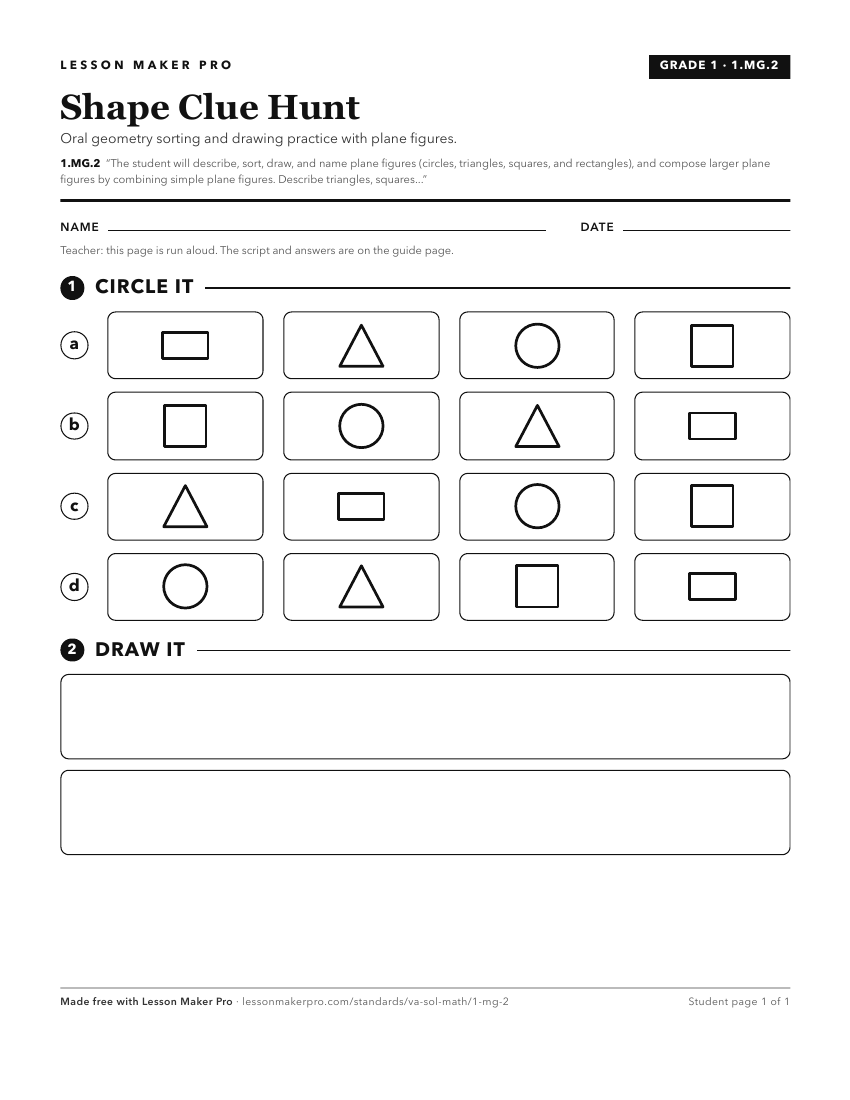
A ready-to-print activity worksheet aligned to 1.MG.2, with an answer key for the teacher on its own page. No account needed.
PDF, US Letter, prints cleanly in black and white.
Download the worksheetKeep exploring
Related Standards
- 2.MG.4
The student will describe, name, compare, and contrast plane and solid figures (circles/spheres, squares/cubes, and rectangles/rectangular prisms).
- K.MG.2
The student will identify, describe, name, compare, and construct plane figures (circles, triangles, squares, and rectangles).
- 2.MG.3
The student will identify, describe, and create plane figures (including circles, triangles, squares, and rectangles) that have at least one line of symmetry an...
- 4.MG.6
The student will identify, describe, compare, and contrast plane and solid figures according to their characteristics (number of angles, vertices, edges, and th...
Turn this cluster into a lesson
Grade, subject, topic, and the complete cluster are prefilled. Create one free, no account needed.
Also for this cluster:Make a WorksheetMake a QuizMake a Sub Lesson