Virginia SOL 4.MG.6
SOL Standard (Knowledge and Skills Cluster)
The student will identify, describe, compare, and contrast plane and solid figures according to their characteristics (number of angles, vertices, edges, and the number and shape of faces), with and without models.
Virginia Standards of Learning for Mathematics
Cluster contents
Knowledge and Skills in This Standard
4.MG.6 is a Standards of Learning standard. These are the knowledge and skills expectations under it.
- 4.MG.6.a
Identify concrete models and pictorial representations of solid figures (cube, rectangular prism, square pyramid, sphere, cone, and cylinder).
- 4.MG.6.b
Identify and describe solid figures (cube, rectangular prism, square pyramid, and sphere) according to their characteristics (number of angles, vertices, edges,...
- 4.MG.6.c
Compare and contrast plane and solid figures (limited to circles, squares, triangles, rectangles, spheres, cubes, square pyramids, and rectangular prisms) accor...
Teacher's field guide
What This Cluster Means
What Students Need to Do
- Students name plane and solid figures from objects, models, and pictures. They count sides, angles, vertices, edges, and faces, then use those features to compare figures.
What Mastery Looks Like
- Students correctly name figures from models and drawings. They count visible and hidden features accurately and describe face shapes. They compare figures using sides, angles, vertices, edges, and faces.
Common Misconceptions
- Students may call every box a cube or treat a square and cube as the same figure. They may count faces as sides, miss hidden edges and vertices, or say a sphere has a circular face.
How to Assess It
- Show a cube, rectangular prism, square pyramid, sphere, cone, and cylinder for students to name. Then have them list a cube’s features and compare it with a square.
Lesson moves
Ways to Teach It
Give pairs a cube, box, ball, can, cone, and square pyramid; have them sort, name, and record faces, edges, and vertices.
Students write a response to “How is a square like a cube, and how is it different?” using sides, faces, edges, and vertices.
Play shape clue bingo by reading clues such as “six square faces,” while students cover the matching figure on their boards.
Run a packaging hunt: students match cans, cereal boxes, dice, balls, and party hats to solids, then explain which features match.
Free download
Printable 4.MG.6 Worksheet
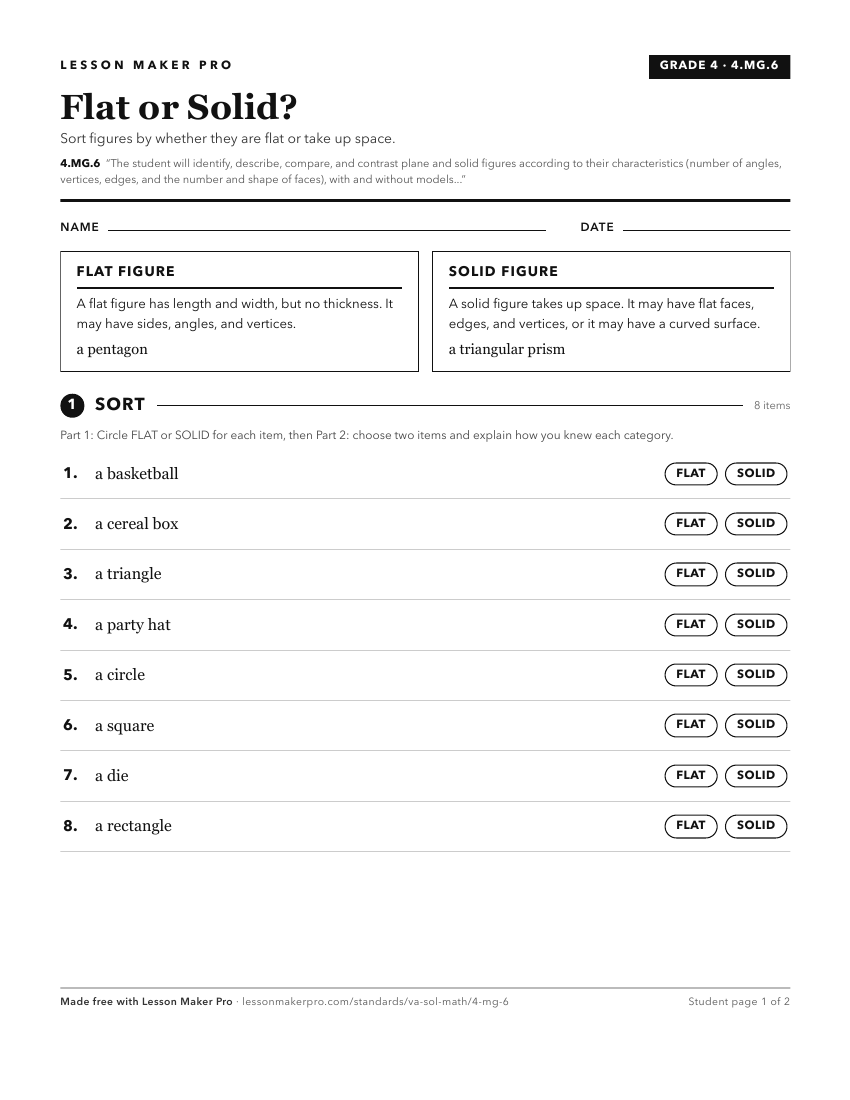
A ready-to-print activity worksheet aligned to 4.MG.6, with an answer key for the teacher on its own page. No account needed.
PDF, US Letter, prints cleanly in black and white.
Download the worksheetKeep exploring
Related Standards
- 2.MG.4
The student will describe, name, compare, and contrast plane and solid figures (circles/spheres, squares/cubes, and rectangles/rectangular prisms).
- K.MG.2
The student will identify, describe, name, compare, and construct plane figures (circles, triangles, squares, and rectangles).
- 2.MG.4.d
Compare and contrast plane and solid figures (circles/spheres, squares/cubes, and rectangles/rectangular prisms) according to their characteristics (e.g., numbe...
Turn this cluster into a lesson
Grade, subject, topic, and the complete cluster are prefilled. Create one free, no account needed.
Also for this cluster:Make a WorksheetMake a QuizMake a Sub Lesson