Virginia SOL 2.MG.4
SOL Standard (Knowledge and Skills Cluster)
The student will describe, name, compare, and contrast plane and solid figures (circles/spheres, squares/cubes, and rectangles/rectangular prisms).
Virginia Standards of Learning for Mathematics
Cluster contents
Knowledge and Skills in This Standard
2.MG.4 is a Standards of Learning standard. These are the knowledge and skills expectations under it.
- 2.MG.4.a
Trace faces of solid figures (cubes and rectangular prisms) to create the set of plane figures related to the solid figure.
- 2.MG.4.b
Compare and contrast models and nets (cutouts) of cubes and rectangular prisms (e.g., number and shapes of faces, edges, vertices).
- 2.MG.4.c
Given a concrete or pictorial model, name and describe the solid figure (sphere, cube, and rectangular prism) by its characteristics (e.g., number of edges, num...
- 2.MG.4.d
Compare and contrast plane and solid figures (circles/spheres, squares/cubes, and rectangles/rectangular prisms) according to their characteristics (e.g., numbe...
Teacher's field guide
What This Cluster Means
What Students Need to Do
- Students name circles, squares, rectangles, spheres, cubes, and rectangular prisms. They explain how each plane figure relates to a solid figure. They trace solid faces and decide which nets fold into cubes or rectangular prisms.
What Mastery Looks Like
- A student correctly names plane and solid figures shown as objects, drawings, or nets. The student knows cubes and rectangular prisms have six faces, 12 edges, and eight vertices, while spheres have no flat faces, edges, or vertices. The student traces faces and explains whether a net will fold into the named solid.
Common Misconceptions
- Students may call a sphere a circle or a cube a square because a drawing looks flat. They may say a sphere has one circular face, miss hidden edges and vertices, or count the same feature twice. Some think any arrangement of six squares or rectangles will fold into a solid.
How to Assess It
- Give students models of a cube, rectangular prism, and sphere, plus two candidate cube nets. Ask them to name each solid, list its features, and circle the valid net.
Lesson moves
Ways to Teach It
Give pairs a cube block, small box, ball, and paper; students trace every flat face and record which object cannot be traced.
Show a square and cube, then ask students how they are alike and why only one is a solid figure.
Play Geometry Match: students pair figure cards with characteristic cards, then justify each match using faces, edges, and vertices.
Inspect a cereal box, tissue cube, and ball; students name each solid and explain how its shape affects stacking or rolling.
Free download
Printable 2.MG.4 Worksheet
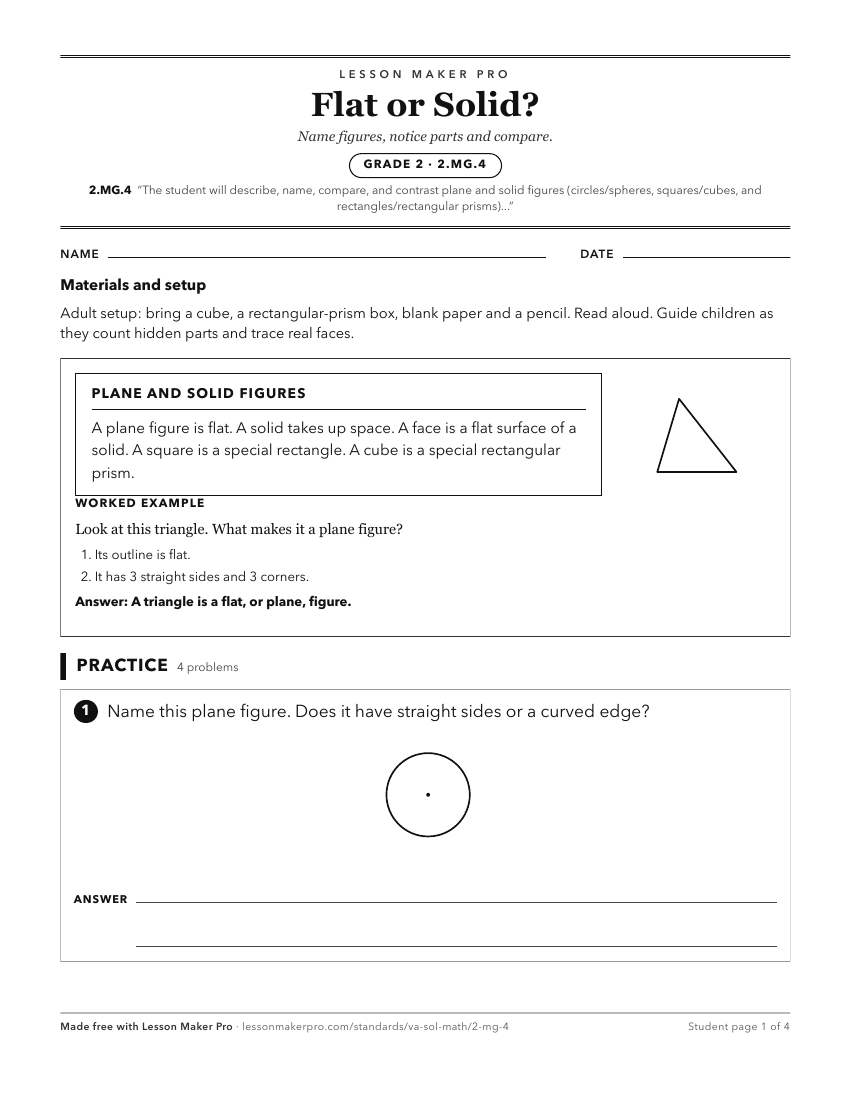
A ready-to-print activity worksheet aligned to 2.MG.4, with an answer key for the teacher on its own page. No account needed.
PDF, US Letter, prints cleanly in black and white.
Download the worksheetKeep exploring
Related Standards
- K.MG.2
The student will identify, describe, name, compare, and construct plane figures (circles, triangles, squares, and rectangles).
- 4.MG.6.c
Compare and contrast plane and solid figures (limited to circles, squares, triangles, rectangles, spheres, cubes, square pyramids, and rectangular prisms) accor...
- 4.MG.6
The student will identify, describe, compare, and contrast plane and solid figures according to their characteristics (number of angles, vertices, edges, and th...
- 1.MG.2
The student will describe, sort, draw, and name plane figures (circles, triangles, squares, and rectangles), and compose larger plane figures by combining simpl...
Turn this cluster into a lesson
Grade, subject, topic, and the complete cluster are prefilled. Create one free, no account needed.
Also for this cluster:Make a WorksheetMake a QuizMake a Sub Lesson