Virginia SOL VS.4
SOL Standard (Skills Cluster)
The student will apply history and social science skills to understand life in the Virginia colony by explaining the importance and influence of agriculture; examining how colonial Virginia reflected the culture of Virginia’s Indigenous People, European (English, Scots-Irish, German) immigrants, and Africans; distinguishing between indentured servants and enslaved people, including how European countries traded for, transported, and sold Africans to be enslaved in British North America beginning in the 17th century; describing the laws that established race-based enslavement; explaining the reasons for the relocation of Virginia’s capital from Jamestown to Williamsburg; and describing ways people exchanged goods and services in colonial Virginia.
Virginia Standards of Learning for History and Social Science
Cluster contents
Skills in This Standard
VS.4 is a Standards of Learning history and social science standard. These are the skills expectations under it.
- VS.4.a
explaining the importance and influence of agriculture
- VS.4.b
examining how colonial Virginia reflected the culture of Virginia’s Indigenous People, European (English, Scots-Irish, German) immigrants, and Africans
- VS.4.c
distinguishing between indentured servants and enslaved people, including how European countries traded for, transported, and sold Africans to be enslaved in Br...
- VS.4.d
describing the laws that established race-based enslavement
- VS.4.e
explaining the reasons for the relocation of Virginia’s capital from Jamestown to Williamsburg
- VS.4.f
describing ways people exchanged goods and services in Colonial Virginia
Teacher's field guide
What This Cluster Means
What Students Need to Do
- Students explain how agriculture shaped work, trade, land use, and daily life in colonial Virginia. They identify Indigenous, English, Scots-Irish, German, and African influences, then compare indentured service with enslavement, including forced transport and race-based laws. They explain why the capital moved to Williamsburg and how colonists used barter, money, credit, goods, and services.
What Mastery Looks Like
- A student can use a map, artifact, or short source to connect tobacco farming with labor, trade, and settlement. The student separates time-limited indentures from lifelong enslavement, explains how laws tied slavery to race, and identifies several cultural influences. The student can give sound reasons for moving the capital and describe a colonial exchange using correct economic terms.
Common Misconceptions
- Students may think indentured servants and enslaved people had the same legal status, or that both became free after a set term. They may assume Africans migrated voluntarily or that slavery was race-based from the colony’s first years, rather than enforced through later colonial laws. They may picture colonial culture as only English and name the Jamestown fire as the sole reason for moving the capital.
How to Assess It
- Give students six labeled boxes for agriculture, cultural influence, labor systems, slavery laws, capital relocation, and trade. Ask for one accurate fact in each box, including one comparison and one cause-and-effect link.
Lesson moves
Ways to Teach It
Give groups crop, tool, labor, and trade cards to build a model colonial farm, then explain how agriculture shaped daily life.
Have students write a paragraph naming one Indigenous, European, and African cultural influence and explaining how colonial laws limited freedom.
Run a sorting relay with cards for indentured service, enslavement, barter, money, credit, Jamestown, and Williamsburg, requiring reasons for every placement.
Compare a modern store receipt with a colonial account ledger, then identify where money, credit, barter, goods, and services appear.
Free download
Printable VS.4 Worksheet
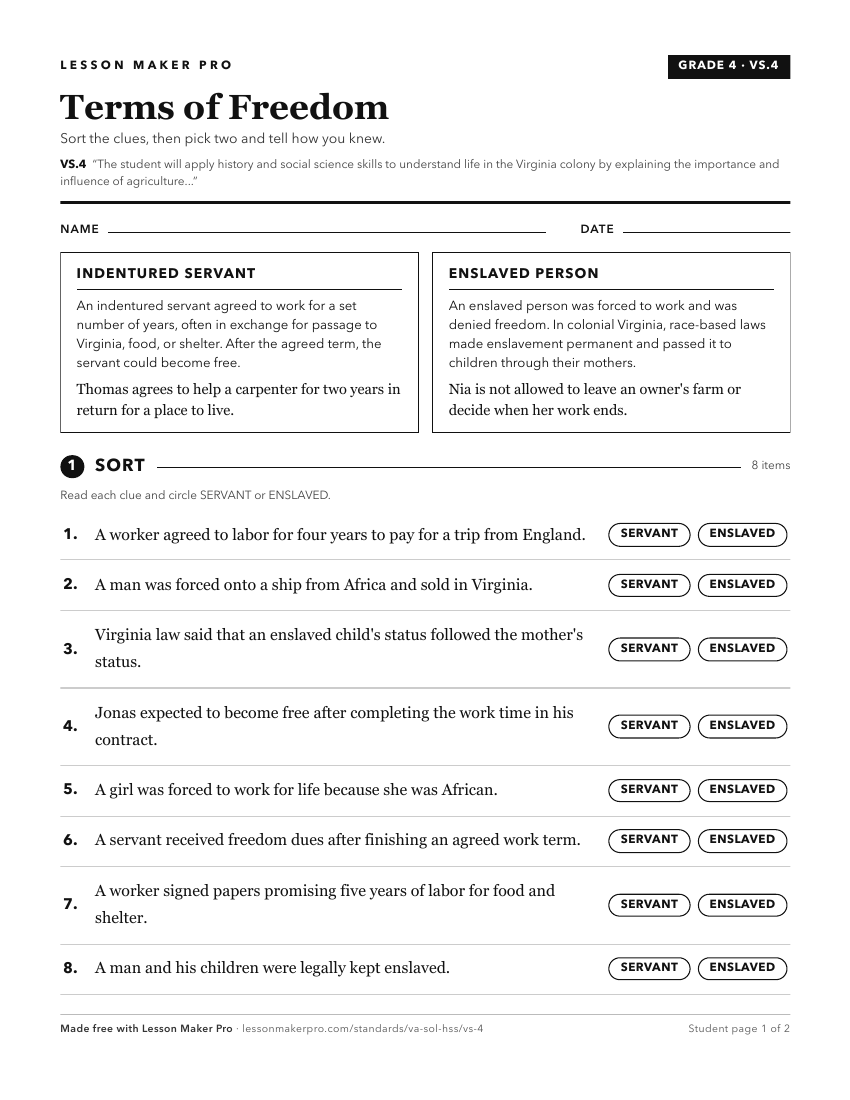
A ready-to-print activity worksheet aligned to VS.4, with an answer key for the teacher on its own page. No account needed.
PDF, US Letter, prints cleanly in black and white.
Download the worksheetKeep exploring
Related Standards
- VS.1
The student will apply history and social science skills to explain the relationship between physical geography and the lives of Virginia’s peoples, past and pr...
- 1.7
The student will apply history and social science skills to connect geography to historic events of Virginia and the United States by
- VS.5
The student will apply history and social science skills to explain Virginia and Virginians’ role during the American Revolution by
- 1.4
The student will apply history and social science skills to understand Virginia’s history by
Turn this cluster into a lesson
Grade, subject, topic, and the complete cluster are prefilled. Create one free, no account needed.
Also for this cluster:Make a WorksheetMake a QuizMake a Sub Lesson