Virginia SOL VS.4.c
The Standard
- VS.4
- The student will apply history and social science skills to understand life in the Virginia colony by
distinguishing between indentured servants and enslaved people, including how European countries traded for, transported, and sold Africans to be enslaved in British North America beginning in the 17th century
Virginia Standards of Learning for History and Social Science
Teacher's field guide
What This Standard Means
What Students Need to Do
- Students compare each group’s work conditions, legal rights, length of service, and ability to gain freedom. They trace how European traders bought captive Africans, forced them across the Atlantic, and sold them in British North America.
What Mastery Looks Like
- Students can explain that indentured servants had contracts with end dates, while enslaved people faced forced, lifelong bondage that could pass to their children. They can label the Middle Passage on a map and describe the roles of European traders and ships.
Common Misconceptions
- Students may think indentured servants and enslaved people had the same legal status because both performed unpaid labor. They may think Africans chose to migrate. Some may assume only Britain participated in the Atlantic slave trade.
How to Assess It
- Give students two short worker profiles and a blank Atlantic map. Ask them to identify each worker’s status, cite one clue, and draw the forced transport route.
Lesson moves
Ways to Teach It
Have pairs sort evidence cards by contract length, legal rights, family status, payment, and freedom into indentured servant, enslaved person, or both.
Ask students to write how a contract end date and inherited bondage would create different futures for two Virginia workers.
Use four corners labeled indentured servant, enslaved person, both, and neither, then read one fact for students to classify and explain.
Examine an Atlantic trade map and ship record, then identify what each source shows about the forced movement and sale of Africans.
Free download
Printable VS.4.c Worksheet
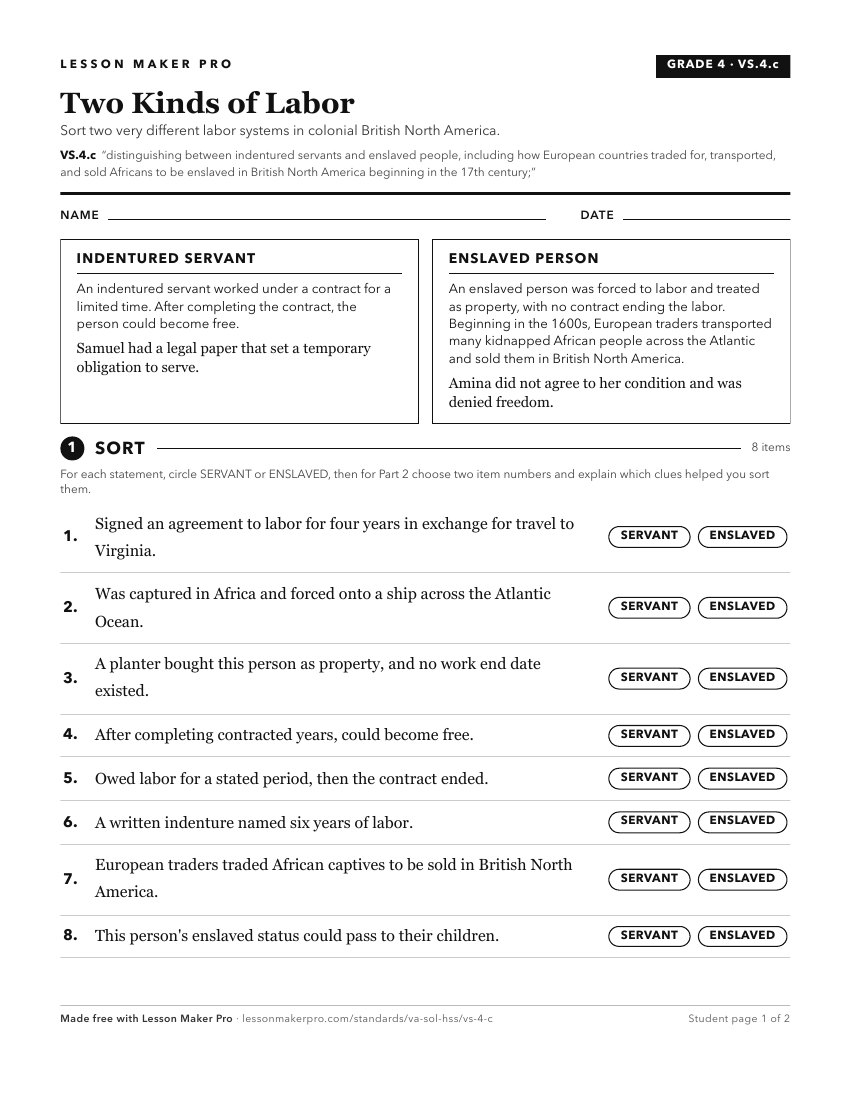
A ready-to-print activity worksheet aligned to VS.4.c, with an answer key for the teacher on its own page. No account needed.
PDF, US Letter, prints cleanly in black and white.
Download the worksheetKeep exploring
Related Standards
- USI.4.c
explaining the Transatlantic Slave Trade and its impact on the African coast and the Western Hemisphere
- USI.5.c
comparing life from the perspectives of various groups including, but not limited to large landowners, farmers, artisans, clergy, merchants, women, indentured s...
- VS.4.d
describing the laws that established race-based enslavement
- USI.4.d
identifying the cultural connections, conflicts, and common values of enslaved people in the Western Hemisphere, as well as challenges and hardships endured by ...
Turn this exact standard into a lesson
Grade, subject, topic, and the complete standard are prefilled. Create one free, no account needed.
Also for this standard:Make a WorksheetMake a QuizMake a Sub Lesson