Virginia SOL USI.4.c
The Standard
- USI.4
- The student will apply history and social science skills to understand how the Western Hemisphere impacted West Africa by
explaining the Transatlantic Slave Trade and its impact on the African coast and the Western Hemisphere
Virginia Standards of Learning for History and Social Science
Teacher's field guide
What This Standard Means
What Students Need to Do
- Students trace the forced movement of enslaved Africans across the Atlantic and describe the conditions of the Middle Passage. They explain effects on African communities, colonial economies, and cultures in the Americas.
What Mastery Looks Like
- Students can label the main route on a map and explain that the movement was forced, not voluntary. They can name effects in both regions and support each with a historical fact.
Common Misconceptions
- Students may think most enslaved Africans were taken to British North America or traveled by choice. They may also assume African societies and cultures disappeared completely after people were taken.
How to Assess It
- Give students a blank Atlantic map and ask them to draw the forced migration route. Below it, have them list two effects on Africa and two effects on the Americas.
Lesson moves
Ways to Teach It
Give pairs a map, yarn, and route cards to model capture, coastal imprisonment, the Middle Passage, and forced labor in the Americas.
Ask students to write: How did forced migration change both the communities people left and the places where they were enslaved?
Run a cause-and-effect card sort with facts about population loss, warfare, plantation labor, economic growth, and African cultural traditions.
Have students research one African influence on food, music, language, or religion in Brazil, the Caribbean, or the United States.
Free download
Printable USI.4.c Worksheet
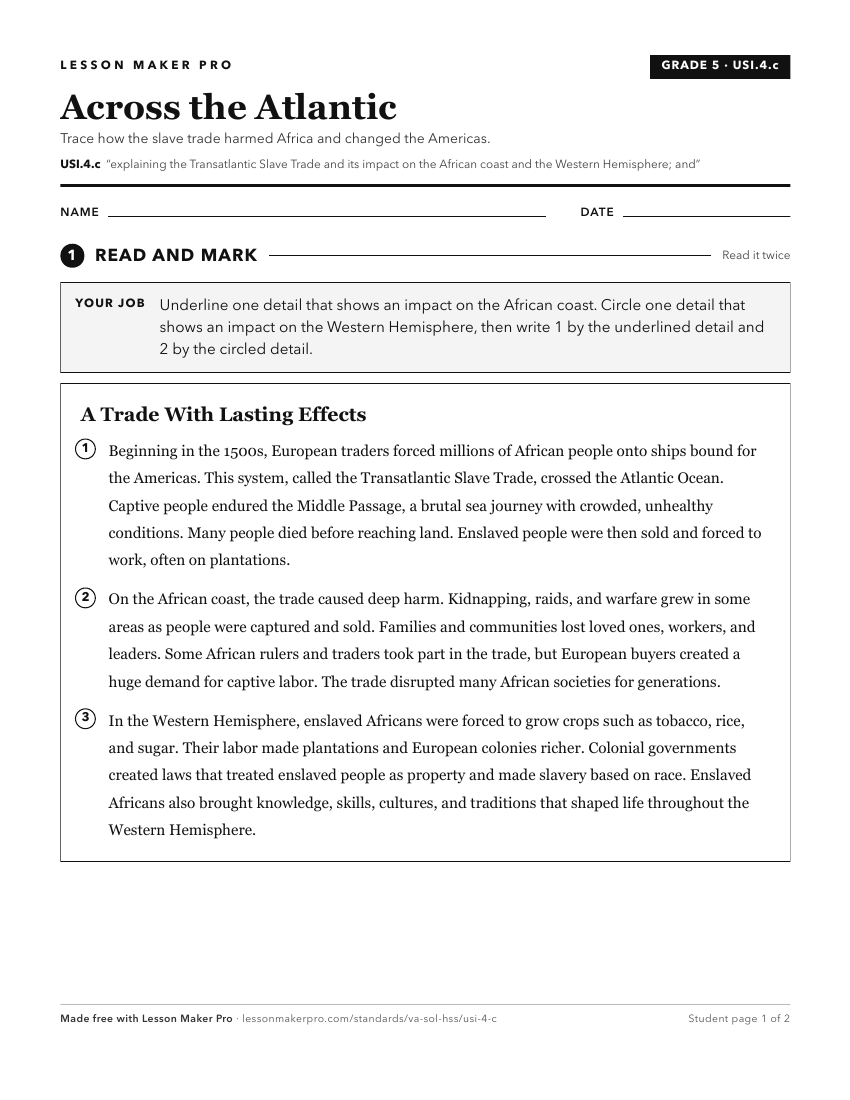
A ready-to-print activity worksheet aligned to USI.4.c, with an answer key for the teacher on its own page. No account needed.
PDF, US Letter, prints cleanly in black and white.
Download the worksheetKeep exploring
Related Standards
- VS.6.e
explaining the causes and events of Nat Turner’s Rebellion and how it impacted the institution of slavery
- USI.4.d
identifying the cultural connections, conflicts, and common values of enslaved people in the Western Hemisphere, as well as challenges and hardships endured by ...
- VS.4.c
distinguishing between indentured servants and enslaved people, including how European countries traded for, transported, and sold Africans to be enslaved in Br...
- USI.4
The student will apply history and social science skills to understand how the Western Hemisphere impacted West Africa by
Turn this exact standard into a lesson
Grade, subject, topic, and the complete standard are prefilled. Create one free, no account needed.
Also for this standard:Make a WorksheetMake a QuizMake a Sub Lesson