Virginia SOL VS.4.f
The Standard
- VS.4
- The student will apply history and social science skills to understand life in the Virginia colony by
describing ways people exchanged goods and services in colonial Virginia.
Virginia Standards of Learning for History and Social Science
Teacher's field guide
What This Standard Means
What Students Need to Do
- Students identify barter, money, and credit as methods colonists used to make trades. They explain why tobacco and other goods often replaced scarce coins.
What Mastery Looks Like
- Students can match a colonial trade scenario to barter, money, or credit and explain their choice. They can describe how a service could be traded for goods.
Common Misconceptions
- Students may think colonists always paid with coins or that barter only involved objects. They may also confuse credit with receiving something for free.
How to Assess It
- Give this exit ticket: “A farmer receives a tool now and promises tobacco after harvest. Which exchange method is this, and how do you know?”
Lesson moves
Ways to Teach It
Give pairs cards showing tobacco, coins, tools, food, and services, then have them negotiate three colonial trades.
Ask students to write which payment they would accept for repairing a fence in colonial Virginia and explain why.
Play a scenario sort where teams label each exchange as barter, money, or credit and defend one answer.
Compare a colonial store account with a modern credit card purchase, focusing on receiving goods now and paying later.
Free download
Printable VS.4.f Worksheet
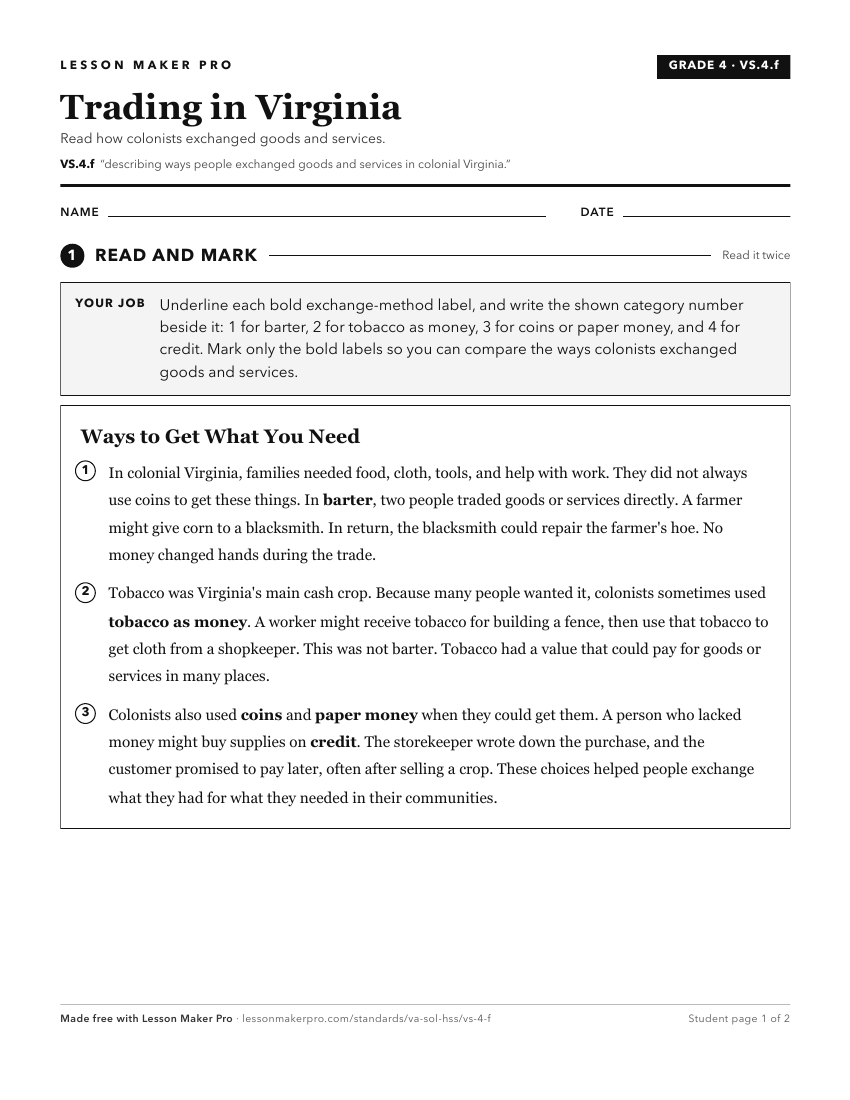
A ready-to-print activity worksheet aligned to VS.4.f, with an answer key for the teacher on its own page. No account needed.
PDF, US Letter, prints cleanly in black and white.
Download the worksheetKeep exploring
Related Standards
- 1.8.d
describing goods produced and services provided in Virginia
- VS.3.b
describing the economic and geographic influences on the decision to settle at Jamestown
- VS.2.d
describing the relationships and interactions of Virginia’s Indigenous People and their environment, circa 1600
- USI.5.b
explaining Virginia’s importance as one of the most populous and wealthiest colonies
Turn this exact standard into a lesson
Grade, subject, topic, and the complete standard are prefilled. Create one free, no account needed.
Also for this standard:Make a WorksheetMake a QuizMake a Sub Lesson