Virginia SOL CE.4
SOL Standard (Skills Cluster)
The student will apply history and social science skills to analyze American constitutional government at the local level by describing the structure and powers of the local government and explaining the local lawmaking process; describing how state, national, and international issues and events impact local decision making; and comparing and contrasting powers and responsibilities of local, state, federal, and tribal governments including, but not limited to citizen engagement, how each is financed, and how they work together and independently.
Virginia Standards of Learning for History and Social Science
Cluster contents
Skills in This Standard
CE.4 is a Standards of Learning history and social science standard. These are the skills expectations under it.
- CE.4.a
describing the structure and powers of the local government and explaining the local lawmaking process
- CE.4.b
describing how state, national, and international issues and events impact local decision making
- CE.4.c
comparing and contrasting powers and responsibilities of local, state, federal, and tribal governments including, but not limited to citizen engagement, how eac...
Teacher's field guide
What This Cluster Means
What Students Need to Do
- Students identify who makes and carries out decisions in Virginia counties, cities, and towns, including councils, boards, mayors, and managers. They trace an ordinance from proposal and public hearing through vote, implementation, and enforcement. They compare government powers, funding, citizen input, and cooperation, then explain how wider events shape local choices.
What Mastery Looks Like
- Students can read a scenario and name whether local, state, federal, or tribal government has authority, how the action is funded, and how citizens participate. They can sequence local lawmaking and explain why governments might cooperate on roads, emergencies, schools, or public safety. They can connect a wider event to a specific local budget or policy choice.
Common Misconceptions
- Students often treat mayors like governors or presidents and assume every locality has the same structure. They may confuse ordinances with state or federal laws, or think all taxes go into one shared fund. They may overlook tribal sovereignty or assume international events cannot affect local decisions.
How to Assess It
- Use this exit prompt: “A county wants to limit late-night noise near homes. Name the decision-making body, list three ordinance steps, identify one enforcement cost, and describe one way residents could participate.”
Lesson moves
Ways to Teach It
Give groups role cards for residents, supervisors, staff, and police, then stage a hearing and vote on a proposed noise ordinance.
Ask students to write: How could a hurricane, federal rule, or overseas conflict change one local budget decision?
Run a card sort matching services, taxes, citizen actions, and shared projects to local, state, federal, or tribal governments.
Use a current city council or county board agenda to trace one proposal, its funding, public input, and partner agencies.
Free download
Printable CE.4 Worksheet
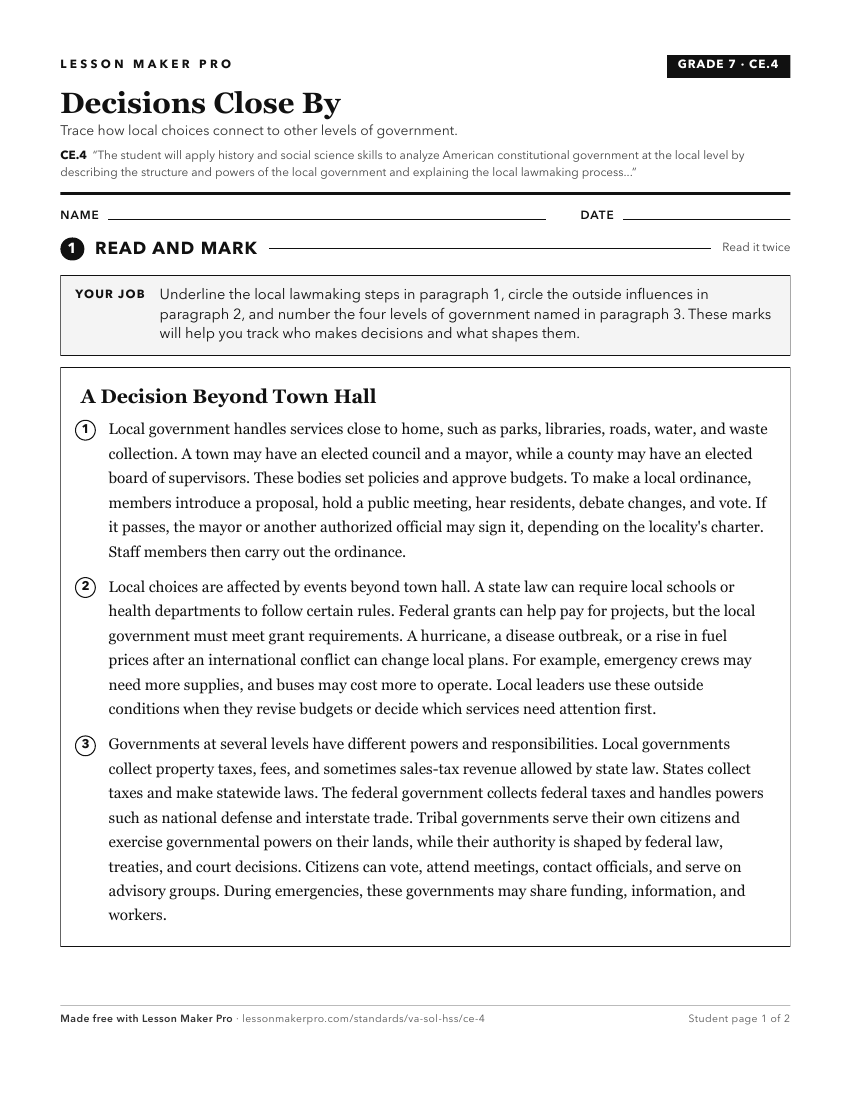
A ready-to-print activity worksheet aligned to CE.4, with an answer key for the teacher on its own page. No account needed.
PDF, US Letter, prints cleanly in black and white.
Download the worksheetKeep exploring
Related Standards
- CE.1
The student will apply history and social science skills to explain the foundations of the American constitutional democracy by
- CE.8
The student will apply history and social science skills to examine the political process at the local, state, and national levels of government by
- CE.3
The student will apply history and social science skills to analyze how constitutional government functions at the state level by
- CE.2
The student will apply history and social science skills to analyze how American constitutional government functions at the national level by
Turn this cluster into a lesson
Grade, subject, topic, and the complete cluster are prefilled. Create one free, no account needed.
Also for this cluster:Make a WorksheetMake a QuizMake a Sub Lesson