Virginia SOL CE.4.a
The Standard
- CE.4
- The student will apply history and social science skills to analyze American constitutional government at the local level by
describing the structure and powers of the local government and explaining the local lawmaking process
Virginia Standards of Learning for History and Social Science · The student will apply history and social science skills to analyze American constitutional government at the local level by
Teacher's field guide
What This Standard Means
What Students Need to Do
- Students identify the roles of county boards of supervisors, city and town councils, mayors, managers, and local agencies. They connect local powers to services, taxes, budgets, land use, and public safety. They trace an ordinance from proposal and public notice through hearing, vote, adoption, and enforcement.
What Mastery Looks Like
- Given a local issue, students can name the governing body responsible, the power it would use, and any limits set by state law. They can place the ordinance steps in order and explain where residents can speak.
Common Misconceptions
- Students may think a mayor makes local laws alone or that local governments can act without state authority. They may confuse an ordinance with a state law or think public comments count as official votes.
How to Assess It
- Give this exit ticket: A town wants to limit late-night noise. Name the governing body that would act and list four steps needed to pass the ordinance.
Lesson moves
Ways to Teach It
Give students role cards for council members, mayor, manager, clerk, and residents, then run a mock hearing and vote on a noise ordinance.
Ask students to write: Who should decide where a new park goes, and when should residents have a voice?
Have teams race to arrange ordinance process cards, then defend the order using one sentence per card.
Open a current local council agenda and have students label one service, one spending item, and one proposed ordinance.
Free download
Printable CE.4.a Worksheet
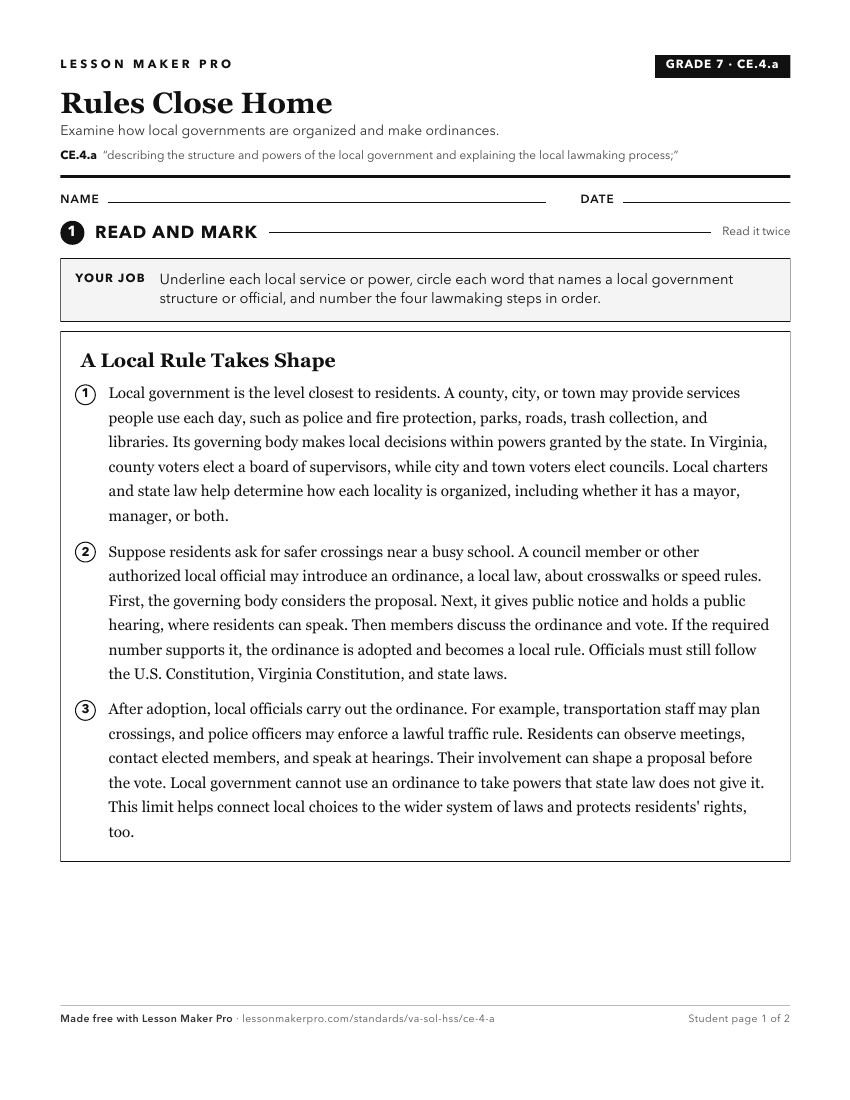
A ready-to-print activity worksheet aligned to CE.4.a, with an answer key for the teacher on its own page. No account needed.
PDF, US Letter, prints cleanly in black and white.
Download the worksheetKeep exploring
Related Standards
- CE.2.a
describing the structure and powers of the government (the three branches of government)
- 3.9.d
explaining what governments do at the national, state, and local levels
- CE.3.a
describing the structure and powers of the state government (the three branches of government)
- CE.3.b
explaining the state lawmaking process
Turn this exact standard into a lesson
Grade, subject, topic, and the complete standard are prefilled. Create one free, no account needed.
Also for this standard:Make a WorksheetMake a QuizMake a Sub Lesson