Virginia SOL CE.3.b
The Standard
- CE.3
- The student will apply history and social science skills to analyze how constitutional government functions at the state level by
explaining the state lawmaking process
Virginia Standards of Learning for History and Social Science · The student will apply history and social science skills to analyze how constitutional government functions at the state level by
Teacher's field guide
What This Standard Means
What Students Need to Do
- Students trace a bill from introduction through committee review, debate, and voting in both chambers of the Virginia General Assembly. They explain how the governor can sign, veto, amend, or take no action on a bill.
What Mastery Looks Like
- Students can place each step in order and explain the job of legislators, committees, and the governor. They can predict what happens after approval, rejection, amendment, or a veto.
Common Misconceptions
- Students may think one chamber can pass a law alone or that committee approval makes a bill law. They may also think a governor writes laws independently or that a veto always ends a bill.
How to Assess It
- Use this exit ticket: “A bill passes the House of Delegates. What steps must occur before it can become a Virginia law, and what could happen after a veto?”
Lesson moves
Ways to Teach It
Give groups labeled cards for introduction, committee, chamber votes, governor action, and veto override, then have them build and defend the sequence.
Ask students to write which step gives citizens the best chance to influence a bill and support their choice with evidence.
Play Bill Pathway Relay, where teams draw event cards and move a sample bill forward, backward, or out of consideration.
Use Virginia's Legislative Information System to trace one current bill, then record its sponsor, committee, votes, and final status.
Free download
Printable CE.3.b Worksheet
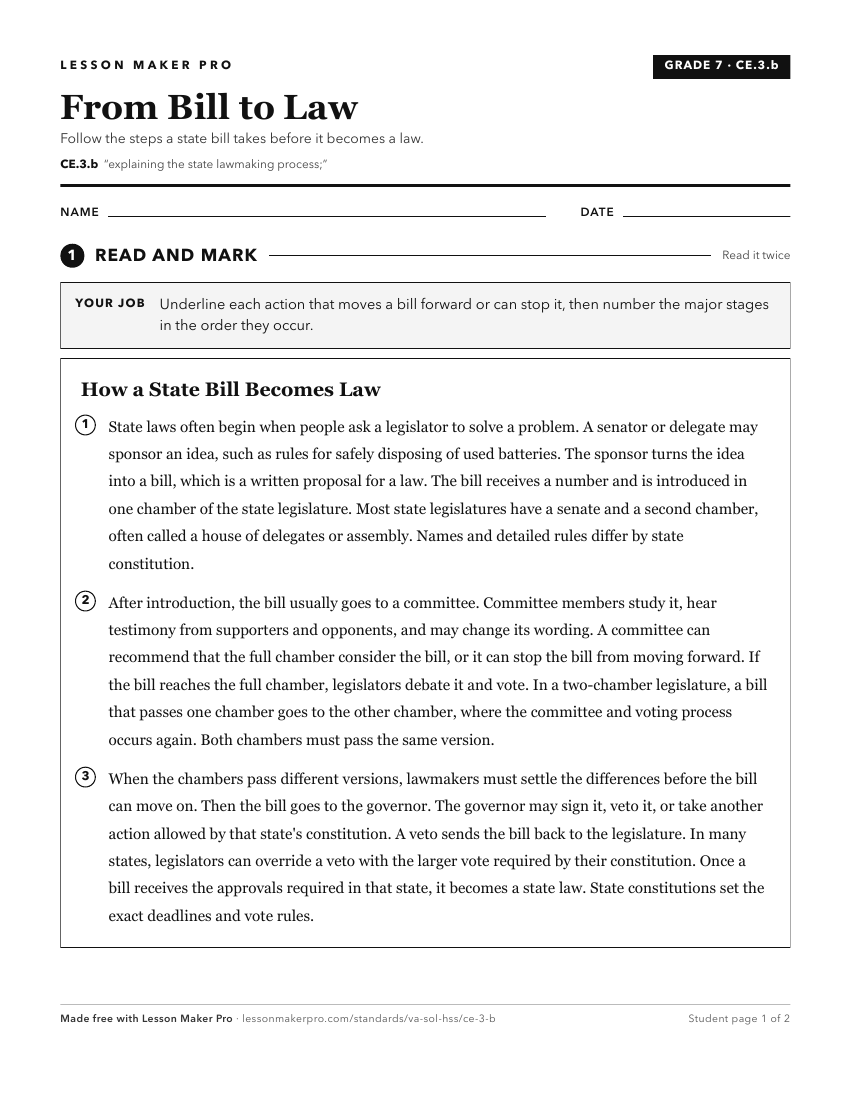
A ready-to-print activity worksheet aligned to CE.3.b, with an answer key for the teacher on its own page. No account needed.
PDF, US Letter, prints cleanly in black and white.
Download the worksheetKeep exploring
Related Standards
- CE.3.e
explaining the principle of separation of powers and the operation of checks and balances at the state level.
- CE.2.b
explaining the legislative branch and the lawmaking process as explained in Article I of the Constitution of the United States
- CE.4.a
describing the structure and powers of the local government and explaining the local lawmaking process
- CE.3.a
describing the structure and powers of the state government (the three branches of government)
Turn this exact standard into a lesson
Grade, subject, topic, and the complete standard are prefilled. Create one free, no account needed.
Also for this standard:Make a WorksheetMake a QuizMake a Sub Lesson